New Mexico’s Two-Day Accompaniment Requirement
One of the most common anxieties for hunters applying for tags in New Mexico, especially those using the outfitter draw pool, is understanding the nuances of the state's specific regulations. Among these, the "two-day accompaniment requirement" often causes a bit of head-scratching and worry, leading many to wonder exactly what it means for their hunt. This guide will clarify this particular rule, explaining its purpose, who it affects, and how both outfitters and hunters can ensure full compliance for a smooth, legal hunting experience in the Land of Enchantment.
Understanding New Mexico's Two-Day Accompaniment Rule
New Mexico has a unique approach to its outfitter-allocated tags, designed to ensure a genuine relationship between the outfitter and their client. This isn't just a casual suggestion; it's a firm regulation that dictates a minimum amount of direct engagement. The two-day accompaniment rule is essentially the state's way of verifying that an outfitter applying for tags within the special outfitter pool is providing actual guiding services, rather than simply acting as a tag broker. It's a foundational piece of The New Mexico Outfitter Draw and Its Two-Day Rule framework.
Imagine you've applied through the outfitter pool, hoping to secure a coveted elk tag in a premier unit like the Gila. The excitement of drawing that tag is immense, but it comes with a responsibility: your chosen outfitter must physically accompany you in the field for at least two full calendar days of your hunt. This isn't just about showing up for an hour or two; it's about active, in-the-field guidance and presence. This rule exists to prevent scenarios where an outfitter simply provides their registration number for the draw, collects a fee, and then disappears, leaving the hunter to navigate complex wilderness areas alone. It ensures that the outfitter is truly invested in the hunt and upholding the spirit of the outfitter draw system.
What "Accompaniment" Truly Means in New Mexico
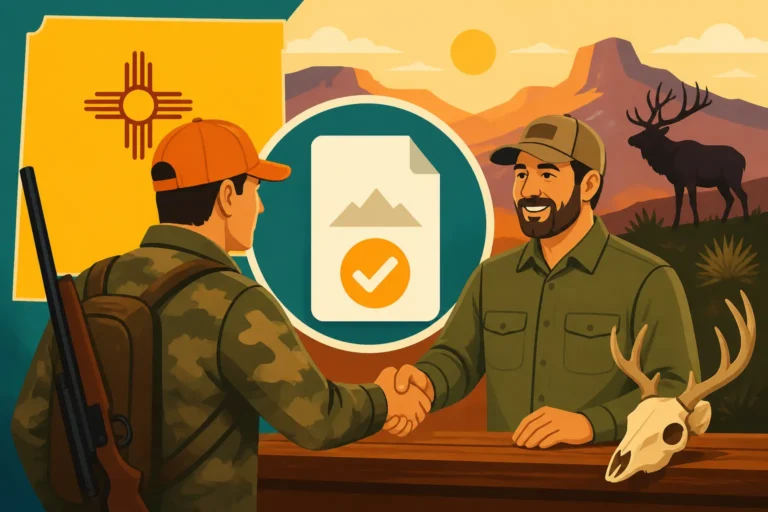
When we talk about "accompaniment," it's easy to picture the outfitter and client walking side-by-side, step-for-step, for every moment of those two days. While that's certainly one way it can play out, the regulation is a bit more flexible, but still very clear about the intent. Accompaniment means the outfitter, or a registered guide working directly under that outfitter's license, must be physically present in the field with the client for a minimum of two full calendar days.
This presence implies active participation in the hunt. It could mean calling for elk right alongside you, tracking a mule deer through rough terrain, setting up a glassing session, or providing direct advice on shot placement and animal behavior. It's not about driving you to a trailhead and waving goodbye, only to pick you up later. The guide or outfitter needs to be hunting with you. They should be sharing their knowledge of the unit, helping you interpret sign, and actively working to put you on an animal. For instance, if you're hunting in the Gila, an outfitter might spend those two days showing you how to Glassing Benches and Parks for Elk or demonstrating proper Bugle Timing Through New Mexico's Rut. The focus is on direct, active guidance and presence in the actual hunting area. This isn't a passive arrangement; it's an active partnership for a defined period.
The Purpose Behind This Specific Regulation
Why did New Mexico implement such a specific and seemingly rigid rule? It boils down to a few key objectives. First and foremost, it's about maintaining the integrity of the outfitter draw pool. As you might know, New Mexico allocates New Mexico Splits Every Hunt 84, 10 and 6 Percent, with 10% going to outfitter clients. This allocation is a significant advantage for non-resident hunters, as it effectively creates a separate, often less competitive, draw pool. Without the accompaniment rule, there would be a strong incentive for individuals to simply "rent" an outfitter's license number without actually receiving any guiding services, thereby undermining the purpose of the outfitter pool.
Secondly, the rule helps ensure quality and accountability. By requiring physical presence, the state ensures that hunters who pay for outfitter services are actually receiving them. It protects clients from predatory practices where an outfitter might take a fee but provide no real value beyond a draw application. Finally, it promotes ethical hunting practices and safety. A professional outfitter or guide in the field can offer invaluable insights into local regulations, wildlife behavior, and safety protocols, particularly in challenging New Mexico terrains like those found in the high country or vast deserts. They might guide you on Heat Management on an Early Season Hunt or advise on Altitude Preparation for a Gila Elk Hunt, which are critical for a safe and successful trip. This direct supervision and guidance benefits both the hunter and the conservation efforts in the state.
Who the Accompaniment Rule Affects Most
While the two-day accompaniment rule is a regulation that applies to the hunt itself, its primary impact falls on two key parties: the outfitter and the client. Both have specific roles and responsibilities to uphold to ensure compliance. Understanding these roles is crucial for anyone considering applying for a New Mexico tag through the outfitter pool, or for any outfitter operating within the state. It's a fundamental aspect of The New Mexico Guide-Client Contract Requirement.
The Outfitter's Direct Responsibilities
For the outfitter, this rule is a non-negotiable part of their service agreement. If they submit an application using their outfitter number for a client, they are legally obligated to ensure that either they, personally, or one of their properly registered guides, accompanies that client for at least two full calendar days during the hunt. This isn't a suggestion; it's a condition of their license and their participation in the outfitter draw.
This responsibility extends beyond just showing up. The outfitter must actively schedule these two days with the client, integrate them into the hunt plan, and be prepared to provide actual guiding services during that time. They are responsible for ensuring their designated guide is knowledgeable, ethical, and able to provide a valuable hunting experience. Failure to meet this requirement can lead to serious consequences for the outfitter, ranging from fines to suspension or revocation of their outfitter license. It’s a core component of The Signed Guide-Client Contract New Mexico Requires, and any reputable outfitter will make this clear from the outset, often detailing how these days will be spent. They might even use online platforms like BookYourHunt to manage bookings and communicate these critical requirements.
What This Means for the Client Hunter
For the client hunter, the two-day accompaniment rule translates into a guaranteed level of service and engagement. When you apply through the outfitter pool, you are essentially committing to utilizing a portion of that outfitter's services. This isn't a burden; it's an advantage. You get dedicated, in-the-field guidance from an experienced professional.
However, it also means you need to be proactive. Before you even submit your application, you should discuss with your prospective outfitter how and when these two days will be fulfilled. It's important to confirm that the outfitter (or one of their guides) will be available and committed to those days. Don't assume anything; get it in writing within your The New Mexico Guide-Client Contract Requirement. If for some reason the outfitter can't personally accompany you, ensure they specify who their registered guide will be. Remember, the goal is a legitimate, guided hunting experience, not just a way to improve your draw odds. You should also be prepared for active participation during these two days, learning from your guide and working together to pursue your game.
Implications for Registered Guides
While the primary legal responsibility rests with the licensed outfitter, individual registered guides also play a crucial role. An outfitter can delegate the accompaniment duty to one of their registered guides. This means the guide must be properly licensed by the state and acting under the direct authority and employment of the outfitter.
For guides, this rule underscores the importance of their professionalism and adherence to state regulations. When a guide accompanies a client for those two required days, they are representing the outfitter and are expected to uphold the same standards of ethical conduct, safety, and expertise. Any misstep by a guide in fulfilling the accompaniment requirement could reflect poorly on the outfitter and potentially lead to issues for both parties. It’s a point of pride for many guides to ensure their clients have a positive and compliant experience, contributing to the outfitter's reputation and ensuring clients return or recommend their services.
Navigating the Accompaniment Requirement in Practice
So, how does this two-day rule actually play out on a typical guided hunt in New Mexico? It's not always a rigid, start-to-finish 48-hour block. Outfitters have developed various strategies to integrate this requirement seamlessly into their hunt plans, aiming to maximize the benefit to the client while ensuring full compliance. Understanding these practical applications can help set realistic expectations for hunters and simplify planning for outfitters.
Planning for the Two Days in the Field
When an outfitter plans a hunt that involves the two-day accompaniment rule, they typically incorporate these days early in the itinerary or strategically place them when a client might need the most hands-on assistance. For example, on a five-day elk hunt, the outfitter might choose the first two full hunting days for accompaniment. This allows them to:
- Orient the client: Introduce them to the specific terrain, discuss Reading a New Mexico Unit Boundary Before You Apply, point out key landmarks, and explain local game patterns.
- Assess client skills: Observe the hunter's physical conditioning, shooting proficiency, and overall hunting experience. This helps the outfitter tailor the remainder of the hunt or offer specific advice.
- Build rapport: Establish a working relationship and trust, which is vital for a successful guided hunt.
- Cover crucial ground: These initial days can be spent extensively scouting or covering areas known to hold game.
Alternatively, some outfitters might offer to fulfill the requirement during the peak of the rut, say for Bugling Bulls Through New Mexico's Mid-September Rut, or when conditions are most challenging. The exact timing is often flexible and can be discussed between the outfitter and client, but the key is that those two days must be full calendar days spent actively hunting together in the field. This isn't merely a camp presence; it's active pursuit.
Scenarios Where Accompaniment Can Be Tricky
Life, and hunting, rarely go exactly as planned, and there are a few scenarios where the two-day accompaniment rule can become tricky:
- Client injury or illness: If a client becomes ill or injured early in the hunt, reducing their time in the field, it can impact the ability to complete the two days. Reputable outfitters will have contingency plans and communication protocols, but it's a scenario that both parties need to be aware of.
- Early success: What if you tag out on the very first day? This is a great problem to have! In this situation, the outfitter has fulfilled their obligation by being present for that initial day. While you might not need the second day of active hunting, the outfitter was present and fulfilling the requirement. The regulations focus on the opportunity for accompaniment, not necessarily that the client needed it for all two days.
- Outfitter emergency: Should an unforeseen emergency prevent the designated outfitter or guide from fulfilling the two-day commitment, the outfitter must have a backup plan. This usually involves another registered guide from their team stepping in. This is a critical point that should be discussed and confirmed when vetting a New Mexico outfitter, as mentioned when discussing If Your New Mexico Guide Cannot Attend.
- Weather disruptions: Severe weather, like heavy snow or flash floods, can sometimes make parts of a unit inaccessible or unsafe, impacting hunting days. Outfitters are skilled at adapting to these conditions and will work to fulfill the requirement as best as possible within the constraints.
Open communication between client and outfitter is absolutely essential to navigate these situations effectively.
How Outfitters Structure Their Guided Hunts to Comply
Outfitters in New Mexico are well-versed in the two-day accompaniment rule and typically build it directly into their hunt packages. For a standard 5-7 day guided hunt, the outfitter will simply include themselves or a registered guide as part of the daily hunting team for the first two days, or other designated days.
Here’s how they might structure it:
- Fully Guided Hunts: On these hunts, clients already expect constant accompaniment, so the two-day rule is inherently met as the guide is with the client every day. This is the most straightforward scenario.
- Semi-Guided or Drop Camp Hunts: This is where it gets more specific. Even if a client is otherwise largely self-sufficient, the outfitter will still ensure a guide is with them for those two full days. For example, an outfitter might pack a client into a New Mexico Drop Camp Hunts Explained, spend the first two days actively hunting with them, showing them key areas, and then leave them with specific instructions for the remaining days, while still providing logistical support like game retrieval or check-ins.
- "Hybrid" Arrangements: Some outfitters might offer a package where the first two days are fully guided, and the remaining days are more self-directed, with the guide providing daily check-ins, advice, and assistance as needed. This still fulfills the spirit and letter of the law.
Reputable outfits often highlight their compliance with this rule as a point of pride, demonstrating their commitment to ethical business practices and quality service. Many even use platforms like GoHunt's planning tools to ensure their hunt schedules align with these requirements for each client.
The Connection to New Mexico's Outfitter Pool
The two-day accompaniment rule isn't just a standalone regulation; it's intricately linked to the very existence and function of New Mexico's outfitter draw pool. This special allocation of tags for clients who book with registered outfitters is a significant feature of the state's draw system, and the accompaniment rule acts as its vital gatekeeper. Without it, the system simply wouldn't work as intended.
For many non-resident hunters, applying through the outfitter pool is a strategic decision because it often presents better odds of drawing a coveted tag, especially for species like elk in high-demand units. However, this advantage comes with the explicit understanding that a legitimate, guided service will be rendered.
How the Two-Day Rule Links to Draw Odds
New Mexico's draw system is unique in that it sets aside The 10 Percent New Mexico Outfitter Pool of all available tags for clients who apply with a registered outfitter. This means that if you, as a hunter, apply with an outfitter, you're competing in a smaller pool of applicants specifically against other outfitter clients. The idea is that by using a guide, you are supporting the local economy and ensuring a higher quality, more regulated hunting experience.
The two-day accompaniment rule is the mechanism by which the state verifies that the "outfitter" aspect of your application is legitimate. It prevents hunters from simply paying an outfitter a minimal fee just to get their registration number on an application, thereby gaming the system to get into the smaller draw pool without actually intending to use a guide. If there were no such requirement, the outfitter pool would quickly become saturated with applications from hunters who have no intention of hiring a guide, defeating its purpose and making draw odds just as tough as the public pool.
Therefore, when you apply in the outfitter pool, you are not just hoping to draw a tag; you are also tacitly agreeing to utilize at least two days of professional guiding services. It’s a package deal, and the state uses the accompaniment rule to enforce that. This ensures that Does a New Mexico Outfitter Application Improve Odds? for those genuinely seeking a guided experience, as intended.
The Importance of a Signed Guide-Client Contract
Before you even think about applying through an outfitter, a signed guide-client contract is paramount. This isn't just good business practice; it's a requirement under New Mexico law for outfitter draw applications. The contract is the formal agreement between you and your outfitter, outlining the services to be provided, the cost, the hunt dates, and, critically, how the two-day accompaniment rule will be fulfilled.
This contract should explicitly state:
- Who will be accompanying you: The outfitter themselves or a specific registered guide working for them.
- When the accompaniment will take place: The specific days during your hunt.
- What services will be rendered: General outline of the guiding activities.
- Contingencies: What happens if unforeseen circumstances (like illness or early success) prevent the full two days.
Having a clear, detailed contract protects both parties. For the hunter, it ensures you understand what you're paying for and what to expect. For the outfitter, it formalizes their obligation and sets expectations with the client. Always read this document carefully, ask questions, and ensure it directly addresses The New Mexico Guide-Client Contract Requirement and the accompaniment rule before you sign and apply.
What Happens If the Rule Isn't Met After Drawing an Outfitter Tag
This is where the stakes get high. If a hunter draws a tag through the outfitter pool, and the outfitter fails to meet the two-day accompaniment requirement, there can be serious repercussions.
For the outfitter, non-compliance can lead to:
- Fines: Monetary penalties for violating state regulations.
- Suspension or Revocation of License: The New Mexico Department of Game and Fish (NMDGF) takes these rules seriously, and repeated or egregious violations can result in an outfitter losing their ability to operate in the state.
- Exclusion from the Outfitter Pool: An outfitter might be barred from participating in the outfitter draw pool for future seasons.
For the hunter, while less severe, there could still be issues, particularly if the non-compliance is discovered during the hunt or after. In extreme cases where an outfitter completely fails to provide any service, the NMDGF could potentially investigate the legitimacy of the tag. However, the primary focus of enforcement typically falls on the outfitter's license.
It’s crucial to understand that if the outfitter you applied with cannot make it for the required days, they must provide a registered guide to take their place. This is part of What If Your New Mexico Outfitter Cannot Attend considerations. The burden of proof for accompaniment often falls on the outfitter in case of an investigation, so keeping clear records of hunting days, communication, and field activities is a smart practice for both parties.
| Aspect | Hunter's Perspective | Outfitter's Perspective |
|---|---|---|
| Purpose | Guarantees professional service; potential better draw odds. | Verifies legitimate guiding; maintains draw pool integrity. |
| Accompaniment | Expect active, in-field guidance for two full days. | Must physically be present or assign a registered guide. |
| Contract | Essential for clarity on dates, services, and compliance. | Legal requirement; outlines responsibilities and scope of work. |
| Non-Compliance | Risk of invalidated tag (rare); poor hunt experience. | Fines, license suspension/revocation, exclusion from draw pool. |
| Flexibility | Discuss preferred days early with outfitter. | Integrate into hunt plan; have backup guide for emergencies. |
| Communication | Ask questions, confirm details, get it in writing. | Be transparent, set expectations, provide clear itinerary. |
Tips for Hunters and Outfitters to Ensure Compliance
Navigating the intricacies of hunting regulations can feel overwhelming, but when it comes to New Mexico's two-day accompaniment rule, a proactive approach and clear communication are your best allies. Whether you're a seasoned outfitter or a hopeful hunter, following a few key steps can ensure a smooth, compliant, and ultimately successful hunting adventure.
For Hunters: Asking the Right Questions Upfront
As a hunter considering the outfitter pool, your due diligence starts long before you submit your application. It’s not just about finding an outfitter who can get you a tag; it’s about finding one who aligns with your expectations and operates legally and ethically. Here are some critical questions to ask:
- "How do you typically fulfill the two-day accompaniment requirement?"
- This will give you insight into their standard operating procedure. Do they plan to be with you the first two days? Later in the hunt? Will it be them personally or one of their guides? A good outfitter will have a clear answer.
- "Who specifically will be accompanying me for those two days?"
- Get a name if possible. If it's a guide, confirm they are registered with the state. This helps you understand who you'll be working with.
- "What happens if unforeseen circumstances (e.g., my early success, your emergency, severe weather) prevent the full two days of accompaniment?"
- A professional outfitter will have contingency plans. Their answer should instill confidence that they can still comply or clearly explain the alternative arrangements. This directly addresses What If Your New Mexico Outfitter Cannot Attend.
- "Can I see a sample of your guide-client contract, specifically the clauses related to accompaniment?"
- Review the contract thoroughly. Ensure the terms are clear, fair, and explicitly cover the two-day rule. Don't be afraid to ask for clarification on any ambiguous language. This is part of Reading the Cancellation and Refund Terms and understanding your agreement.
It's also a good idea to research the outfitter's reputation using resources like GoHunt's forums or client testimonials on BookYourHunt. Look for consistency in their service delivery and positive feedback regarding their professionalism and adherence to regulations.
For Outfitters: Clear Communication and Documentation
Outfitters bear the primary responsibility for ensuring compliance. To protect their business, their clients, and their reputation, transparency and meticulous record-keeping are vital.
- Clearly Communicate the Requirement: From the very first contact, ensure prospective clients understand the two-day accompaniment rule and its implications for their hunt. Include it prominently on your website, in marketing materials, and during initial phone calls. Explain why it exists—to legitimize their application in the outfitter pool.
- Detail the Plan in the Contract: The guide-client contract should explicitly state who will accompany the client and for which specific days of the hunt. This leaves no room for ambiguity. Make sure the client signs off on these details.
- Maintain Registered Guides: If delegating accompaniment, ensure all guides are properly licensed and registered with the NMDGF. Keep their registration numbers on file and ensure they understand their role in fulfilling the accompaniment requirement.
- Keep Records of Field Days: While not explicitly required to submit, maintaining a log of which guide was with which client on which days can be invaluable in case of any future questions or audits by the NMDGF. This could include field notes, communication logs, or even dated photos with the client (with their permission).
- Develop Contingency Plans: Have a plan for unexpected situations. What if you, as the primary outfitter, get sick? Ensure you have another registered guide on staff who can step in. Communicate these contingencies to clients upfront so they know you are prepared for any eventuality.
- Educate Your Team: Regularly train all your guides on the latest NMDGF regulations, emphasizing the importance of the two-day accompaniment rule and ethical guiding practices. Their adherence is a direct reflection on your business.
By following these guidelines, both hunters and outfitters can approach the New Mexico hunting season with confidence, knowing they are operating within the rules and setting themselves up for a legitimate and memorable experience in New Mexico's wild places.
Disclaimer
This article is for general informational purposes only and does not constitute professional advice. Laws, prices and regulations vary by location and change over time. Consult a qualified professional for guidance on your specific situation.