Glassing Benches and Parks for Elk
Hunting elk in New Mexico's vast, rugged country is a challenge that often feels more like a hide-and-seek game against an opponent who knows every nook and cranny. You've hiked for miles, scaled ridges, and peered into dark timber, only to find yourself wondering where these elusive animals could possibly be. That feeling of frustration, of covering ground blindly, is one many of us have faced. This guide aims to turn that frustration into focused effort by diving deep into the art of glassing benches and parks for elk, helping you unlock the secrets of their hideouts and significantly boost your chances of success.
Understanding Why Elk Use Benches and Parks
Elk aren't just wandering aimlessly through the mountains; they're creatures of habit and efficiency. They choose specific terrain features for very practical reasons, and once you understand those reasons, you can start to predict where they'll be. Benches and parks are prime real estate for elk, offering a unique combination of resources that are hard to beat in the rugged New Mexico landscape.
The Allure of Security, Food, and Water
Imagine a broad, relatively flat or gently sloped area that breaks up a steep mountainside – that's a bench. Now picture an open meadow, often nestled within timber or between ridges – that’s a park. These aren't just random spots; they're vital habitats. Elk gravitate to benches because they offer security. The elevated position often provides a commanding view of the surrounding terrain, allowing them to spot predators or approaching hunters from a distance. The broken topography of a bench, with its subtle rolls and depressions, also offers excellent cover for bedded animals, allowing them to disappear from view even in seemingly open areas. They can quickly slip into thicker timber or over a ridge if threatened.
Beyond security, benches and parks are frequently rich in forage. These areas often feature a mix of grasses, forbs, and browse that elk absolutely relish. During the spring and summer, lush green growth explodes, providing a smorgasbord of nutrients. As the seasons progress, even in drier conditions, these spots might hold more palatable vegetation than the steeper, more exposed slopes. Water sources are often nearby, too. Seeps, springs, or small drainages frequently run through or along the edges of benches and parks, providing that essential element for elk survival. Thinking about it, it's like a perfectly situated convenience store with a hidden bunker out back – everything an elk needs is right there.
How Seasonal and Daily Patterns Influence Elk Location
Elk movements are not static; they shift dramatically throughout the year and even within a single day. Understanding these patterns is crucial for knowing when to glass which benches and parks. During the early archery seasons in New Mexico, often in late August and early September, elk are still largely in their summer patterns. Bulls might be in bachelor groups, focused on feeding heavily to pack on weight before the rut. They’ll frequent benches and parks with abundant forage and easy access to water. The rut, which generally kicks into high gear through mid-September in New Mexico, completely changes the game. Bulls become vocal, chasing cows and establishing dominance. They’ll often stage in parks and on benches where cows are feeding, making them excellent places to locate a bugling bull. You can learn more about Bugle Timing Through New Mexico's Rut to fine-tune your approach.
As the weather cools and the rut winds down, elk transition into post-rut and late-season behaviors. Their focus returns to feeding and conserving energy. Parks and benches that offer good sun exposure (often south-facing) become attractive during colder periods, providing warmth. Conversely, during unseasonably warm fall hunts, north-facing benches might offer cooler bedding opportunities. Daily patterns are just as important. In the early mornings and late evenings, elk are typically on the move, feeding. This is when you're most likely to catch them out in the open, grazing in a park or moving across a bench. As the sun climbs higher, especially during warmer hunts, they'll often retreat into the timber bordering these open areas to bed down for the day. Learning the Best Time of Day to Glass for Elk can really pay off here. Your glassing strategy needs to adapt to these shifts, targeting different areas at different times.
Essential Gear for Effective Glassing
You can have the best intentions and the sharpest eyes, but without the right tools, effective glassing becomes an exercise in frustration. New Mexico's expansive landscapes, from wide-open mesas to the thick timber of the Gila National Forest, demand specific optics and accessories that can handle the distances and varied conditions.
Optics Selection: Binoculars, Spotting Scopes, and Tripods
When it comes to glassing, your primary tools are your binoculars and, for detailed long-range work, a spotting scope. For general scanning and covering broad areas, a good pair of 10×42 or 12×50 binoculars is invaluable. Companies like Vortex, Leica, and Swarovski offer fantastic options that provide clear, bright images even in low light. These larger binoculars excel at picking apart distant timber lines and subtle terrain features on a bench. However, for truly picking out an antler tip tucked under a juniper three miles away, or confirming whether that distant speck is a deer or an elk, a spotting scope becomes indispensable. A 65mm or 80mm spotting scope with variable magnification (like 20-60x or 25-75x) will allow you to resolve incredible detail at extreme distances.
The most critical, yet often overlooked, piece of gear is a sturdy tripod for both your binoculars and your spotting scope. Handholding even 10x binoculars for extended periods will lead to fatigue and an unstable image, causing you to miss subtle movements. A solid tripod, like those from Manfrotto or Really Right Stuff, coupled with a quality head (ball head or fluid head), eliminates shake and allows for incredibly precise scanning. You might think it's extra weight, but trust me, it’s worth every ounce. Being able to lock your binoculars onto a specific area and scrutinize it for minutes on end without wobbling is how you find elk. Without a tripod, you're essentially handicapping your expensive optics. For deeper insights on specific gear, check out Binocular Size That Survives an All-Day Session and Optics Power for New Mexico's Open Country.
Comfort and Stability for Long Glassing Sessions
Glassing for elk isn't a sprint; it's a marathon. You might spend hours, or even an entire day, locked onto a distant hillside. If you're uncomfortable, you'll get antsy, sloppy, and miss things. Stability goes hand-in-hand with comfort. Beyond the tripod, think about how you're going to sit or position yourself. A small, lightweight foam pad or an inflatable seat cushion can make a world of difference when sitting on cold, rocky ground for hours. Some hunters prefer a compact folding chair, but these can be bulky. The key is to find a position where you can remain still and focused without constant fidgeting.
When setting up your glassing position, prioritize a clear line of sight, but also consider concealment and protection from the elements. Position yourself so the sun isn't directly in your eyes, especially during prime morning and evening hours. If possible, find a spot with a natural backrest or something to brace against, further enhancing your stability. Remember, elk have incredible eyesight, so try to break up your silhouette against the skyline. A small, lightweight tarp or umbrella can also be a lifesaver for shade on hot, exposed New Mexico ridges, protecting both you and your optics from the harsh sun. It’s all about creating an environment where you can patiently and meticulously scan the landscape, knowing you’re in it for the long haul.
Strategic Glassing Techniques
Once you've got your gear sorted and you're comfortable, it's time to put those optics to work. Simply pointing your binoculars at a hillside and hoping to see an elk usually isn't enough. You need a methodical approach to truly pick apart the complex terrain of New Mexico's benches and parks.
Breaking Down the Landscape: Grid Glassing and Segmenting
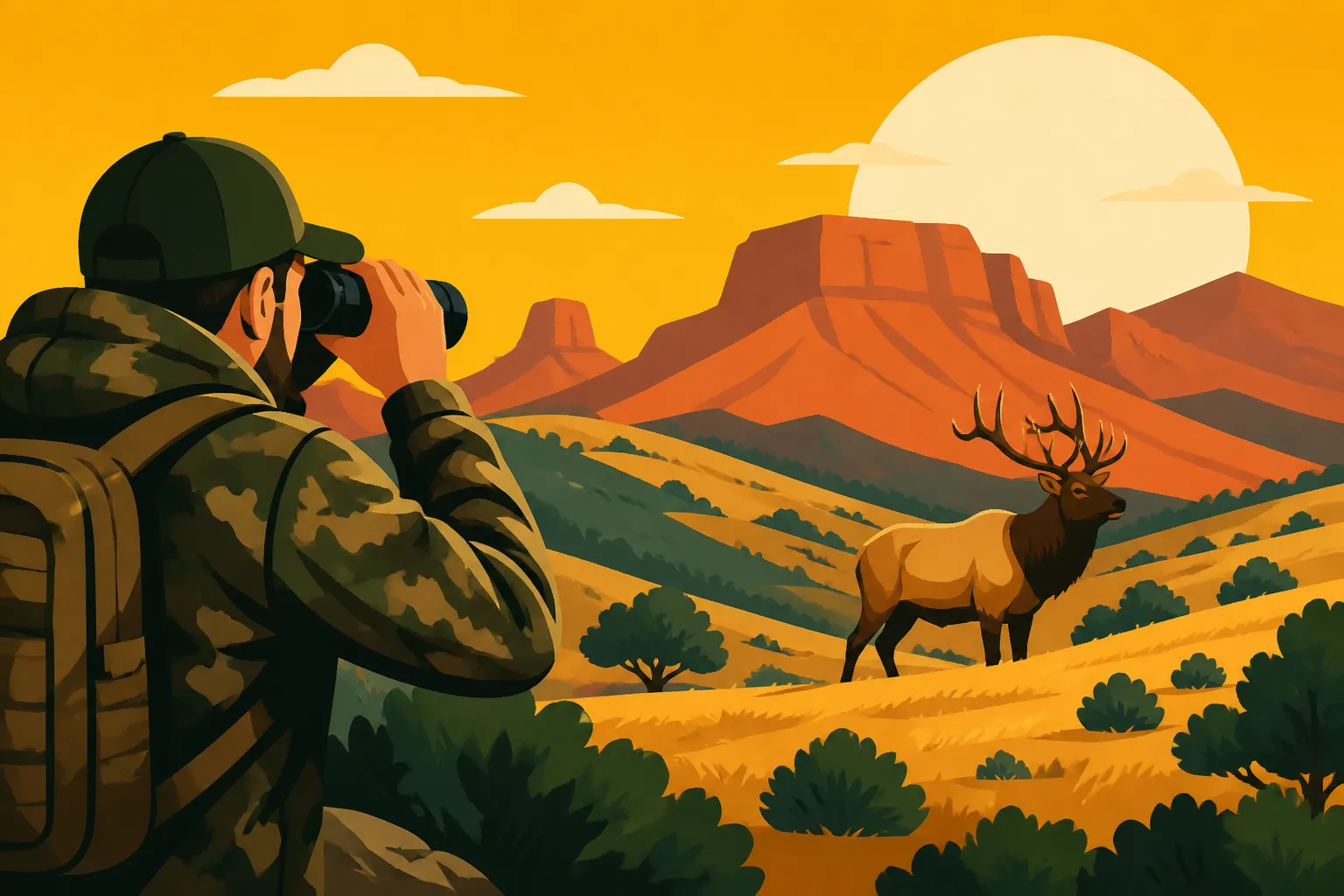
The biggest mistake many hunters make is scanning too fast or too broadly. Your eyes will naturally be drawn to movement or obvious shapes, but elk are masters of camouflage. The secret lies in systematic, slow scanning. This is where the grid glassing method shines. Instead of sweeping your binoculars across an entire bench or park, divide the area into smaller, manageable "grids" or segments in your mind. Start at one edge of your chosen area, pick a starting point, and meticulously scan a small section (say, 10×10 yards) from left to right, then drop your binoculars slightly and scan right to left. Repeat this process, slowly working your way across the entire area, like you’re reading a book.
When you're glassing a long bench, don't try to take it all in at once. Break it down. Focus on the timberline where it meets the open grass, the shadows at the base of large trees, the pockets of thicker cover within the park, and any transition zones where different vegetation types meet. Elk love these edge habitats. Pay special attention to any depressions, small draws, or subtle changes in elevation on the bench—these are natural places for elk to bed down and remain hidden. With a high-quality spotting scope on a solid tripod, you can then zoom in on any suspicious patches, analyzing every rock, stump, and shadow. You’d be surprised how many “rocks” suddenly grow ears and antlers when you apply this patient, segmented approach. The Grid Glassing Method, Step by Step article offers an even more detailed breakdown of this crucial technique.
Patience, Persistence, and Reading Sign from Afar
Finding elk through glass takes an immense amount of patience. It’s not about seeing an entire elk standing broadside in the open (though that’s always a welcome surprise!). More often, it's about catching a flick of an ear, a patch of hide, a horizontal line that doesn't quite fit the vertical lines of trees, or the tell-tale glint of an antler. This is where the "one-hour rule" comes into play: spend at least an hour glassing a promising area before moving on, no matter how discouraged you might feel. Why an hour? Because elk move. They stand up, stretch, re-bed, or simply shift their position slightly. What was hidden a moment ago might become visible.
While you’re patiently scanning, also train your eyes to look for indirect sign. You might not see the elk themselves, but you could spot fresh rubs on saplings along the edge of a park, indicating a bull has been in the area. Droppings in open grassy areas, especially if numerous, suggest elk are regularly feeding there. Displaced rocks or freshly disturbed dirt could point to recent movement. Water sources are magnets for all animals, and you might spot game trails leading to and from a spring or tank in a bench system. Seeing a group of ravens circling over a distant ridge might indicate a carcass, but it could also signal the presence of other animals, including elk. Even from a distance, understanding Reading Fresh Elk Sign in Ponderosa Timber or other habitats can provide crucial clues. Every little bit of information helps you build a picture of elk activity in that specific area.
Finding Benches and Parks in New Mexico Terrain
New Mexico is a vast state, and simply saying "go glass a bench" isn't exactly helpful. You need a strategy for identifying these prime elk habitats before you even step foot in the field. This is where modern technology and good old-fashioned scouting merge to give you an edge.
Utilizing Topographic Maps and Satellite Imagery
Before you ever pack your truck, you should be spending hours behind your computer screen or on your tablet, digitally scouting. Tools like onX Hunt and GoHunt's mapping system are absolute game-changers for identifying promising benches and parks. Start by looking at the topo lines. Benches will appear as areas where the contour lines spread out, indicating a flatter or gentler slope, in contrast to the tightly packed lines of steep hillsides above and below. Parks, especially those nestled within timber, will often show up as lighter green patches surrounded by darker green forest on satellite imagery, or as relatively flat areas in basins or saddles.
Pay close attention to where these features intersect with other critical resources. Are there dark timber pockets nearby for bedding? Are there drainages or springs indicated on the map that would provide water? Is there a south-facing aspect for winter sun, or a north-facing aspect for summer shade? Look for saddles between peaks—these are natural travel corridors that elk often use to move between feeding and bedding areas, and they often connect to benches. Pinpoint potential glassing knobs that will give you a commanding view of these areas. By doing this extensive e-scouting, you can narrow down vast units into smaller, more manageable areas, saving you countless miles and precious time in the field. This kind of preparation is key for E-Scouting a New Mexico Unit Before the Season.
Ground Truthing and Pre-Season Scouting
Digital scouting is powerful, but it's only half the battle. Nothing beats boots on the ground for confirming your suspicions and really getting a feel for the terrain. If you have the luxury of pre-season scouting trips, use them to visit the benches and parks you identified on your maps. Walk the edges of these areas, look for fresh tracks, droppings, rubs, and active wallows. Check out those potential glassing points in person—do they offer the clear line of sight you anticipated? Are there any hidden draws or ridges that would obscure your view?
Sometimes, what looks like a perfect bench on a map might be choked with impenetrable thickets or heavily pressured by other recreationists. Other times, a subtle feature you barely noticed on the map might turn out to be an elk magnet. Pay attention to historical use—are there old, well-worn game trails? Do you see older rubs from previous seasons? Elk are creatures of habit, and often use the same areas year after year if conditions allow. Document everything you find with notes, GPS waypoints, and photos. This ground truthing solidifies your understanding of the area and allows you to refine your hunt plan, giving you confidence when the season finally opens. You’ll be able to make informed decisions about Reading Terrain Before You Pick a Camp and where to focus your efforts.
Identifying Key Features Within Elk Habitat
Within any bench or park, certain micro-features are particularly attractive to elk. Knowing what to look for can help you prioritize your glassing efforts. North-facing slopes, for instance, are often cooler and hold moisture longer, leading to lusher vegetation during dry periods and providing shaded bedding in warmer months. During colder late-season hunts, however, elk might seek out sun-drenched south-facing slopes. Saddles, as mentioned, are natural travel ways, but they also often collect moisture and provide cover, making them excellent spots for elk to pause and feed.
Look for areas with a mix of cover and open ground. Elk rarely spend all their time in wide-open parks; they prefer to be close to dense timber or brushy pockets where they can quickly disappear if danger arises. These "edges" where open and dense habitats meet are prime locations. Ponderosa pine stringers running through a park or along a bench, for example, offer both cover and potential bedding. Rocky outcrops or subtle rises can provide lookout points for bedded animals. Any indication of water—a green strip of vegetation, a boggy area, or even just a darker patch of soil—should be thoroughly investigated. These nuanced features are often where the elk are tucked away, and your persistent glassing will eventually reveal them.
Dealing with Challenging Glassing Conditions
New Mexico's diverse geography and unpredictable weather can throw a lot of curveballs at a hunter. From scorching desert heat to high-mountain winds, these conditions can make glassing incredibly difficult. But understanding how to mitigate their effects can mean the difference between seeing an elk and seeing nothing.
Battling Atmospheric Haze and Heat Shimmer
Ah, the dreaded heat shimmer, or "mirage." On a clear, sunny day, especially in the more open, lower-elevation units or even high up on exposed ridges, the ground heats up and creates shimmering air currents that distort your view, making distant objects appear wavy and indistinct. This is incredibly frustrating when you're trying to pick out an antler tip. The best defense against heat shimmer is to glass during cooler times of the day: early morning and late evening. As the sun rises, the shimmer will increase, often making glassing impossible from late morning through mid-afternoon.
Even during peak shimmer, you can sometimes find brief windows of clarity. Waiting for a cloud to pass over, or a slight change in wind, can sometimes temporarily reduce the effect. Using a higher-quality spotting scope with excellent glass coatings can also help, as these optics are designed to transmit light more efficiently and minimize distortion. Sometimes, changing your angle slightly, or moving to a slightly higher elevation, can also help you look over some of the worst shimmer. In areas where you know heat shimmer will be a factor, prioritize your glassing during the first two hours of daylight and the last two hours of light. During the midday, you might focus on still-hunting thicker cover or checking water sources at closer range.
Reading Wind and Utilizing Sun Angles
Wind isn't just a factor for an animal's scent; it also impacts your ability to glass. High winds can make your tripod unstable, even a sturdy one, causing your optics to shake and making it difficult to keep a steady image. If you're glassing from an exposed ridge, find a position that offers some protection from the wind – a rock outcrop, a clump of trees, or a depression. If possible, set up your tripod low to the ground to reduce its profile and increase stability. Strong winds also carry sound, which can be both a blessing and a curse. It can mask your movements if you need to stalk, but it can also make it harder to hear distant bugles or the subtle sounds of elk moving. Pay attention to Reading Wind in a Deep Gila Canyon for a deeper understanding of this critical element.
Sun angle is equally important. Never glass directly into the sun. Not only is it painful and potentially damaging to your eyes, but it also creates glare and shadows that effectively blind you to anything the elk might be doing. Always try to position yourself so the sun is at your back or to your side. This illuminates the area you're glassing, making elk stand out better. During the morning, this often means glassing west-facing slopes. In the evening, you'll be looking at east-facing slopes. Adjusting your position throughout the day to keep the sun behind you is a simple but highly effective tactic. Remember, the goal is to make it as easy as possible for your eyes and optics to do their job.
Adapting to Hunting Pressure
New Mexico's elk units, especially the more popular ones, can see significant hunting pressure, particularly on opening weekend. Elk are incredibly intelligent and quickly learn to avoid areas with heavy human activity. When pressured, elk will often retreat to the thickest, nastiest, steepest country they can find, or they’ll go completely nocturnal. This makes glassing them in open benches and parks much harder, but not impossible.
To combat pressure, consider looking for benches and parks in areas that are harder to access. This might mean hiking in deeper, further away from roads and popular trailheads. Use GoHunt or onX to identify remote drainages or wilderness areas that most hunters won't bother with. Even a small bench tucked away in a less-traveled canyon can hold elk that are actively avoiding pressure. When elk are pressured, they become incredibly adept at using even the smallest pockets of cover. This means your grid glassing technique becomes even more critical—you need to scrutinize every single shadow, every clump of brush, every depression. They might be bedded in plain sight, just perfectly camouflaged. Being the hunter willing to go the extra mile, or patiently pick apart terrain others overlook, is often how you find success in pressured units.
Integrating Glassing with Your Hunt Plan
Glassing isn't a standalone activity; it's a vital component of a larger hunt strategy. Once you've spotted an elk, the real work begins: transitioning from observation to a successful stalk and shot. And in New Mexico's rugged terrain, having a partner can amplify your glassing efforts exponentially.
Transitioning from Glassing to Stalking
The moment you spot an elk through your optics, a jolt of adrenaline typically shoots through you. But this is where discipline is paramount. Don't immediately grab your bow or rifle and charge off. Take a breath. Observe the elk for a while. What are they doing? Are they feeding, bedding, moving purposefully? What direction are they headed? Are there other elk with them? Understanding their immediate behavior will inform your next steps. Before you move, meticulously plan your stalk. Identify a clear route that uses terrain features (ridges, draws, timber) to conceal your approach. Pay close attention to the wind direction and how it might shift as you move. A slight change in thermals or wind can blow your entire stalk.
Mark the elk's exact location on your GPS or mapping app. Pinpoint multiple landmarks around them so you can re-orient yourself during the stalk. Think about potential shooting lanes and escape routes for the animal. Consider the terrain underfoot—is it noisy? Will you be able to move quietly? If it's a long stalk, mentally break it down into smaller segments. Move slowly, deliberately, and constantly re-evaluate the wind and the elk's position. Remember, New Mexico elk often move up or down elevation as thermals shift. Understanding Playing Thermals on a Canyon Stalk is absolutely critical here. Be prepared to adapt if the elk moves or if conditions change. The goal is to get within your effective shooting range undetected.
Two-Man Glassing Strategies
Hunting with a partner offers a significant advantage, especially when glassing. A two-man team can cover more ground, corroborate sightings, and execute more effective stalks. One common strategy is to have one hunter serve as the primary "spotter" while the other prepares for the stalk. The spotter remains on the glassing point, providing real-time updates to the stalker via radio (if cell service allows, or using satellite communication devices like Garmin inReach or Zoleo, or even simple hand signals). They can guide the stalker around obstacles, update on elk movement, and help confirm yardage.
Another effective two-man glassing strategy is to "split" an area. If you're glassing a large basin or a series of benches and parks, one hunter can focus on one side while the other focuses on the opposite. This ensures comprehensive coverage and doubles your chances of spotting an animal. Communication is key. Discuss beforehand what areas each person will cover, what landmarks to use, and what constitutes a "target animal." When one person spots an elk, the other can help confirm it, judge its size, and assess its behavior. This collaborative approach not only increases efficiency but also helps prevent overlooking animals and provides an extra set of eyes and an extra brain for planning complex stalks. It’s an invaluable asset for Planning a DIY Public Land Hunt in New Mexico.
| Optic Type | Primary Use | Ideal Magnification | Pros | Cons |
|---|---|---|---|---|
| Binoculars | General scanning, quick observation, identifying movement | 8x-12x | Portable, wide field of view, good for covering large areas | Limited detail at long ranges, less stable handheld |
| Spotting Scope | Detailed long-range viewing, antler identification, evaluating specific animals | 20x-60x (or higher) | Extreme detail, high magnification, excellent for judging | Heavier, narrower field of view, requires tripod |
| Binocular Tripod | Stabilizing binoculars for extended scanning | N/A | Eliminates shake, reduces fatigue, increases detection | Added weight, requires setup |
| Spotting Scope Tripod | Essential for steady, high-magnification viewing | N/A | Critical for stability, precise scanning, long sessions | Added weight, requires setup |
Disclaimer
Always consult the current New Mexico Department of Game and Fish regulations before planning any hunt. Hunting rules and regulations can change, and it is the hunter's responsibility to be aware of and comply with all applicable laws.