Playing Thermals on a Canyon Stalk
There’s nothing quite like the rush of spotting a magnificent animal tucked away in a New Mexico canyon, but the excitement can quickly turn to frustration when the wind refuses to cooperate. Canyon thermals are notorious for their unpredictable nature, swirling and shifting in ways that seem to defy logic, often leaving even seasoned hunters busted. This guide is all about demystifying those tricky canyon winds, giving you the knowledge and strategies to turn that frustration into successful stalks.
Unpacking the Dynamics of Canyon Thermals
Understanding how air moves in and out of canyons is fundamental to hunting them effectively. It's not just about wind direction; it's about elevation, sun exposure, and the sheer physics of air heating and cooling. Ignoring these forces is like trying to hunt with a blindfold on – you're just asking for trouble.
The Basics of Upslope and Downslope Winds
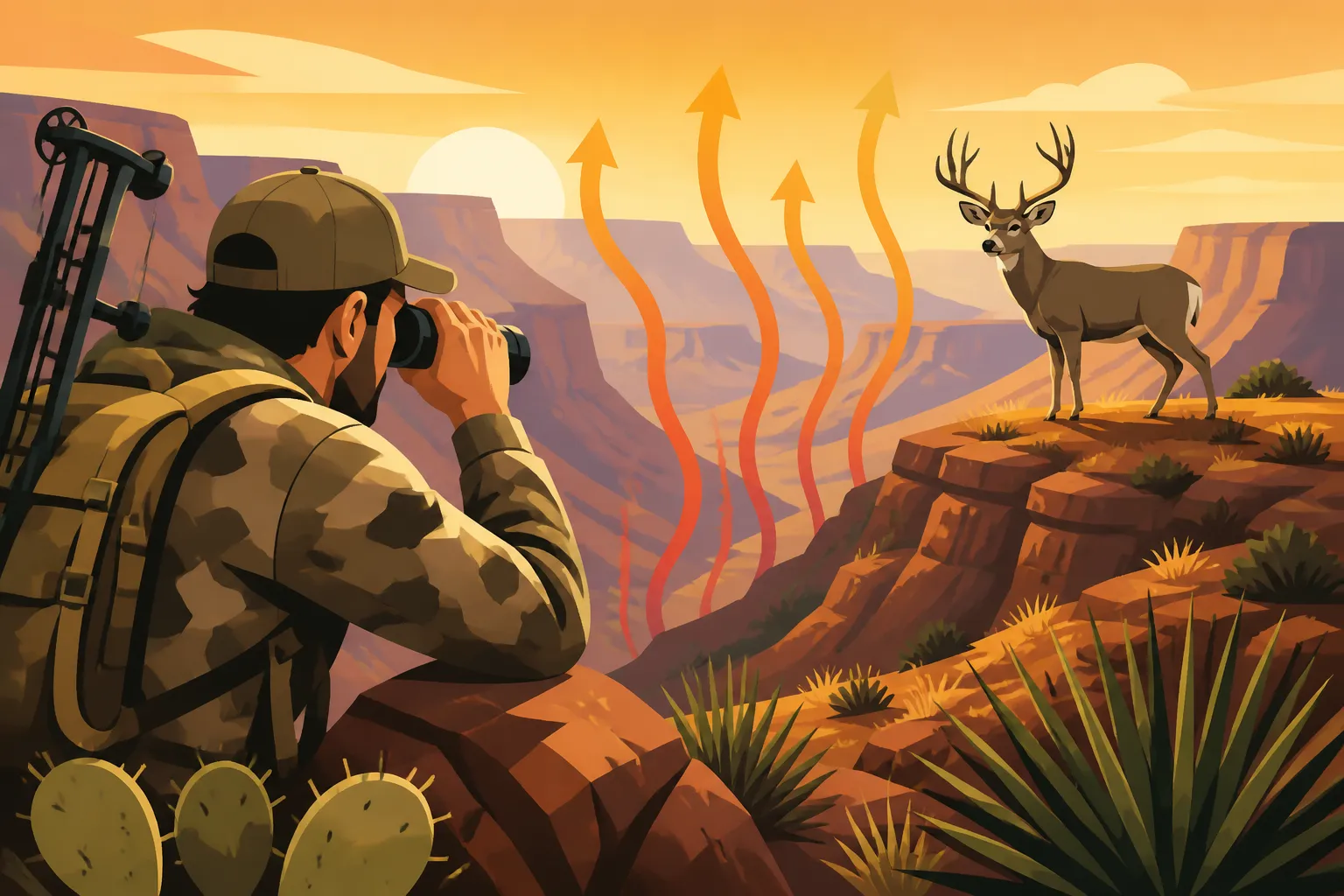
At its core, a thermal is simply air moving due to temperature differences. Think of it like a giant, invisible elevator for your scent. During the day, as the sun warms the canyon walls and floor, the air heats up, becomes lighter, and rises. This creates an upslope thermal, drawing your scent up the canyon walls and out of the drainage. This is often the ideal time to be above your quarry, looking down.
Conversely, as evening approaches and the sun dips below the horizon, the canyon floor and walls begin to cool rapidly. The cooler air becomes denser and heavier, sinking down into the lowest points of the canyon. This generates a downslope thermal, pulling your scent down into the drainage. If you're below an animal during a downslope, your scent is almost certainly being carried directly to them. This is why many experienced hunters prefer to stalk from below during the evening, staying ahead of that falling scent cone.
It’s crucial to remember that these aren't just gentle breezes; they can be powerful currents, especially in deep, steep-sided canyons common in areas like the Gila National Forest or the rugged country of the Big Hatchet Mountains. The strength and consistency of these thermals depend heavily on the severity of the temperature difference between the sun-drenched and shaded areas.
Daily Transitions: From Dawn to Dusk
The most critical times for thermal shifts occur at dawn and dusk. Just after first light, as the sun hits the east-facing slopes, the downslope thermal that dominated the night begins to weaken. There’s often a period of relative calm, sometimes called a "dead air" period, where the air seems to hang still, or at least become highly unpredictable. This transitional phase can be incredibly challenging, as your scent might swirl in any direction before the upslope thermal fully establishes itself.
As the sun climbs higher, the upslope thermal takes over, typically holding strong throughout the warmer parts of the day. This is a prime window for glassing from a vantage point across a canyon, or for making high-to-low stalks if you're confident in your approach. However, don't get complacent. Mid-day can see micro-thermals popping up from sun-warmed rocks, causing temporary swirls that can still give you away.
The late afternoon sees a reverse transition. As shadows lengthen and the sun's intensity wanes, the upslope thermal gradually dies. Again, you'll encounter that tricky "dead air" phase, followed by the establishment of the downslope thermal as evening settles in. This is often when animals become most active, moving from their bedding areas down to feed or water, making it a pivotal time for your strategy. Knowing these specific transition windows is key to Timing Your Approach.
The Perils of Microthermals and Swirls
While the general rules of upslope and downslope are a great starting point, canyons in New Mexico are rarely textbook. The broken, irregular topography, sudden changes in slope, and varying vegetation create countless opportunities for microthermals and swirls. A microthermal is essentially a small, localized thermal cell that can pull air in unexpected directions. Imagine a single sun-baked rock outcropping in a generally shaded area; the air above it will rise, even if the larger thermal is moving downslope.
Swirls are the bane of every canyon hunter. These happen when the air currents become chaotic, often at thermal transition times or when a larger, directional wind interacts with the canyon's unique topography. Your scent can be picked up, carried a short distance, dropped, then picked up again and pulled in a completely different direction. This is where things get truly maddening.
You'll notice this especially in complex drainages, where multiple smaller canyons feed into a larger one. Each sub-drainage can have its own mini-thermal system, creating a confusing patchwork of air movement. It’s not uncommon to feel the wind on your cheek coming from one direction, only to see a puff of milkweed floating off in another entirely. This is where a deep understanding of Reading Wind in a Deep Gila Canyon becomes invaluable. The takeaway? Never trust a single indicator in a canyon. Always be hyper-aware and ready to adapt.
Scouting for Thermal Advantage
Before you even think about putting boot to ground, a good chunk of your thermal strategy should happen long before the hunt. E-scouting and on-the-ground observation are your best friends for anticipating how air will move in your chosen unit.
Mapping Terrain and Predicting Flow
Modern mapping tools are revolutionary for understanding canyon thermals. Applications like Gaia GPS or the mapping features available through GoHunt can show you detailed topographical lines, contour intervals, and even 3D renderings of the landscape. Spend time pouring over these maps, visualizing the canyons, draws, and benches.
Look for key features:
- Steep, unbroken slopes: These tend to create more consistent thermal flows.
- Complex, broken terrain: Areas with numerous smaller drainages, saddles, and rock outcroppings are prime candidates for unpredictable swirls.
- Aspect (which direction the slope faces): South-facing slopes will heat up and cool down faster than north-facing ones, influencing the timing and strength of thermals.
- Shadow lines: Use the sun angle tool on your mapping app to see where shadows will fall at different times of the day. This helps you predict where cold air will pool and where warm air will rise.
By virtually exploring your unit, you can start to identify potential thermal "lanes" or "traps" that you can either use to your advantage or avoid if they put your scent in danger. This kind of diligent E-Scouting a New Mexico Unit Before the Season is an absolute must.
Observing Local Conditions
Once you're in the field, your job isn't over. While maps give you a general idea, nothing beats real-time observation. Before you start your stalk, spend at least 15-20 minutes, or even longer, just watching the environment.
Look for natural wind indicators:
- Dry leaves and dust: How are they moving? Are they consistently flowing in one direction, or are they swirling?
- Tall grasses and small branches: Do they show a steady bend or twitch erratically?
- Spiderwebs: A spiderweb shimmering in the breeze can offer incredible insight into subtle air currents.
- Smoke from a distant fire or campfire: If allowed and safe, a small amount of smoke can illustrate thermal drift over a longer distance.
- Your own breath: On cold mornings, watch how your breath dissipates.
Carry a small bottle of unscented powder or milkweed fluff. Every 50-100 yards, or whenever the terrain changes, release a small amount and watch it. It's often shocking how different the wind can be just a few feet away from you. Pay close attention not just to the direction, but also to the height at which the air is moving. Your scent cone might be rising even if you feel a slight breeze on your face.
Reading Animal Behavior for Thermal Cues
Animals, especially mature ones, are experts at using the wind to their advantage. They often bed in locations where they can see danger approaching from one direction and smell it coming from another. In canyons, this typically means bedding high on a ridge or bench where they can watch the upslope thermal carry their scent safely above any predators approaching from below.
During the daytime, elk and deer will often bed in cool, shaded areas, typically on north-facing slopes or in dense timber, letting the prevailing upslope thermals carry their scent up and away. As evening approaches and the thermals switch to downslope, they might start moving down into the bottom of the canyon or out onto open benches to feed, using the falling air to catch the scent of anything approaching from above.
If you can identify common bedding areas (often on benches or small flats just below a ridge line) and feeding areas (typically in the bottoms or on grassy slopes), you can deduce how an animal might be using the thermals. For instance, if you're trying to figure out How Far to Stalk a Bedded Mule Deer in a canyon, understanding these thermal patterns is critical. This insight helps you choose the optimal time and angle for your stalk, putting the wind in your favor rather than against you.
| Thermal Characteristic | Daytime (Upslope) | Nighttime (Downslope) | Transition Periods (Dawn/Dusk) |
|---|---|---|---|
| Air Movement | Air warms, rises, flows up canyon walls | Air cools, sinks, flows down canyon bottom | Stagnant, unpredictable, swirling |
| Scent Direction | Carried upwards and out of the drainage | Pulled downwards into the drainage | Chaotic, difficult to predict |
| Optimal Stalk | From above (high-to-low), across the canyon | From below (low-to-high), often staying on contour | Extremely challenging, often best to wait |
| Animal Behavior | Often bedded in shade, relying on upward scent travel | Moving to feed/water in bottoms, using downward scent | Increased movement, but still cautious |
| Best Strategy | Gain elevation, glass across, approach from above | Stay low, move carefully upwind, use cover | Patience, observe, or relocate |
Stalking Strategies Based on Thermals
Once you understand the 'why' and 'when' of thermals, it's time to put that knowledge into action on a stalk. This is where the rubber meets the road, and split-second decisions can make or break your hunt.
Timing Your Approach Precisely
The timing of your move is arguably the most critical component when hunting canyon thermals. As we've discussed, the thermal system effectively "resets" twice a day.
- Mid-morning to early afternoon (Stable Upslope): This is often the best time to attempt a high-to-low stalk. The upslope thermal should be well-established, reliably carrying your scent up and away from any animals below you. If you're glassing from a ridge and spot an animal bedded on a north-facing slope below you, this is your window. You'll want to stay above their elevation as much as possible, using the terrain to maintain that advantage.
- Late afternoon to evening (Stable Downslope): This is the prime time for a low-to-high stalk. As the sun dips, the downslope thermal will start to pull your scent down the canyon. If you're moving up the canyon floor or along a contour, your scent will theoretically fall behind you, away from any animals moving or feeding higher up the slopes. This strategy is particularly effective for Using Draws and Benches to Close Distance where you can hide your approach.
- Dawn and Dusk (Transition Zones): These are generally the riskiest times to be actively stalking in a canyon. The thermals are transitioning, causing unpredictable swirls. If you must be moving, do so incredibly slowly and be extra vigilant with your wind checks. Often, the best strategy during these periods is to be in position, waiting for the thermals to stabilize, or to simply observe and plan your next move. If you're heading out for Hunting New Mexico From 4,000 Feet to 10,000, these transitions will vary considerably with elevation.
The "Thermal Trap" Approach
This is a more advanced technique that uses the canyon's natural structure to your advantage, especially during an upslope thermal. Imagine you're on a ridge looking into a canyon and you spot an elk bedded below you. Instead of trying to drop straight down on them, which can expose you or cause a rockslide, consider using a "thermal trap."
Here’s how it works:
- Identify a perpendicular draw or smaller side canyon: Look for a feature that runs at a right angle to the main canyon, leading up to your elevation.
- Use the main canyon's upslope thermal: Make your approach along the ridge or high on the side of the main canyon, where the upslope thermal is reliably carrying your scent away.
- Descend into the side draw: Once you're directly across from or slightly above the animal, drop down into the smaller, perpendicular draw.
- Use the side draw's localized thermal (if present): Often, these smaller draws will have their own mini-thermal, or at least a pocket of relatively still air, that allows you to sneak in from the side, unseen and unheard. The main canyon's thermal is still working to carry your primary scent signature away, while the side draw protects your immediate approach.
This strategy requires careful observation and excellent map reading, but it can be incredibly effective at closing the distance on wary animals without broadcasting your presence. It's about finding the "dead air" zones or predictable flows within the larger, more chaotic canyon system.
Managing Your Scent: The Constant Battle
Even with perfect thermal timing and strategy, human scent is a powerful deterrent. In the close confines of a canyon, where air can get trapped and swirl, minimizing your scent is paramount.
- Scent Control Regimen: This isn't just a marketing gimmick; it's a necessary discipline. Wash your hunting clothes in unscented detergent, store them in airtight bags, and use unscented hygiene products. Don't forget your boots – they pick up and distribute a lot of odor.
- Wind Direction Indicators: Always, always, always have a wind checker with you. Use it constantly. Every time you pause, every time the terrain changes, every time you think about taking another step, puff that powder. It’s your most reliable real-time indicator of where your scent is going.
- Playing the Terrain: Use the terrain itself as a scent buffer. If you’re making a low-to-high stalk, stay on the far side of a small ridge or knoll, letting it block your scent from directly hitting the animal. If you're above, stay well back from the rim until the last possible moment.
- The "Clean Air" Bubble: Try to imagine your scent as a bubble around you. Your goal is to keep that bubble either completely behind you (on a downslope stalk) or completely above and away (on an upslope stalk). Avoid walking through dense vegetation that can "rub off" and leave concentrated scent.
Managing your scent is a full-time job in the field, and it’s especially critical when Layering for Gila Temperature Swings where you might sweat a lot during the day, creating even more scent.
Real-World Scenarios and Adaptations
Canyon hunting in New Mexico is rarely a straightforward affair. The diverse landscape means you’ll encounter endless variations, and successful hunters are those who can adapt their thermal strategies on the fly.
Hunting a Shaded North Slope vs. a Sunny South Slope
The sun's influence on thermals is undeniable. Understanding the aspect of a slope can give you a significant advantage.
- Shaded North Slopes: These areas stay cooler for longer, meaning the downslope thermal will persist well into the morning, and the upslope thermal will establish later and be weaker. Animals often bed here during warm weather to escape the sun. If you're trying to hunt a north slope in the morning, be prepared for unpredictable or lingering downslope winds. A mid-day stalk from above once the upslope is marginally established might be your best bet, but careful attention to wind checks is vital, as pockets of cold air can still cling to the slope.
- Sunny South Slopes: These slopes heat up quickly in the morning, rapidly transitioning to a strong upslope thermal. They also cool down just as fast in the evening, leading to an early and robust downslope. Animals might feed on south slopes early and late, but rarely bed there during the heat of the day. If you're hunting a south slope, you can typically rely on a strong upslope during mid-day, making it a good target for glassing from afar or high-to-low stalks. In the evening, the downslope will be your ally for a low-to-high approach.
Knowing this means you might adapt your hunt timing. You might focus on a north slope later in the day, or hit a south slope first thing in the morning when a strong downslope is still in play, pushing your scent away as you approach.
Navigating Mid-Day Stalls and Swirls
Even when the sun is high, canyons can throw curveballs. A sudden cloud cover, a shift in the broader weather pattern, or simply the sun dipping behind a ridge can cause thermals to stall or swirl.
- Patience is Key: If the wind checker goes dead or starts swirling erratically, stop. Find a comfortable, concealed position and wait it out. Trying to push through unpredictable wind is a recipe for disaster. This might mean waiting for 30 minutes, an hour, or even several hours.
- Re-evaluate: Use this downtime to study your map again. Look for alternative routes that might offer more consistent wind. Sometimes, simply moving to a different, less complex part of the canyon system can solve the problem.
- Glassing Opportunity: While waiting, use your binoculars or spotting scope to intensively glass the surrounding slopes. Animals might be moving during these thermal lulls, or you might spot new opportunities.
A mid-day stall is often a test of discipline. It’s tempting to keep pushing, especially if you know an animal is close, but patience almost always pays off more than recklessness.
Post-Rainfall Considerations
Rainfall, even a light shower, can dramatically alter thermal dynamics in a canyon.
- Cooling Effect: Rain cools the ground and vegetation, reducing the temperature differential that drives thermals. This can weaken both upslope and downslope flows, making the air more stagnant or susceptible to broad, directional winds.
- Scent Masking (Temporarily): While rain does wash some scent away, the humidity it introduces can actually make your scent carry further once the air starts moving again. Don't rely on rain to completely mask your presence.
- Increased Animal Activity: Animals are often very active after a rain, as the ground is softer, vegetation is refreshed, and temperatures are more pleasant. This means more movement, but also more opportunities if you can manage the thermals.
After a rain, be extra cautious. The ground might be quieter for walking, but the thermals will be less predictable than on a dry, sunny day. Continuously use your wind checker, pay attention to any remaining mist or fog, and consider a slightly more conservative approach until you can gauge the new thermal patterns. Remember, every hunt in New Mexico's diverse terrain offers new lessons, from the desert floor to the highest peaks.
Disclaimer
Hunting is an inherently dangerous activity. The information provided in this guide is for educational purposes only and should not be considered a substitute for proper training, experience, or adherence to all local, state, and federal hunting regulations. Always prioritize safety, respect wildlife, and obtain all necessary licenses and permits before venturing into the field.