Reading Wind in a Deep Gila Canyon
Hunting in the deep canyons of New Mexico, particularly within the vast and rugged Gila National Forest, presents a unique challenge that can make or break a hunt: the constantly swirling, unpredictable wind. You can have the best optics, the most dialed-in rifle, and a perfect read on animal sign, but if the wind shifts and carries your scent, all that effort evaporates in an instant. This comprehensive guide will equip you with the knowledge and practical strategies to better understand, anticipate, and ultimately work with the fickle air currents in these challenging mountain environments, helping you stay undetected and increase your chances of success.
Understanding the Gila's Unique Air Currents
The Gila National Forest isn't just "mountains"; it's a labyrinth of steep canyons, deep drainages, and high ridges that act like a giant, convoluted wind tunnel. What seems like a gentle breeze on a ridge top can become a violent crosscurrent just a hundred feet down into a canyon, or worse, swirl back up and betray your position. Understanding these unique air currents is the first step to mastering them.
The Gila's Canyon-Dominated Topography
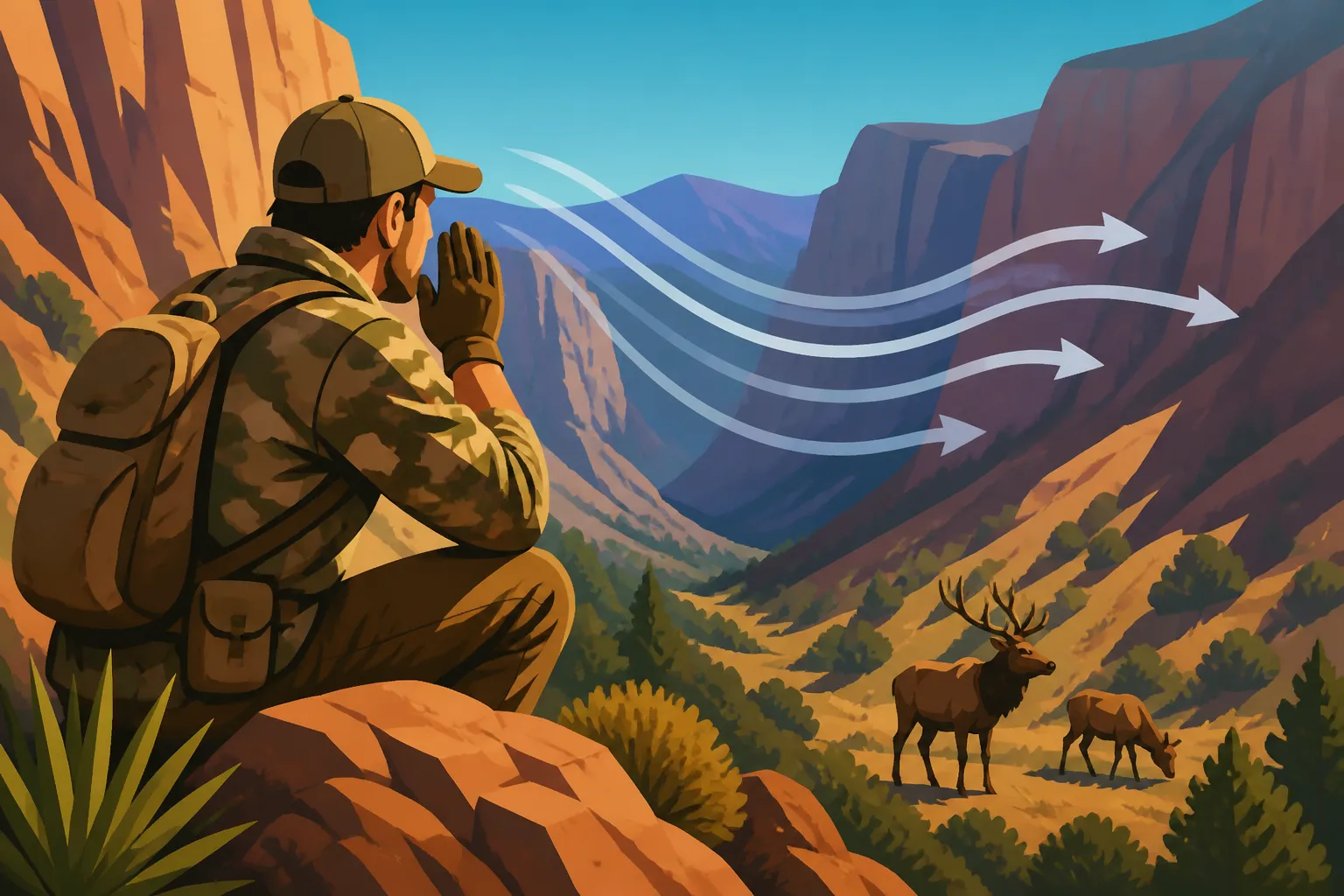
Imagine trying to predict how water flows through a complex series of narrow channels, eddies, and waterfalls. Now replace the water with air, and you have a good picture of what it's like to read wind in a place like the Gila. The sheer walls of the canyons create their own microclimates, where thermal currents are exaggerated, and the general prevailing wind often has little say in the localized air movement. These canyons act as funnels, speeding up air in some places, and creating dead spots or violent swirls in others. It's not uncommon to feel the wind blowing directly into your face, only to see a scent checker indicate it's swirling directly behind you into the canyon. This phenomenon makes a direct approach incredibly difficult if you're not constantly vigilant.
Furthermore, the varied vegetation within these canyons—from dense ponderosa pines and Douglas firs on north-facing slopes to sparse scrub oak and juniper on sun-drenched south faces—also influences how air moves. Timber acts as a filter, breaking up consistent breezes into localized gusts, while open areas can allow wind to accelerate. It’s a dynamic system, always changing with the sun's position, cloud cover, and overall atmospheric pressure.
Thermals and Katabatics
The diurnal (daily) wind cycle is perhaps the most significant factor in canyon hunting. As the sun rises and warms the earth, the air in the valleys and canyons begins to heat up. Hot air rises, creating what hunters call "thermals" – uphill drafts that typically begin an hour or two after sunrise and continue through the warmest part of the day. If you're hunting in the morning, stalking up a canyon, these rising thermals can be your friend, carrying your scent away from animals that are likely bedded higher up on the slopes. However, if you're trying to descend into a canyon, these same thermals will carry your scent directly to anything below you.
Conversely, as the sun begins to set and the earth cools, the air in the higher elevations cools faster. Cold air is denser and sinks, creating "katabatic" winds, or downhill drafts. These usually kick in a few hours before sunset and persist through the night. So, in the evening, if you're trying to sneak down into a canyon towards a watering hole or feeding area, these falling katabatics can work in your favor, carrying your scent away from the animals below. But approach from below, and you'll be busted. Understanding this predictable pattern of Playing Thermals on a Canyon Stalk is crucial, but remember, the Gila's complex terrain can throw curveballs, causing these thermals and katabatics to swirl or reverse unexpectedly, especially near prominent features or sudden drops.
Essential Tools for Reading Canyon Wind
You can't just guess which way the wind is blowing in the Gila. It's a game of constant observation and verification. Relying solely on your nose or a lick of your finger will lead to far too many busted stalks. Having the right tools and knowing how to use them is paramount to success.
Visual Cues and Natural Indicators
Before you even reach for a gadget, hone your observational skills. Nature offers countless clues to wind direction if you know where to look. Watch the trees, especially the smaller leaves on oaks or aspens, as they twitch and rustle in the breeze. Even a subtle shimmer can indicate air movement. Dust, especially around dry creek beds or trails, can show you ground-level currents. Smoke from a distant campfire, if visible, can give you a larger perspective on prevailing winds. Look for spider webs, which are incredibly sensitive to air currents, or even floating dandelion seeds.
Animals themselves are excellent wind indicators. Watch how they move, how they feed, and which direction they face. Deer and elk often feed into the wind, relying on their strong sense of smell to detect danger ahead. If you see a group of elk all facing the same direction, you can bet that’s where the wind is coming from. Pay attention to their ears; they'll often swivel into the breeze. While these natural cues are helpful for general awareness and for confirming what your tools tell you, they often won't reveal the minute swirls and eddies that can give you away in tricky canyon terrain.
Scent Checkers and Wind Meters
This is where the rubber meets the road. Every serious hunter in the Gila should have a reliable scent checker. Powdered indicators, like "milkweed" or similar fine, light-colored powders, are excellent because they are highly visible and float for a long time, showing not just direction but also swirls and how far your scent might drift. Puffs of smoke from a small squeeze bottle work similarly. You need something that can give you instant, precise readings, especially when you're making your final approach on a bedded animal or setting up for a call.
For those wanting an extra layer of data, a handheld wind meter can be useful, especially for judging general wind speed on a ridge or open slope, which can affect bullet trajectory for rifle hunters. However, for the intricate, localized currents within a deep canyon, a visual scent checker that shows drift and swirl is far more valuable than just a speed reading. Many experienced Gila hunters will pull out their scent checker every few minutes, sometimes even every few steps, to ensure they aren't about to walk into an unexpected crosswind. There are some fantastic products out there now, some even available through reputable retailers like GoHunt, that are specifically designed for hunters and are easy to use quietly and efficiently in the field.
Strategies for Hunting With the Wind, Not Against It
Once you understand the Gila's winds and have the tools to read them, the next step is to integrate that knowledge into your hunting strategy. This means constantly adapting your approach and never fighting the wind.
Anticipating Directional Shifts
Successful canyon hunting isn't just reacting to the current wind; it's anticipating its shifts. As mentioned, the thermal cycle is your primary prediction tool. Plan your morning hunts to move uphill with the rising thermals, and your evening hunts to move downhill with the falling katabatics. If you're making a midday stalk, be acutely aware that thermals can be at their strongest and most erratic, often swirling as they reach the rim of a canyon or hit a particularly steep rock face. In these situations, the wind might shift multiple times within an hour. This constant vigilance is critical, perhaps even more so than How Far to Stalk a Bedded Mule Deer in open country, where wind might be more predictable.
Before you commit to a long stalk or a calling setup, pause and observe for an extended period. Watch how the wind interacts with the terrain. Notice the shadows moving as the sun traverses the sky, knowing that a newly shaded slope might begin to cool and create a localized downdraft, even if the general thermal is still rising. If you're glassing from a distant ridge, observe how dust or leaves move in the canyon below you. Sometimes, waiting for the wind to settle into a more predictable pattern, even for an hour, can be the difference between success and failure.
Playing the Eddies and Swirls
Deep canyons often create areas where the wind doesn't just blow in one direction but creates eddies—small, localized currents that swirl back on themselves—or complex, unpredictable swirls. These are scent traps, and they are where hunters often get busted. The key is to recognize these areas and either avoid them or use them to your advantage. For example, a sharp bend in a canyon or a sheltered pocket behind a large rock formation might create a back eddy. If the main wind is blowing from left to right, the eddy might cause air to swirl briefly from right to left in that specific spot.
When you encounter these unpredictable spots, the best strategy is often to move around them, taking a wider path, or to climb to higher ground where the wind might be more consistent. However, sometimes you can use an eddy to your advantage, especially if it's consistently swirling your scent back towards you or dispersing it harmlessly. This requires extensive testing with your scent checker. Never assume an eddy is safe; always verify with frequent checks. This is part of the art of hunting these complex areas, much like understanding Reading Wind in a Deep Gila Canyon involves more than just a single direction.
Real-World Scenarios and Adaptations
Knowing the theory is one thing; applying it under pressure in a real hunting scenario is another. Let's look at how to use wind knowledge in specific situations you'll encounter in the Gila.
Stalking Bedded Animals
Imagine you've spotted a nice mule deer buck bedded on a bench halfway up a steep canyon wall. It's mid-morning, so the thermals are generally rising. Your initial thought might be to approach from below, letting the rising air carry your scent over him. However, the buck is bedded in a small alcove, and a crosswind is pushing air into his bed from an unexpected direction. If you just charge up the canyon, that crosswind could carry your scent directly to him.
Instead, you need to pause, assess the terrain, and use your scent checker frequently. If the thermals are indeed rising and consistent, a patient, deliberate uphill stalk might work. But if there are any subtle crosscurrents or swirls, you might need to adjust your approach significantly. This could mean climbing higher than the buck and then making a lateral move, hoping to find a more consistent downdraft on his far side (though this is risky in a thermal cycle). Or it might mean circling around entirely to approach from a different ridge, taking advantage of a slight change in terrain that channels the wind more favorably. This detailed planning is a critical part of Using Draws and Benches to Close Distance effectively. Patience is your greatest ally here; often, waiting for an hour for the thermal to stabilize, or even waiting until the evening katabatic winds begin to fall, is a smarter move than rushing in and blowing the opportunity.
Setting Up for a Calling Sequence
When elk hunting during Bugle Timing Through New Mexico's Rut in the Gila, calling is often a key tactic. But a perfectly executed cow call or bugle means nothing if the wind carries your scent directly to the bull you're trying to entice. Setting up your calling sequence requires as much attention to wind as it does to acoustics. You need the wind to carry the sound of your call, but not your scent.
This typically means setting up with the wind blowing your scent away from where you expect the elk to approach. If you anticipate a bull will come from downwind, you need to position yourself so your scent isn't blowing directly into his path. Often, this means using a topographical feature, like a small ridge or a thick stand of timber, to create a "scent shadow" or to divert your scent. If you're working with a partner, the caller might set up 50-100 yards behind the shooter, allowing the shooter to have a better wind advantage while the caller pulls the bull past their position. Always use your scent checker before you start calling, and monitor it constantly. If the wind starts to swirl, hold off on calling or be prepared to quickly reposition. There's nothing more frustrating than having a bull respond aggressively only to have him hit your scent stream and bolt.
Technology and Scouting for Wind Intelligence
While in-the-field observation and tools are crucial, modern technology can give you a significant advantage in pre-planning and adapting your strategy for Gila winds. Don't underestimate the power of a good app or a detailed map.
Topographic Maps and Satellite Imagery
Before you even step foot in the Gila, your e-scouting game should involve a deep dive into topography. Tools like GoHunt's mapping features or onX Hunt are invaluable for this. Look at contour lines on a topo map to identify deep canyons, saddles, and prominent ridges. These features are essentially highways for wind. Pay attention to how drainages connect; air will naturally funnel through these corridors. High, exposed ridges will often have more consistent prevailing winds, while the bottoms of deep, narrow canyons will be prone to thermals, katabatics, and unpredictable swirls.
Using satellite imagery, you can identify areas of dense timber versus open parks. Timber can block wind, creating calm pockets or forcing air around it. Open areas, conversely, can accelerate wind. By overlaying public land boundaries, you can plan your approach routes, considering potential access points that keep you downwind from likely animal travel corridors. This detailed planning during E-Scouting a New Mexico Unit Before the Season helps you understand the macro-level wind patterns you're likely to encounter, allowing you to prioritize certain areas or plan specific entry and exit strategies based on predicted wind direction for your hunt dates.
Weather Apps and Predictive Models
While no app can perfectly predict micro-currents in a deep canyon, modern weather apps and hunting-specific forecast tools can provide a general idea of prevailing wind direction and speed for your hunting area. Apps like AccuWeather, or even dedicated hunting apps with built-in wind forecasts, can show you what the general wind is expected to do throughout the day. This is valuable for broadly planning your day – deciding which ridges to hunt in the morning versus the evening, or which side of a mountain to approach.
However, always remember the caveat: these forecasts are for general, open-air conditions and do not account for the nuances of canyon topography. A forecast calling for a 10 mph west wind might be accurate at 10,000 feet on an exposed peak, but it could be a swirling 2 mph downdraft at the bottom of a 2,000-foot canyon. Use these tools as a starting point, but always, always verify with your in-field scent checker. Think of them as giving you a hypothesis, which you then need to test rigorously once you're on the ground. A general forecast can help you decide which side of the mountain to camp on, but your powder will tell you where to take your next step.
Navigating the complex winds of the Gila is a skill that develops with experience and diligent observation. There's no magic bullet or single trick that will guarantee success. It requires a constant, almost obsessive, awareness of your surroundings and an unwavering commitment to understanding how the air moves through that incredible landscape. By combining an understanding of thermals and katabatics with reliable scent checkers and smart pre-hunt scouting, you'll significantly increase your odds of staying undetected and getting closer to those elusive Gila animals. Remember, the wind is a force of nature, and you can't conquer it, but you can learn to dance with it.
Disclaimer
The information provided in this guide is for general informational purposes only and does not constitute legal advice. Hunting regulations and laws in New Mexico are subject to change. Always consult the official New Mexico Department of Game and Fish regulations and local land management agency rules before planning any hunting activity. Safety should always be your top priority in the field.