Still Hunting Oak Brush for Coues
Hunting Coues deer in New Mexico’s oak brush can feel like searching for a ghost in a green labyrinth. These little desert whitetails are masters of vanishing, and when they dive into those dense, thorny thickets, it’s enough to make even the most seasoned hunter want to throw in the towel. But don’t despair! This guide is here to break down the highly effective, albeit challenging, art of still hunting these elusive deer in their preferred, tangled domain, giving you the real-world tactics you need to succeed.
Understanding Coues Deer and Their Oak Brush Kingdom
Coues deer, often called the "gray ghost of the desert," are a unique subspecies of white-tailed deer found in the southwestern United States and Mexico. They thrive in rugged, broken country, and while they might seem tiny compared to their northern cousins, they offer one of the toughest hunting challenges out there.
Why Coues Love Oak Brush Thickets
It’s not just that oak brush offers incredible cover; it’s a full-service resort for Coues deer. These dense, often thorny, shrubs provide food, water retention, and thermal regulation all in one package. In areas like New Mexico's Bootheel ranges, where the landscape is a mix of arid desert and mountainous terrain, oak brush patches are oases. They offer palatable browse throughout much of the year, especially new growth after summer monsoons, which is crucial in dry environments. The intertwined branches and dense foliage are also fantastic at holding moisture, keeping the ground cooler in the brutal desert heat and providing shade. This thermal cover is absolutely vital for Coues, allowing them to conserve energy during the day. When you're glassing for these deer, remember that they aren't just hiding; they're living comfortably in these sanctuaries. They know every escape route, every subtle dip, and every shadowed nook within their thorny fortress.
Coues Behavior in Dense Cover
Unlike mule deer that might browse more openly or bed down in relatively exposed areas, Coues deer are built for the thick stuff. Their smaller size and incredible agility allow them to navigate dense scrub with astonishing stealth. When they feel pressure, their first instinct is rarely to run far out into the open. Instead, they’ll often weave deeper into the brush, sometimes only moving a few yards, freezing, and allowing their camouflage to do the work. This is where hunters often make mistakes, assuming the deer is long gone. In reality, that buck might be twenty yards inside the thicket, watching you. They'll also use these thickets as travel corridors, moving between feeding areas and water sources under the protective canopy. Understanding this behavior is critical for successful still hunting; you're not just looking for a deer, you're looking for a deer that wants to disappear in plain sight within its chosen habitat. They'll pause, listen intently, and use every rustle of the leaves to their advantage.
The Art of Still Hunting in Oak Brush
Still hunting is an incredibly effective, yet demanding, method for targeting Coues deer in their brushy strongholds. It requires immense patience, sharp observation skills, and a methodical approach that goes against the instinct to cover ground quickly.
Mastering Your Pace and Awareness
This is where the "still" in still hunting really comes into play. You’re not walking; you're barely moving. Think of it more as creeping than walking. A good rule of thumb is to take 3-5 deliberate steps, then stop for a full minute, sometimes two or three. During those pauses, your eyes should be constantly scanning, not just for a whole deer, but for parts of a deer: an ear flick, a horizontal backline, a patch of gray contrasting with the green and brown of the brush, or the tell-tale glint of an antler. It's like finding Waldo, but Waldo is actively trying to hide from you in a complex, three-dimensional puzzle.
Your pace should be so slow that if you were to look at your track line an hour later, you’d barely believe you moved at all. This glacial movement allows you to detect subtle movements or sounds that quicker travel would mask. It also gives the deer time to relax and perhaps make a small movement that gives them away. You're trying to integrate yourself into the environment, becoming just another slow-moving shadow until you spot your quarry. Pay close attention to the ground, searching for fresh tracks and droppings to confirm you’re in a productive area.
Reading the Wind and Thermals in Brush
Wind and thermals are your best friends and worst enemies in still hunting, especially in the broken terrain where Coues thrive. In thick oak brush, the wind can swirl unpredictably, but understanding the general patterns is crucial. As a general rule, cold air sinks and warm air rises. This means that in the mornings, thermals will typically pull air uphill as the sun warms the slopes. In the evenings, as the air cools, thermals will reverse, pushing air downhill. You’ll want to hunt in a way that keeps your scent blowing away from where you expect the deer to be.
When you're Playing Thermals on a Canyon Stalk, the principles apply just as much to these smaller, brushy draws. Always try to approach from the downwind or crosswind side. However, in dense brush, the wind can be fickle, eddying and swirling, especially in small pockets and ravines. Carry a wind checker bottle (talcum powder or milkweed down) and use it constantly. Before every series of slow steps, take a reading. If the wind shifts unfavorably, you need to adjust your approach or back out and try another route. A single puff of scent carried on a fickle breeze can send a wary Coues buck bolting deeper into the cover.
Utilizing Natural Openings and Edges
While still hunting is about moving through the brush, you’re not just plowing blindly into the thickest stuff. The key is to hunt the edges and openings within the brush. Look for natural clearings, old game trails, or even sparse areas where the oak brush thins out. These are the highways and rest stops for Coues deer. Deer use these openings to move from one section of cover to another, to feed on interspersed grasses, or to simply grab a quick look around.
Canyons and arroyos that cut through dense oak brush can also act as natural corridors. Deer will often follow the contour of these features. Use geological features like small ridges, benches, and draws to your advantage for both cover and observation. When you're Using Draws and Benches to Close Distance, remember that these features can provide an unseen approach. Always approach these openings slowly, stopping just before you expose yourself, and then carefully peer around the corner or over the rise. This tactic allows you to observe before being observed. Maximize your visibility from these vantage points, even if it means slowing down even further to pick apart every shadow.
Essential Gear and Tactics for Success
Still hunting Coues deer in thick oak brush demands a specific set of tools and refined tactics. Your gear needs to be robust, quiet, and optimized for close-range engagements in dense cover.
Optics and Their Role in Thick Country
Many hunters assume that in dense timber or brush, powerful optics are less useful. For still hunting Coues, this couldn't be further from the truth. While you might not need the extreme Optics Power for New Mexico's Open Country, a good pair of 8x or 10x binoculars is absolutely essential. Forget the huge, heavy binoculars for wide-open glassing – for oak brush, you want something light, durable, and with excellent low-light performance. Brands like Vortex or Leupold offer fantastic options that can stand up to the abuse of crawling through thorns.
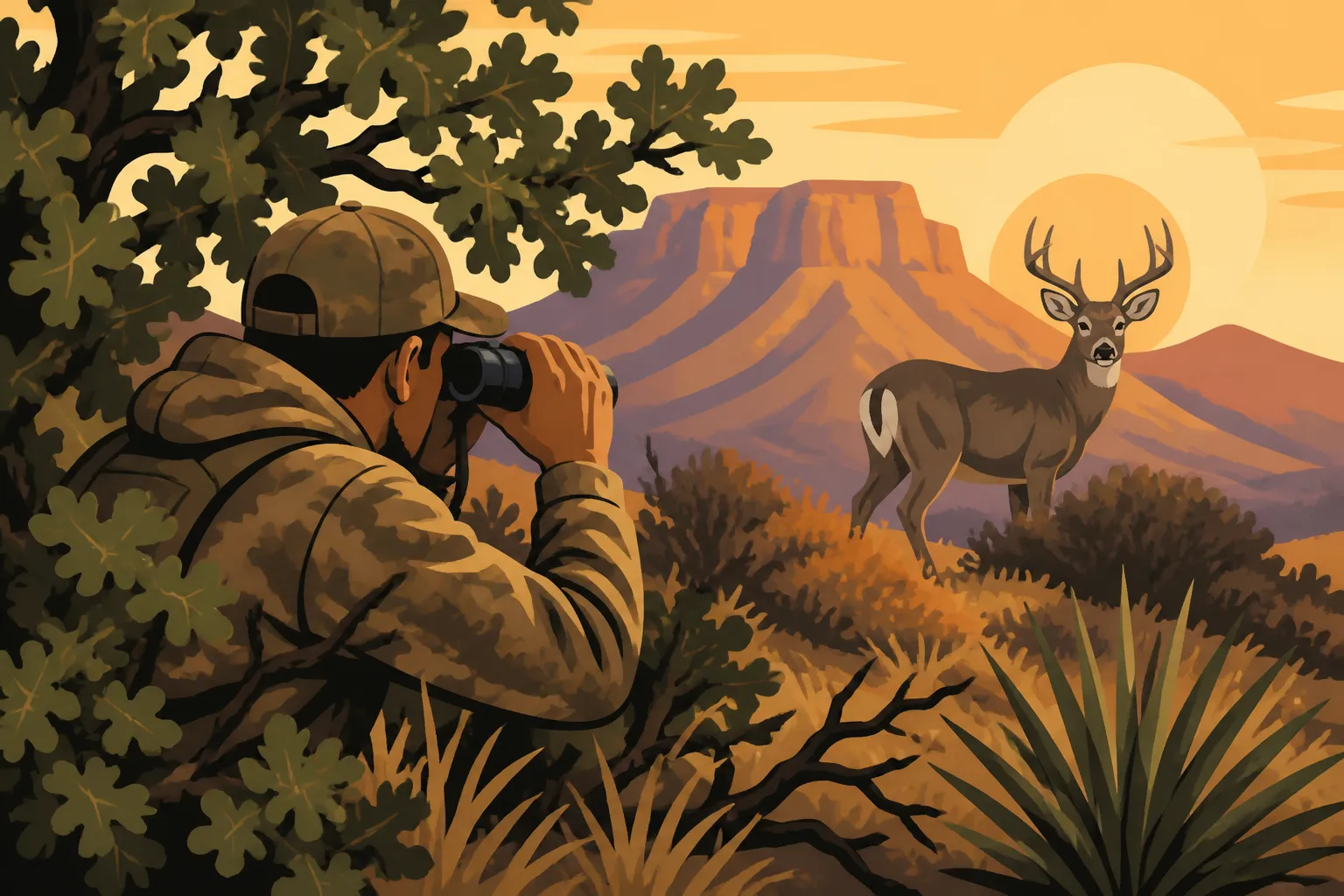
The key is how you use them. You’re not necessarily spotting deer from miles away. Instead, you're using your binoculars to meticulously pick apart every clump of brush, every shadowed recess, and every seemingly inanimate object at close range. Every pause in your still hunt should involve a slow, deliberate scan with your binoculars. Look for the horizontal line of a deer's back, the distinct shape of an ear, a patch of contrasting hair, or the tell-tale gleam of an antler tine. It’s amazing how a deer can disappear to the naked eye but become obvious through quality glass. Think of it as painting with light, revealing what the shadows try to hide. This is also where a reliable mapping application like GoHunt's mapping system can be invaluable for identifying potential bedding or feeding zones within the oak brush, allowing you to prioritize your still hunting efforts in the most promising areas.
Weapon Choice for Close-Quarters Hunting
In the dense, unforgiving world of oak brush, your choice of weapon is paramount. You need something that can deliver quick, precise shots at close range. For rifle hunters, a fast-handling rifle in a moderate caliber is ideal. Something like a .243, .270, or .308 with a short barrel (20-22 inches) will be much easier to maneuver through tangled branches than a long-barreled magnum. Accuracy at 100-200 yards is far more important than extended long-range capability. When considering your Rifle Zero Distance for Canyon Country, think about how that might translate to much closer, snapshot opportunities in dense brush.
Bowhunters face an even greater challenge. A compact bow is always a plus, and a solid, fixed-blade broadhead or a reliable mechanical broadhead is crucial. Broadhead Requirements for Bowhunting emphasize effectiveness and penetration, which are doubly important when a shot might be slightly obstructed by a twig or branch. Practice shooting from kneeling or even seated positions, as standing shots might not always be an option in thick cover. Muzzleloaders, if hunting during a dedicated season, also benefit from being compact and easy to handle, focusing on accuracy within the effective range of the brush. The goal is a quick, ethical kill shot, often at very close quarters, so familiarity and confidence with your chosen weapon are non-negotiable.
Calling Strategies for Still Hunters
While still hunting emphasizes stealth, strategic calling can be a game-changer, especially during the rut, When the Coues Rut Peaks. Soft doe bleats or fawn distress calls can sometimes pique a buck's curiosity enough to get him to stand up or take a few steps into an opening. Remember, Coues deer are generally smaller and more wary than their larger whitetail cousins, so calls should be subtle and used sparingly.
A quiet grunt tube can be effective for a buck that you've spotted but is reluctant to move. A soft "mmmp" can sometimes make him pause, giving you an extra second for a shot, or even get him to take a step into a shooting lane. Avoid aggressive or loud calls, as these can easily spook a cautious Coues in the close confines of oak brush. Always have your weapon ready when you call, as a response can be immediate and often from an unexpected direction. If a buck responds, be prepared for him to circle downwind before presenting a shot, using his incredible sense of smell to pinpoint the source of the sound.
Overcoming the Challenges of Oak Brush
Hunting Coues deer in oak brush isn't just physically demanding; it tests your mental fortitude. The constant battle with noise, limited visibility, and the possibility of losing a blood trail in the dense cover can be frustrating.
Dealing with Noise and Limited Visibility
The primary frustration of still hunting in oak brush is the sheer noise you make. Every step crunches leaves, every branch scrapes your clothing. It's a symphony of sound that seems designed to alert every animal within a quarter-mile. The key is to embrace it and manage it. Move slowly enough that any noise you make sounds natural and non-threatening, like a squirrel or another deer. Take small, deliberate steps, picking up your feet rather than dragging them, and placing them softly.
Wear quiet clothing. Avoid anything that rustles loudly. Wool or fleece are excellent choices. Choose Choosing Boots for Rocky Desert Ground that are quiet yet provide good traction and protection from thorns. The limited visibility means you’re often only seeing a small window of terrain at any given moment. This necessitates constant, methodical scanning with your eyes and binoculars. Don't stare blankly; actively search for patterns, shapes, and colors that don't belong. This is where the practice of grid glassing, adapted for close range, becomes invaluable. Break down the visible area into small, imaginary squares and scrutinize each one. Utilize mapping tools like GoHunt to mark potential game trails or dense bedding areas, helping you to anticipate movement even when visibility is poor.
Tracking and Recovery in Dense Cover
This is arguably the most critical and challenging aspect of still hunting Coues in oak brush. If you're fortunate enough to get a shot, the deer will almost inevitably flee into the thickest part of the brush. Losing a blood trail in this environment is incredibly easy. Your number one priority after a shot is to mark the exact spot where the deer was standing, and then the last place you saw it. Use a piece of toilet paper, surveyor's tape, or even your hat to mark these spots.
Wait a reasonable amount of time before tracking, at least 30 minutes for a good hit, and much longer for a questionable one. This gives the deer time to bed down and expire. When you do start tracking, move slowly and methodically. Look for any sign: disturbed leaves, broken twigs, tracks, and of course, blood. Even sparse drops can be followed if you’re patient. Get down on your hands and knees if necessary. If you lose the trail, spread out and search in ever-widening circles from the last confirmed sign. If you’re hunting with a partner, one person can stay on the last sign while the other searches. Remember, The Meat Salvage Requirements for Big Game are serious, and every effort must be made to recover your animal. This often means crawling, pushing through thorns, and spending hours painstakingly following a faint trail. It's tough, but that's part of the challenge and the satisfaction of still hunting the gray ghost.
Disclaimer
Hunting is an inherently dangerous activity. Always prioritize safety, understand and follow all New Mexico Game and Fish regulations, and obtain appropriate licenses and permits before heading into the field. This guide provides general information and recommendations, but individual situations may vary. Always verify current regulations and conditions with the New Mexico Department of Game and Fish.