Telling a White-Winged Dove From a Mourning Dove
You're out in the New Mexico heat, the sun high, doves darting through the sky, and your mind is a blur trying to figure out if that last bird was a Mourning Dove or a White-Winged. It's a common scenario, and one that can leave even seasoned hunters second-guessing themselves in the field. Accurately telling the difference between these two fantastic game birds isn't just about showing off; it's essential for staying within regulations and ensuring you're making the most of your hunt. This guide is here to strip away the confusion and give you the concrete identifiers you need to confidently distinguish White-Winged Doves from Mourning Doves every single time.
Why Accurate Dove Identification Matters for Your Hunt
When the doves are flying thick and fast, it's easy to get caught up in the excitement and pull the trigger on anything that looks like a dove. However, New Mexico, like many states, often has specific regulations regarding different species of doves, particularly when it comes to things like daily bag limits or even certain seasons. Missing the nuances between a Mourning Dove and a White-Winged Dove can lead to unintended overharvesting of one species, or simply not maximizing your opportunity on another. It's not about being a bird expert; it's about being a responsible and informed hunter.
Beyond the regulatory aspect, truly knowing the game you pursue adds a layer of depth to your hunting experience. It helps you understand their behavior, predict their movements, and ultimately become a more effective and ethical hunter. Imagine knowing exactly which flyways are preferred by White-Wings versus Mourning Doves based on habitat, or understanding how their calls differ, giving you another tool for locating birds. This kind of knowledge transforms a simple dove hunt into a richer, more strategic endeavor. Resources like GoHunt are excellent for delving into species data and understanding specific unit characteristics that might favor one dove over another.
The Nuance of Regulations and Bag Limits
While the general dove season framework might seem broad, specific limits can sometimes apply differently to Mourning Doves and White-Winged Doves. Picture a scenario where you've been shooting birds all morning, and you're nearing your limit, but you haven't been paying close attention to which species you're bagging. Suddenly, you realize you might have accidentally exceeded the individual species limit for one type of dove. This is precisely the kind of frustration proper identification helps avoid. It puts the responsibility squarely on the hunter to know their birds, ensuring compliance with New Mexico Dove Bag Limits and avoiding any unnecessary issues with game wardens.
This isn't just about avoiding a citation; it's about contributing to sound wildlife management. Game and Fish departments set these limits based on population data, breeding success, and overall health of the species. By respecting these distinctions, you're playing a vital role in the conservation of both Mourning and White-Winged Doves for future generations of hunters. Always consult the most current regulations in the Reading the New Mexico Rules and Info Booklet before heading afield.
Habitat and Behavioral Clues for Strategic Hunting
Understanding the subtle differences in where and how these doves live can drastically improve your success. Mourning Doves are incredibly adaptable and widespread, found in almost every conceivable habitat type across New Mexico, from suburban backyards to vast desert plains and high mountain forests. They’re often seen feeding on the ground in open areas, fields, and along roadsides. White-Winged Doves, on the other hand, tend to be more localized, showing a strong preference for riparian corridors, agricultural fields, and urban areas with plenty of trees for roosting and nesting. They are particularly fond of grain fields, mesquite bosques, and areas near water sources, especially in the southern and western parts of the state.
Knowing these preferences means you can tailor your scouting and hunting locations. If you’re hunting a large grain field near a river in southern New Mexico, you're likely to encounter a higher proportion of White-Wings. If you're set up in a sparse juniper flat, you're probably seeing mostly Mourning Doves. Observing their flight patterns can also be telling. Mourning Doves have a more erratic, whistling flight, while White-Wings tend to fly with deeper, slower wing beats, often in straighter lines when commuting between feeding and roosting areas. Pay attention to When the New Mexico Dove Opener Falls to align your strategy with their seasonal patterns.
Key Visual Distinctions Between the Species
Alright, let's get down to the nitty-gritty: what do you actually look for when a bird is zipping by at 40 miles per hour? While both species are slender, grayish-brown doves, a few key features will immediately jump out once you know what to focus on. It takes practice, no doubt, but training your eye to spot these markers is the fastest way to becoming a confident dove identifier. Think of it like learning to judge the rack on a deer; you start with the basics and refine your eye over time.
One of the biggest "aha!" moments for many hunters comes when they realize the distinct wing markings. This is often the first visual cue you'll get, especially on incoming or outgoing birds. Beyond that, the tail is another reliable indicator, followed by subtle body coloration and head markings. These aren't just academic distinctions; they are practical, field-identifiable differences that will empower you to make quick, accurate decisions.
The Tell-Tale Wing Markings
This is arguably the most consistent and easily identifiable difference between the two species, especially when they are in flight.
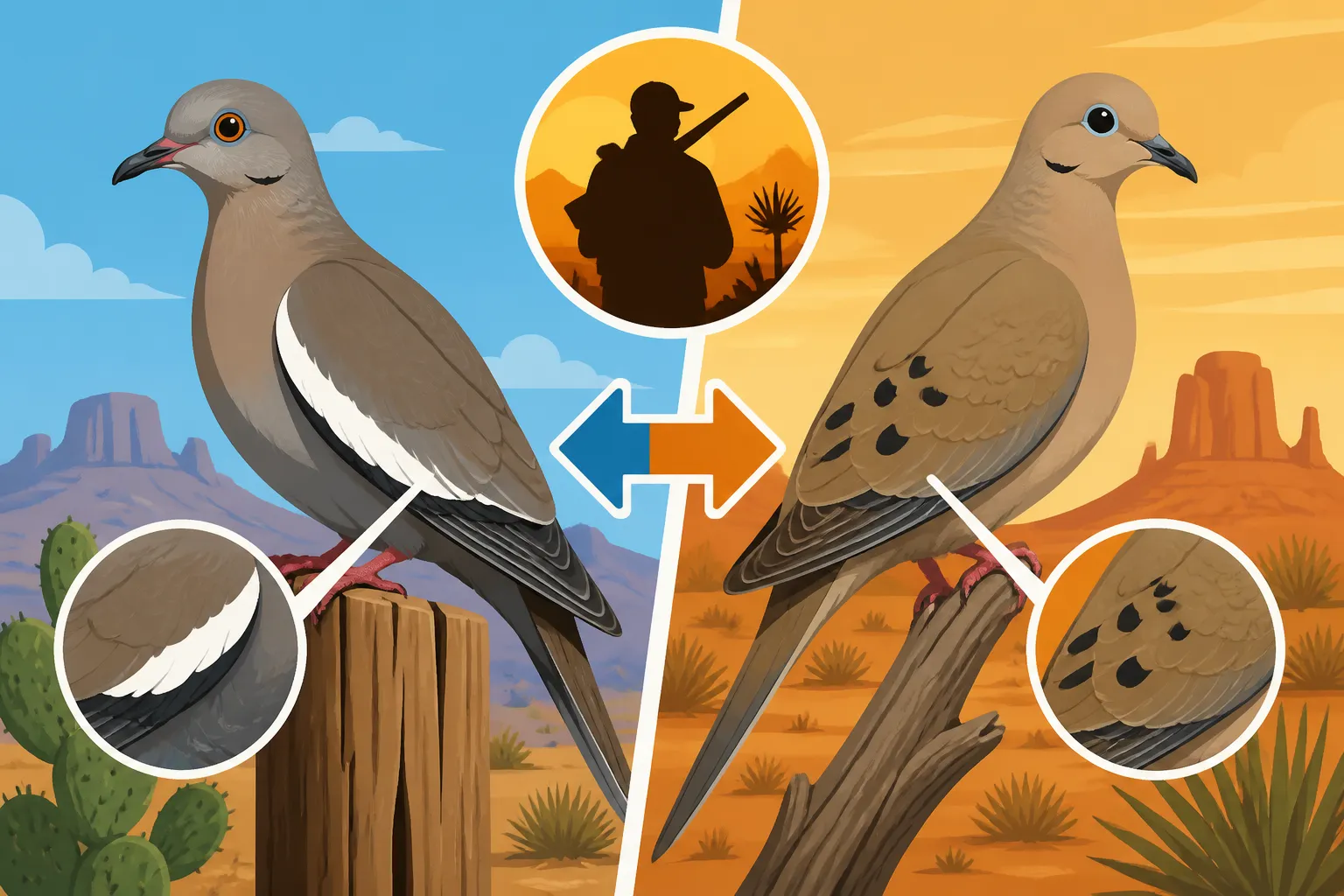
- White-Winged Dove: The clue is right in their name! These doves possess a prominent, bright white patch on the leading edge of their secondary flight feathers. When the bird flies, especially when it flares its wings to land or bank, this white patch becomes incredibly conspicuous, almost like a white "stripe" or "panel" on the wing. It's a bold, unmistakable mark against the otherwise darker gray of their wings and body. This white patch is present on both sexes and across all age classes, making it a reliable identifier. From a distance, even without fine detail, that flash of white on the wing is your primary signal.
- Mourning Dove: In contrast, the Mourning Dove lacks this distinct white wing patch entirely. Their wings are uniformly grayish-brown, perhaps with a scattering of small black spots on the coverts, but no large, bright white markings. Sometimes, the outer edge of their primary feathers might appear slightly lighter in certain lighting, but it will never be the bold, bright white panel you see on a White-Wing. When a Mourning Dove takes flight, its wings will appear consistently dark.
Training your eye to look for this wing patch first is a game-changer. It's often visible even at a fair distance, giving you precious seconds to make a positive identification before committing to a shot.
Tail Shape and Coloration
After the wings, the tail offers another excellent, often overlooked, means of identification. The shape and color patterns of the tail feathers are quite different once you know what to look for.
- White-Winged Dove: Their tail is typically shorter and more rounded or squared off at the end, appearing less pointed than a Mourning Dove's. Critically, the outer tail feathers have broad, white tips, which create a distinct white band across the end of the tail when spread in flight or landing. This white band is another very clear visual cue, especially as the bird approaches or flies away from you. The contrast between the dark inner tail feathers and the bright white tips of the outer feathers is quite striking.
- Mourning Dove: The Mourning Dove is famous for its long, tapered, and pointed tail. This "V"-shaped tail is a hallmark of the species. When spread, the outer tail feathers display white edges or margins, but they do not have the broad white tips or solid white band that a White-Winged Dove exhibits. The overall impression is a darker tail with fine white edging, not a bold white terminal band. When a Mourning Dove flies away, that long, pointed tail is often the last thing you see, giving it a distinctive silhouette.
Think of it this way: White-wings have a "white stripe" on their wings and a "white band" on their tail. Mourning Doves have a plain wing and a "pointed" tail with subtle white edges.
Body Color and Head Markings
While less obvious than wings and tails, paying attention to the overall body coloration and specific facial markings can provide additional confirmation, especially on birds that are sitting or flying closer.
- White-Winged Dove: These birds tend to have a slightly larger, stockier appearance than Mourning Doves, though this can be subjective in the field. Their body plumage is generally a pale gray to brownish-gray, with a distinctive iridescent greenish-purple sheen on the neck, particularly noticeable in good light. A very subtle, dark line often extends from just under the eye towards the back of the head, almost like a faint "eyeliner" mark, but it's not always prominent. Their eyes are red, and they often have a patch of bare, bluish skin around the eye, which can be visible up close.
- Mourning Dove: Mourning Doves are typically more slender and delicate-looking. Their overall plumage is a soft, muted grayish-brown on the back and wings, often with a subtle pinkish or buffy wash on the breast. This subtle coloration gives them excellent camouflage. A key head marking is the distinct small black spot on the lower cheek, just below the eye. This spot is usually quite noticeable and serves as a good identifier. Like the White-Wing, they have iridescent pinkish-purple patches on the neck, but their eye is dark, typically without the prominent bare skin patch around it.
These finer details might require a clearer view, perhaps when a bird is perched or gliding in for a landing. However, combining them with the wing and tail clues creates an undeniable picture for accurate identification.
Behavioral and Auditory Cues for Field Identification
Sometimes, a quick visual isn't enough, or the birds are simply too far to see detailed markings. This is where understanding their behavior and, critically, their vocalizations, becomes incredibly valuable. Doves are generally vocal birds, and their calls are quite distinctive once you learn to listen for them. Furthermore, their typical haunts and flight characteristics can give you a strong hint before you even raise your shotgun.
Think of it as adding layers to your identification process. First, you look for the big visual cues. If those aren't definitive, you listen, and you observe their general demeanor and preferred environment. This holistic approach significantly boosts your confidence in the field, helping you to correctly implement strategies, whether you're focusing on Hunting New Mexico's Two Back-to-Back Archery Deer Seasons or just filling your dove limit.
Distinctive Calls and Vocalizations
The calls of these two dove species are perhaps their most distinct differences, and learning them will instantly tell you who's around, even when you can't see them.
- White-Winged Dove: The White-Winged Dove has a characteristic hooting call that often sounds like "who cooks for you?" or "hoo-hoo-hoo-HOOO-hoo." It's a series of deep, drawn-out hoots, with the emphasis often on the third or fourth note. It’s a very robust and recognizable sound, especially common in the mornings and evenings from their roosts or feeding areas. If you're near a mesquite bosque or a field lined with cottonwoods in southern New Mexico, and you hear these resonant hoots, you can be almost certain you're within White-Wing territory.
- Mourning Dove: The Mourning Dove's call is a softer, more mournful cooing sound, hence their name. It typically consists of a series of "coo-OO-woo-woo-woo" notes. It's gentle, almost sorrowful, and lacks the deep hooting quality of the White-Wing. This call is incredibly familiar to most people, as Mourning Doves are ubiquitous across North America. If you hear that classic, sad cooing from your backyard to the furthest reaches of the desert, it’s a Mourning Dove.
Listening for these calls as you scout or sit in a blind provides an invaluable early warning system, letting you know which species you should be anticipating. It's like having an acoustic range finder for doves.
Flight Characteristics and Speed
While both doves are agile flyers, there are subtle differences in their flight patterns that can aid in identification, especially on birds commuting long distances.
- White-Winged Dove: White-Wings tend to have a slightly slower, deeper wingbeat than Mourning Doves. Their flight often appears more direct and purposeful, especially when flying between feeding grounds and roosts. They can certainly juke and dive, but their baseline flight trajectory is often more linear. That prominent white wing patch, as discussed, is a huge giveaway during any flight maneuver.
- Mourning Dove: Mourning Doves are known for their fast, sometimes erratic, and often noisy flight. Their wings produce a distinct whistling sound, especially on takeoff, which is a key auditory cue. Their flight path can be more darting and unpredictable, making them challenging targets. They often weave and dodge more frequently than White-Wings, particularly when startled.
These flight characteristics are more difficult to pick out definitively, but combined with other cues, they add to the overall picture. For instance, if you see a bird with a whistling flight and a pointed tail, you're looking at a Mourning Dove.
Preferred Habitats and Geographic Range in New Mexico
Understanding where each species typically thrives in New Mexico can narrow down your identification quickly, even before a bird appears.
- White-Winged Dove: In New Mexico, White-Wings are primarily found in the southern and western parts of the state. They love areas with mesquite bosques, cottonwood galleries along rivers like the Rio Grande, and agricultural lands (especially those growing corn, milo, or sunflower). You'll find them concentrating in riparian zones, pecan orchards, and often thriving in urban or suburban environments where food and water are plentiful. Their population centers are typically in the lower elevations.
- Mourning Dove: These doves are the undisputed champions of adaptability. You can find Mourning Doves practically everywhere in New Mexico – from the highest mountain ranges to the driest desert floors, in dense forests, open grasslands, suburban parks, and vast agricultural fields. They are far more widely distributed across the entire state compared to White-Wings.
So, if you're hunting elk up in the Hunting New Mexico From 4,000 Feet to 10,000 in the Gila National Forest, any dove you see is almost certainly a Mourning Dove. If you're on a dove shoot near Las Cruces, along the Rio Grande, or in the agricultural areas around Deming, you'll need to be especially vigilant for both species. Using mapping tools like those from GoHunt can help you identify these specific habitat types within your chosen units, giving you a scouting edge before you even arrive.
Practical Field Identification Tips for Dove Hunters
Okay, so you've got the knowledge. Now, how do you put it all together when the birds are breaking the horizon and you've got seconds to decide? Field identification is a skill, and like any skill, it gets better with practice. It involves quickly scanning for the most obvious features, cross-referencing with other clues, and making a judgment call. This isn't just about identifying a bird for a shot; it's about building confidence and becoming a more observant hunter.
When you're out there, remember the main priorities for New Mexico Dove Season Framework. Knowing what to expect in terms of season dates and potential limits helps you focus on the birds themselves rather than scrambling through regulations. Preparation is always key, whether you're targeting doves or planning for Hunting Oryx on a New Mexico White Sands Tag.
The "Flash" Method in Flight
This is your go-to strategy for fast-moving birds. When a dove flies past, your eyes should immediately snap to two primary areas: the wings and the tail.
- Look for the white wing patch: As the bird flaps, especially when it turns or banks, watch for that distinct, bright white flash on the leading edge of the wing. If you see it, it's a White-Winged Dove. If you don't, it's very likely a Mourning Dove. This is often the first and clearest identifier.
- Observe the tail shape and color: If the wing patch isn't clear, or if the bird is flying directly away from you, look at the tail. Is it long and pointed with subtle white edges (Mourning Dove)? Or is it shorter, more squared, and ends with a clear, broad white band (White-Winged Dove)?
Practicing this "flash" method, even without a gun, just by observing doves in your local area, will significantly improve your reaction time and accuracy in the field.
Listening Before Looking
Before you even see a bird, listen to the sounds of the environment. Are you hearing the mournful cooing of a Mourning Dove or the deeper hooting of a White-Winged Dove? This auditory clue can tell you which species is present in the area, allowing you to anticipate what you might see. If you're in a prime White-Wing area near a river, and you hear only Mourning Dove cooing, you might adjust your expectations for the day. Conversely, if White-Wing hoots are echoing through the pecan orchard, you know what to specifically look for. This can be particularly useful in dense cover where visual identification is delayed.
Sitting vs. Flying: Different Approaches
When doves are perched on power lines, trees, or the ground, identification becomes much easier. You have time to observe all the details: the black cheek spot of a Mourning Dove, the bluish eye-ring of a White-Wing, the subtle body coloration. Use these opportunities to study and reinforce your knowledge.
In flight, however, it's about rapid recognition. Focus on those bold, contrasting features: the white wing patch and the white tail band for the White-Wing, versus the plain wing and pointed tail of the Mourning Dove. Don't try to see every detail on a flying bird; home in on the two or three most reliable identifiers and make your call quickly. Using a good pair of binoculars to scout before the action heats up can also help you identify perched birds and get your eye tuned in.
Ultimately, consistent practice and an intentional approach to identification will make you a more skilled dove hunter. Every dove that flies by is an opportunity to practice, even if you don't take a shot.
Comparing White-Winged and Mourning Doves
To help put all this information into a concise, easily digestible format, here's a comparison table outlining the key differences between White-Winged Doves and Mourning Doves:
| Feature | White-Winged Dove | Mourning Dove |
|---|---|---|
| Wings (in flight) | Prominent, bright white patch on secondary feathers | Uniformly grayish-brown, no distinct white patch |
| Tail Shape | Shorter, more rounded/squared, broad white tips | Long, tapered, pointed; subtle white edges, not tips |
| Body Color | Pale gray/brownish-gray, often stockier look | Soft grayish-brown, often slenderer, pinkish wash on breast |
| Head Markings | Subtle dark line under eye, bare bluish skin around red eye | Distinct small black spot on lower cheek, dark eye |
| Vocalization | Deep, resonant hooting: "hoo-hoo-hoo-HOOO-hoo" | Soft, mournful cooing: "coo-OO-woo-woo-woo" |
| Flight Sound | Generally quiet | Distinctive whistling sound, especially on takeoff |
| Primary Habitat | Riparian corridors, agricultural fields, urban areas | Widespread: forests, grasslands, deserts, urban/suburban |
| New Mexico Range | Primarily southern and western, lower elevations | Statewide, highly adaptable |
By internalizing these distinctions, you'll be well on your way to confidently identifying every dove that crosses your path in the New Mexico skies.
Disclaimer
This article is for general informational purposes only and does not constitute professional advice. Laws, prices and regulations vary by location and change over time. Consult a qualified professional for guidance on your specific situation.