Spotlighting Rules for Predator Hunting
It can be incredibly frustrating to hear coyotes howling nearby, or see foxes darting across a field at night, knowing full well they're preying on local wildlife or even livestock, but feeling paralyzed by uncertainty about hunting regulations after dark. The rules around using artificial light for hunting, often called spotlighting, are a maze of specific allowances and strict prohibitions. This guide is here to untangle the confusion surrounding spotlighting for predator hunting in New Mexico, ensuring you understand exactly what you can and cannot do to pursue these challenging animals ethically and legally.
Understanding New Mexico's General Spotlighting Prohibition
Let's be upfront: New Mexico, like most states, has a deeply ingrained aversion to using artificial lights to hunt big game. This isn't just an arbitrary rule; it's rooted in long-standing principles of fair chase, public safety, and wildlife management. Many hunters mistakenly assume any use of a light at night is illegal, but the reality is more nuanced, especially when it comes to predators.
Why Spotlighting is Generally Illegal for Big Game
The primary reason for the general prohibition on spotlighting big game stems from the principle of fair chase. Hunting is meant to be a challenge, requiring skill, patience, and an understanding of animal behavior. Introducing powerful artificial lights at night gives the hunter an overwhelming advantage, disorienting animals and making them easy targets. It's seen as an unfair, unsportsmanlike method that goes against the spirit of hunting. Imagine a deer frozen in the beam of a spotlight; it offers little to no chance for the animal to escape, which undermines the challenge inherent in the hunt.
Beyond ethics, public safety is a massive concern. Firing a weapon into the darkness, even with a spotlight, presents enormous risks. You can't adequately see beyond your immediate target to ensure a safe backdrop. There could be roads, homes, other hunters, or even livestock behind your intended target, all invisible in the dark. This is why the New Mexico Department of Game and Fish (NMDGF) takes illegal spotlighting seriously. It’s not just about what you’re hunting, but how you’re doing it and the potential dangers it poses to everyone in the area.
The Legal Definition of Artificial Light and Spotlighting
In New Mexico, the law is quite clear about what constitutes "artificial light" in the context of hunting. This isn't just your big, handheld Q-beam spotlight. It encompasses any light not produced by natural means. We're talking about vehicle headlights, auxiliary off-road lights, handheld flashlights, headlamps, even the display screen on your phone if it's used to illuminate an animal. The intent behind using the light is what often determines legality. If you're using it to locate or take a big game animal, that's where you run into trouble.
The act of "spotlighting" specifically refers to casting the beam of a light on an animal with the intent to hunt, injure, or kill it. This applies to big game and protected species. The rules are designed to prevent hunters from using light to gain an unfair advantage or to simply "blind" an animal for an easy shot. While you might use a headlamp to navigate a trail back to camp after dark, shining that light on a deer you happen to encounter, and then attempting to harvest it, would put you squarely in violation of the law. Understanding this distinction is key to staying out of trouble, and it's always a good idea to consult the Where the Current New Mexico Regulations Are Posted before any hunt.
Specific Exceptions for Predator and Furbearer Hunting
Now, here's where the rules get interesting and often cause confusion for hunters. While spotlighting is broadly prohibited for big game, New Mexico recognizes the need for effective predator and furbearer management. These animals, particularly coyotes, can be incredibly destructive to livestock and other game populations, and they are largely nocturnal. To allow hunters to help manage these populations, specific exceptions are made for certain species.
Legal Hours and Methods for Predator Hunting at Night
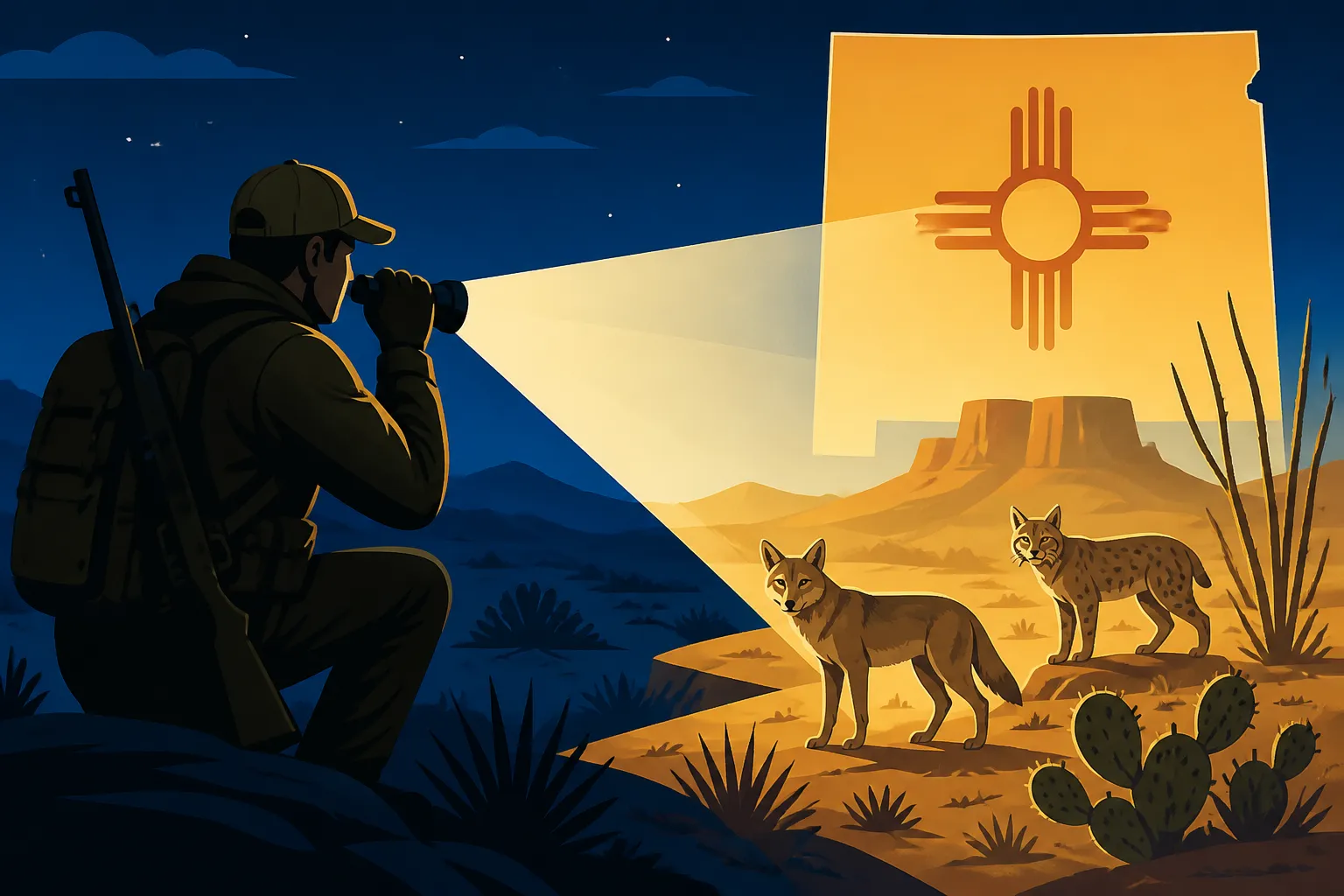
Good news for predator hunters: New Mexico does allow the use of artificial lights for hunting specific predators and furbearers at night. This exception is primarily for species like coyotes, bobcats, foxes, and raccoons. For these animals, you can use artificial light in conjunction with legal hunting methods during legal hunting seasons, or year-round in the case of coyotes. This means you can mount a powerful LED light bar on your UTV, use a handheld spotlight, or wear a headlamp to locate and engage these animals after dark.
The key here is knowing which animals are fair game under these rules. It's vital to be absolutely certain of your target before engaging. The NMDGF emphasizes that while you can use lights for certain predators, you still cannot use them to hunt big game, regardless of your intent when you turned on the light. The method is allowed, but only for certain species. For example, Hunting Coyotes Year Round in the Desert is a popular activity, and these spotlighting rules make it more accessible.
Safety and Ethical Considerations When Hunting at Night
Just because you can hunt predators with a light at night doesn't mean you can throw caution to the wind. Safety remains paramount, perhaps even more so when operating in the dark. Always, and I mean always, positively identify your target and ensure you have a safe backdrop beyond it. This means being able to see what's behind the animal you intend to shoot. A powerful spotlight can illuminate a coyote clearly, but it might not show you a fence line, a dwelling, or a road 100 yards past it.
Ethically, consider how your actions reflect on the hunting community. Even when it’s legal, reckless night hunting can draw negative attention and potentially lead to tighter regulations for everyone. Communicate your intentions if you're hunting near populated areas. A quick call to the local sheriff's office or even a neighbor to let them know you'll be out predator hunting can go a long way in preventing unnecessary alarm or complaints. Also, be acutely aware of your unit's specific boundaries and any local ordinances that might restrict light or noise, even if state law allows it. For general rules, you can often find details when Reading a New Mexico Hunt Code Before You Apply.
Navigating Public and Private Land Spotlighting Rules
The landscape of New Mexico is a patchwork of public and private lands, and understanding where you can and cannot use a spotlight for predators is just as important as knowing the state's general rules. Access can vary wildly, and what's allowed on one piece of ground might be strictly prohibited on another.
Spotlighting on New Mexico State Trust Land and BLM
New Mexico boasts vast tracts of public land, including State Trust Land and Bureau of Land Management (BLM) acreage. Generally, if the state allows spotlighting for predators, these rules apply on accessible State Trust Land and BLM lands. However, "accessible" is the operative word. While your New Mexico hunting license serves as an easement for general hunting access on State Trust Land, there are still specific New Mexico State Trust Land Access Rules to follow. You can't just drive anywhere. For BLM land, a The New Mexico Habitat Stamp for Federal Land might be required, and while the state rules for spotlighting predators generally apply, always be mindful of specific management area regulations. Some BLM areas might have seasonal closures or other restrictions that could impact night hunting.
It's crucial to consult detailed maps, like those offered by GoHunt or similar mapping services, to verify land ownership and access points. These tools can help you discern between State Trust, BLM, National Forest, and private parcels. Always remember that while the act of spotlighting predators might be legal on paper for these public lands, accessing them, or the method of travel you use, might still be restricted. For instance, Rules on Hunting From a Vehicle might restrict driving off established roads, which can impact how you deploy your lights.
Private Property Spotlighting and Landowner Permission
When it comes to private property, landowner permission is king, especially for night hunting. Even if state law permits spotlighting coyotes, you absolutely cannot do it on private land without explicit, usually written, permission from the landowner. This isn't just a courtesy; it's a legal requirement to prevent trespass charges. The NMDGF strongly advises obtaining Written Permission Requirements in New Mexico for any hunting activity on private land, and this is doubly true for night hunting which can be perceived as more intrusive.
Furthermore, local ordinances can sometimes add an extra layer of complexity. Even if a landowner gives you permission and state law is on your side, a county or municipal ordinance might have stricter rules regarding discharging firearms after dark or using powerful lights. Always check with local authorities if you're hunting close to a town or residential area. Having a signed agreement with the landowner that details the dates, times, and specific activities you'll be conducting (like night predator hunting with lights) can protect both you and the landowner from misunderstandings or legal issues.
Equipment and Best Practices for Night Predator Hunting
Success in night predator hunting, especially with lights, hinges on having the right gear and employing smart tactics. It’s not just about flipping on the brightest light you can find; it’s about strategic illumination and blending it with effective calling.
Choosing the Right Lighting Equipment
The world of night hunting lights has exploded in recent years. You're no longer limited to just a bulky handheld spotlight. Today's options include powerful LED light bars that can illuminate vast areas from a vehicle, compact weapon-mounted lights that integrate seamlessly with your firearm, and versatile headlamps for hands-free operation. Many hunters favor lights with green or red filters, as these colors are often less startling to animals and can help make their eyes glow, making them easier to spot. Some even swear by infrared (IR) lights paired with night vision devices, which offer an entirely different level of stealth, as the IR light is invisible to the naked eye.
Beyond traditional lights, thermal optics have become incredibly popular. While not technically "spotlighting" in the traditional sense, as they detect heat signatures rather than emitting visible light, they are often used in conjunction with active lights. A thermal scope allows you to scan an area for heat signatures, quickly identifying the presence of an animal, after which you might then use a visible light to confirm species identification before taking a shot. Each option has its pros and cons in terms of cost, range, and detection capabilities, so consider your typical hunting environment and budget carefully.
Integrating Calls and Decoys with Lights
Night predator hunting is rarely just about driving around with a light. It’s almost always a combination of calling and illumination. Electronic calls are highly effective for predators and are perfectly legal for these species in New Mexico. You can find more details on this in Electronic Calls for Predators and Varmint Hunting. The strategy often involves setting up in a good vantage point, deploying an electronic call (imitating distress cries, pup howls, or rodent squeals), and then, once you hear or see a response, carefully using your lights to pinpoint the animal.
Decoys can also play a crucial role. A simple motion decoy, like a rabbit twitching or a bird fluttering, can draw a predator's attention, giving you a fixed point to focus your light on. When a predator responds to a call, it's often looking for the source of the sound. Using a light to reveal a decoy first, rather than instantly blinding the animal, can sometimes buy you a few extra seconds for a clean shot. Positioning your light source slightly away from your shooting position can also make it harder for the predator to pinpoint your exact location, focusing its attention on the light itself or a decoy.
Avoiding Common Legal Pitfalls and Misunderstandings
Even with good intentions, it's easy to run afoul of the law if you're not diligent. Night hunting adds an extra layer of complexity, and the consequences for mistakes can be severe.
The Risk of Mistaking Non-Predators for Predators
This is perhaps the biggest and most critical pitfall in night predator hunting with lights: misidentification. In the dark, even under a powerful beam, discerning between a coyote and a deer, or a bobcat and a small bear cub, can be incredibly difficult, especially at a distance or in thick cover. The NMDGF cannot stress enough the importance of 100% positive identification before you pull the trigger. Mistaking a big game animal for a predator can lead to severe poaching charges, significant fines, license revocation, and the confiscation of your equipment.
Always take your time. If there's any doubt whatsoever, do not shoot. Scan the animal's entire body, observe its gait, and listen to any sounds it makes. Use good quality optics, and don't rely solely on the "eye shine" a light produces. That reflection might look similar across different species. This is where thermal optics, used for initial detection, can be a great asset, allowing you to see the animal's shape and movement before you introduce a visible light for final identification.
Consequences of Illegal Spotlighting
The penalties for illegal spotlighting, especially for big game, are no joke in New Mexico. You're looking at potential fines that can range from hundreds to thousands of dollars, mandatory court appearances, and the possible loss of your hunting privileges for an extended period, perhaps even permanently. Your firearms, optics, and even your vehicle might be confiscated. These are not minor infractions; they are serious offenses treated as poaching.
Even accidental violations, like shining a light on a deer while predator hunting, could draw the attention of game wardens. While intent plays a role in prosecution, simply having the means and opportunity to illegally spotlight big game can be enough to raise suspicions. Staying informed by regularly checking the Where the Current New Mexico Regulations Are Posted, perhaps using a resource like GoHunt's updated regulation summaries, and always erring on the side of caution is the best way to protect yourself and ensure you continue to enjoy the privilege of hunting in New Mexico.
| Scenario | Big Game (Deer, Elk, Antelope) | Predators (Coyote, Fox, Bobcat, Raccoon) | Key Considerations |
|---|---|---|---|
| Using Artificial Light to Locate/Take | ILLEGAL | LEGAL (with exceptions/conditions) | Fair chase, public safety. |
| Time of Day | Daylight hours only | Nighttime allowed | Strict adherence to legal hunting hours for big game. |
| On Public Land | ILLEGAL | LEGAL | Check specific unit/area regulations; access restrictions. |
| On Private Land | ILLEGAL | LEGAL | Absolute requirement for landowner permission. |
| Consequences of Violation | Severe fines, license revocation, equipment confiscation, poaching charges | Potential fines/citations for misidentification or trespass | Know your target, know your boundaries. |
Disclaimer
The information provided in this guide is for general informational purposes only and does not constitute legal advice. Hunting regulations are complex and subject to change. Always consult the most current New Mexico Department of Game and Fish regulations booklet or website before engaging in any hunting activity.