Bobwhite on the Eastern Grassland
For anyone who’s ever tried to find good bobwhite quail hunting in New Mexico, you know the frustration of looking at maps filled with vast open spaces and wondering where to even begin. Unlike the more common scaled or Gambel's quail you find in other parts of the state, Bobwhites have very specific habitat needs, making their presence a bit more localized and, frankly, a bit harder to pin down. This guide is all about peeling back the layers to help you understand where to find these elusive little rockets, what to expect when you get there, and how to make the most of your hunting efforts on New Mexico's eastern grasslands.
Understanding the Bobwhite Quail and Its Habitat in New Mexico
When you think of quail in New Mexico, your mind might first jump to the speedy Gambel's zipping through desert washes or the "cotton-top" scaled quail scattering in the scrub. But the Northern Bobwhite, with its distinctive "bob-white!" call, is a different bird entirely, and its presence in our state is largely confined to a specific, and often overlooked, ecological niche. If you're looking to broaden your experience beyond just hunting Scaled and Gambel's Quail in New Mexico, understanding the bobwhite's unique requirements is your first step.
Bobwhite Characteristics and Behavior
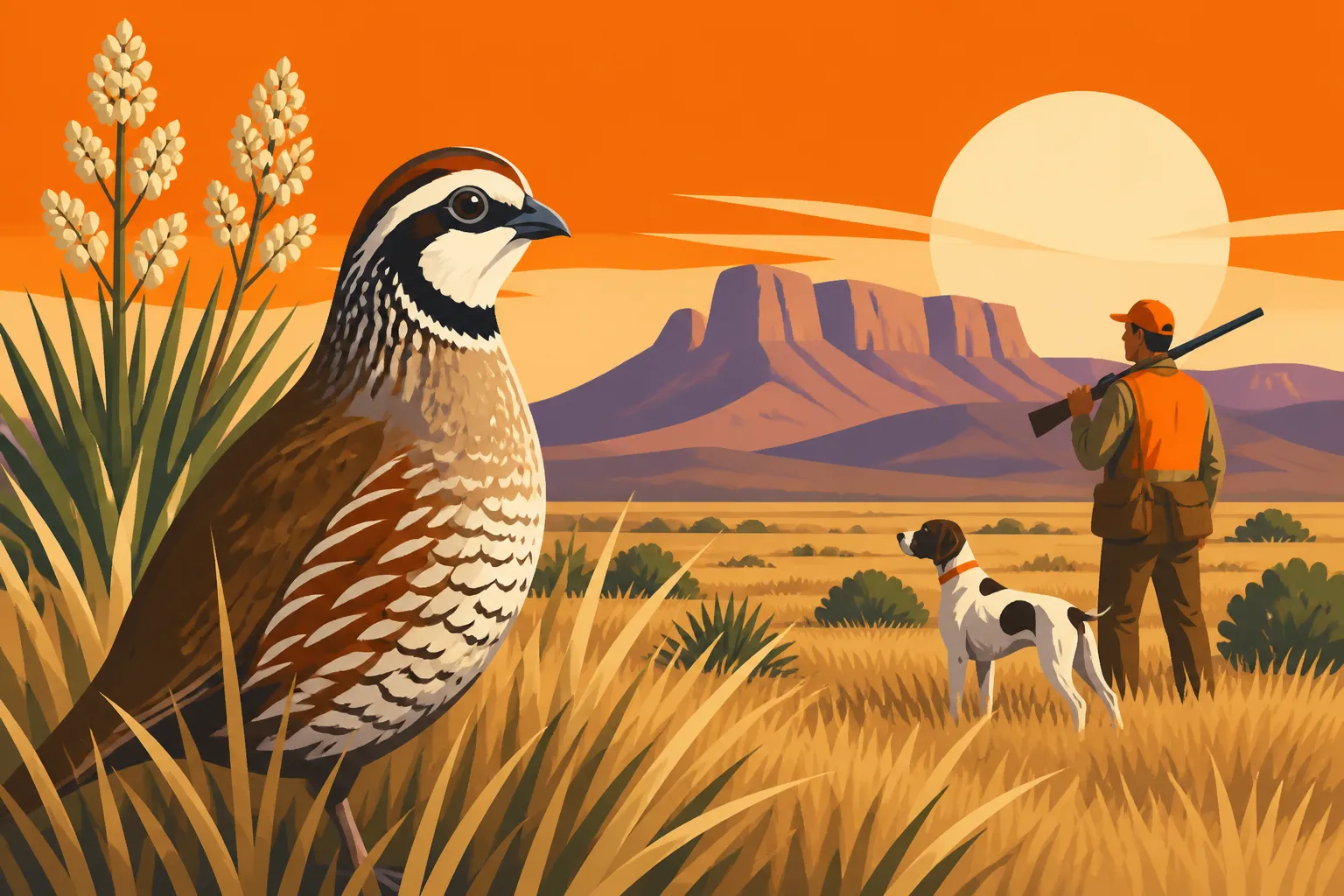
Northern Bobwhites are small, plump game birds, easily recognized by the male's distinct white throat and eye stripe, bordered by black. The females have a similar pattern, but with buffy brown colors instead of white. They prefer to run rather than fly when disturbed, making them a real challenge for hunters without good bird dogs. These birds are highly social, living in coveys that can range from a handful to twenty or more individuals, especially outside the breeding season. Their survival strategy hinges on this covey structure, providing more eyes for predators and communal warmth during colder nights. They are less tolerant of dry, arid conditions than their desert quail cousins, which is precisely why their range is so limited in New Mexico.
Their diet is primarily seeds, insects, and green vegetation, which dictates the type of habitat they absolutely require. Unlike the robust Gambel's that can survive on sparse desert fare, bobwhites need a consistent supply of small seeds and insects, especially during nesting and chick-rearing. This need for specific food sources, combined with adequate cover, is key to locating them.
Specific Eastern Plains Habitat
The eastern plains of New Mexico are a stark contrast to the rugged mountains and vast deserts that define much of the state. Here, you find a landscape characterized by rolling grasslands, agricultural fields, and riparian areas. This is where the Northern Bobwhite calls home. They thrive in areas where native grasses meet agricultural fields, particularly those planted with milo, wheat, or corn, which provide both food and escape cover. The mosaic of cultivated land, dense native grass clumps, and shinnery oak or mesquite thickets creates the perfect storm of habitat they need.
These areas, often found in units along the Texas border, receive just enough rainfall to support the dense, knee-high grass and brushy cover bobwhites depend on. Without this specific mix of thick cover for roosting and protection from predators, along with open ground for feeding, bobwhites simply won't survive. They need those dense grass patches to huddle in on cold nights and to hide their nests during the spring. This kind of habitat is far removed from the rocky, arid terrain you might encounter when hunting New Mexico from 4,000 feet to 10,000. It's a completely different world out there, demanding a different approach and a different set of expectations.
Key Eastern Grassland Units for Bobwhite Quail
Finding bobwhites isn't just about driving east and hoping for the best; it’s about understanding the specific units and areas where their preferred habitat truly shines. New Mexico is a vast state, and while its eastern plains might seem homogenous at first glance, there are distinct differences in land management, vegetation, and rainfall that create hotspots for these unique birds. Knowing where to focus your efforts can save you days of fruitless searching.
Identifying Prime Bobwhite Areas
The most consistent bobwhite populations are typically found in the extreme eastern counties of New Mexico, often hugging the Texas border. Units like Unit 36, Unit 37, Unit 38, and Unit 40 are historically strong contenders, particularly in areas near Clovis, Portales, and Tatum. These units benefit from a combination of agriculture (which provides critical winter food sources), extensive grasslands, and often, small pockets of shinnery oak or other brushy cover.
What makes these areas prime? It’s the balance. You need enough agricultural activity to draw birds in during colder months, but also enough undisturbed native grassland and brush to offer nesting sites and year-round sanctuary. Areas along drainages or playas, even if dry for much of the year, can also hold birds if they support denser vegetation. Keep an eye out for shelterbelts and fence lines grown thick with weeds and brush—these are often travel corridors and refuges for coveys. Using tools like GoHunt's mapping features can be incredibly helpful for E-Scouting a New Mexico Unit Before the Season, allowing you to identify these habitat mosaics from the comfort of your home before you even hit the road.
Accessing Public and Private Lands
New Mexico offers a mix of public and private land, and navigating this patchwork is crucial for bobwhite hunters. Much of the truly prime bobwhite habitat on the eastern plains often lies on private agricultural land. Gaining access to these private parcels can significantly increase your success rates. Don't be shy about knocking on doors well in advance of the season, respectfully asking for permission. Farmers and ranchers are often amenable, especially if you emphasize responsible hunting practices and offer to share some of your harvest.
However, there is still public access available. New Mexico holds over 30 million acres of public hunting land, and while large tracts of Bureau of Land Management (BLM) and State Trust Land exist on the eastern plains, they might not always offer the ideal bobwhite habitat found on adjacent private farms. State Trust Land, in particular, requires only a valid hunting license to access, effectively making your New Mexico license your State Trust Land easement. While these public lands might require more legwork to find birds, they do offer opportunities for the persistent hunter. Always cross-reference your maps with land ownership layers, like those provided by GoHunt, to ensure you're on legal ground and respect all boundaries.
| Unit Number | Primary Habitat Type | Typical Cover | Common Land Ownership | Notes |
|---|---|---|---|---|
| Unit 36 | Cropland, Grassland | Grass, Mesquite | Private, State Trust | Good potential, often requires private access. |
| Unit 37 | Grassland, Agriculture | Grass, Shinnery Oak | Private, State Trust | Strong bobwhite numbers, especially near agricultural fields. |
| Unit 38 | Grassland, Cropland | Grass, Brushy Draws | Private, BLM | Potential for both bobwhite and scaled quail in mixed areas. |
| Unit 40 | Grassland, Agriculture | Grass, Brush | Private, State Trust | Another solid unit, focus on edges of cultivation. |
| Unit 39 | Mixed Grassland | Grass, Yucca | BLM, Private | More arid, better for scaled quail, but bobwhites can be found in isolated pockets. |
This table provides a quick overview, but remember that conditions can change rapidly based on rainfall and agricultural practices from year to year.
Hunting Strategies for New Mexico Bobwhite Quail
Hunting bobwhite quail on the eastern plains is a distinct experience that demands specific strategies. Forget the long-range glassing of antelope or the arduous climbs for elk. This is an intimate hunt, often relying heavily on canine partners and quick reflexes. Success often boils down to patience, understanding bird behavior, and being prepared for fast action.
Dog Work and Flushing
A good bird dog is, without a doubt, the single most important asset for bobwhite hunting. These birds are notorious for holding tight in cover, making them nearly impossible to locate without a dog’s nose. Pointers, setters, and flushers like English Springer Spaniels or Brittany Spaniels excel in this environment. The dog’s job is to systematically cover ground, locate the scent of a covey, and then either point definitively or flush the birds into the air.
When a dog goes on point, hunters need to move in quickly and strategically. Surround the point if possible, or approach from a direction that puts the sun at your back. Bobwhites will typically erupt in a flurry, often scattering in multiple directions. This moment is pure chaos and exhilaration, demanding quick target acquisition. Be ready for that explosion, pick a bird, and swing through. If you miss on the initial flush, mark where the birds land. Often, singles will hold much tighter than the original covey, offering a second chance to work your dog and potentially harvest more birds. Remember, managing heat on an early season hunt is crucial for your dog, so bring plenty of water and plan for breaks.
Calling and Locating Coveys
While dog work is paramount, understanding bobwhite calls can also significantly aid your efforts, especially if you’re trying to locate coveys without a dog or want to confirm their presence in an area you’re scouting. The most iconic call is the "bob-white!" whistle, typically made by the male during the breeding season. However, there are also assembly calls and alarm calls.
A locator call, such as a hawk shriek or even a simple whistle mimicking the bobwhite's call, can sometimes provoke a response from a covey, giving away their location. This is particularly effective in the early mornings or late evenings when birds are most vocal. Be patient, call softly at first, and listen intently. While not as critical as calling for larger game like bugling bulls through New Mexico's mid-September rut, it can provide just enough information to point you and your dog in the right direction, especially in large tracts of seemingly empty grassland.
Shot Placement and Follow-Up
Bobwhites are small, fast targets, and quick, decisive shooting is key. For shotguns, a 20-gauge or 12-gauge with an improved cylinder or modified choke is generally ideal. Load up with #7.5 or #8 shot. The goal is to put enough pellets on the bird without over-patterning and destroying the meat. When a covey flushes, resist the urge to just blast into the brown blur. Pick a single bird, swing through it, and pull the trigger.
Crucially, always mark where birds fall, and be prepared for a quick follow-up shot if a bird is winged. A wounded bird can quickly become lost in the dense cover, which is not only unethical but also a wasted opportunity. Many experienced hunters advocate for a two-shot strategy on the initial flush: one shot for the first bird, and then quickly picking a second bird if opportunity allows. This requires practice and a calm demeanor under pressure, but it’s how many successful hunters fill their vests. After the initial shots, make sure your dog is trained to retrieve promptly, minimizing lost birds.
Essential Gear and Preparation for Bobwhite Hunts
Hunting bobwhite quail in New Mexico’s eastern grasslands, while not as physically demanding as an elk hunt in the Gila, still requires proper gear and preparation. The environment can be unforgiving, with thorny brush, deceptive terrain, and variable weather. Being well-equipped ensures comfort, safety, and ultimately, a more enjoyable and successful hunt.
Shotguns and Ammunition
For bobwhite quail, your choice of shotgun is important for quick, efficient shooting. A lightweight over-and-under, side-by-side, or semi-automatic shotgun in 20-gauge or 12-gauge is typically preferred. The lighter gauges are easier to carry all day and swing quickly. Opt for a barrel length between 26 and 28 inches for a good balance of maneuverability and swing. An improved cylinder or modified choke is usually perfect for the typical flushing distances of bobwhites.
When it comes to ammunition, #7.5 or #8 lead shot is the standard. These smaller pellets provide a dense pattern, which is ideal for small, fast-moving birds, ensuring clean kills without excessive meat damage. Carry plenty of shells, as covey flushes often present multiple shooting opportunities, and you might find yourself taking more shots than anticipated. A good shell belt or vest with easy access to your ammunition is invaluable.
Clothing and Footwear
Clothing needs to be durable, protective, and breathable. The eastern plains, even in fall and winter, can have warm afternoons, but mornings can be chilly. Layering is always a good strategy. Look for brush pants or chaps made of tough material like briar-proof canvas or Cordura, as you'll be pushing through dense shinnery oak and thorny brush. A good hunting vest with large game pockets for harvested birds and shell loops is essential. Blaze orange is often a good idea, not just for safety around other hunters (though not always legally required for archery hunting, it's wise for bird hunting), but it can also make you more visible to your hunting partners.
Footwear is equally critical. You'll be walking many miles over varied terrain, including uneven ground, grass clumps, and possibly sandy areas. Comfortable, supportive, and durable boots are a must. Look for something that offers good ankle support and is waterproof, even if the forecast is dry. Choosing boots for rocky desert ground might seem applicable, but here, comfort for long walks on softer, sometimes thorny ground is more important. Consider a lighter hiking boot over a heavy mountain boot.
Navigation and Safety
Even on seemingly flat plains, it's easy to get disoriented, especially when following dogs or chasing scattered birds. A reliable GPS device or a smartphone app like GoHunt with offline maps is crucial. Download your unit maps and land ownership layers before you head out, especially if you’re relying on your phone, as cell service can be spotty in remote areas. Knowing how to read a land ownership layer correctly will prevent accidental trespassing, which is key when hunting the patchwork of public and private lands.
Beyond navigation, safety includes carrying plenty of water – perhaps more than you think you need, especially on warmer days. Water you must carry on a desert day hunt applies equally here. A basic first-aid kit for both yourself and your dog is also a good idea. Snake awareness on a September archery hunt is also relevant here, as rattlesnakes can still be active during early quail seasons. Inform a friend or family member of your hunting plans and expected return time. A whistle can be useful for communicating with your dog or other hunters if you get separated.
Conservation and Regulations Affecting Bobwhite Quail
Successful bobwhite hunting isn't just about bagging birds; it's also deeply tied to understanding and respecting the regulations in place and the broader conservation efforts that sustain these populations. The New Mexico Department of Game and Fish (NMDGF) manages bobwhite populations through seasons, bag limits, and habitat initiatives, all influenced by environmental factors like drought.
Season Dates and Bag Limits
New Mexico's quail season usually opens in early November and runs through mid-February. For specific dates, always check the current New Mexico Rules and Info Booklet or the official NMDGF website. The daily bag limit for bobwhite quail is generally 15 birds, with a possession limit of 30. This is typically combined with other quail species, so if you're hunting in areas where bobwhites overlap with scaled quail, your combined bag would be 15. Being aware of these limits and respecting them is fundamental to ethical hunting. Reading a New Mexico hunt code before you apply and understanding what the letters in a New Mexico hunt code mean can also clarify any specific regulations for particular areas or hunt types, though quail hunts are usually straightforward.
Remember that regulations can change annually, so always confirm the most current information before heading afield. It’s also important to understand that these season dates are chosen to balance hunter opportunity with the biological needs of the birds, ensuring sufficient time for breeding and protecting populations during vulnerable periods.
Habitat Management and Drought Impact
Bobwhite quail populations are notoriously cyclical, heavily influenced by rainfall and habitat conditions. Good spring and summer rains mean abundant insect populations for chicks and lush vegetation for cover and seeds, leading to strong hatches and higher bird numbers. Conversely, prolonged drought can devastate bobwhite populations. How drought affects desert deer numbers applies to quail as well; lack of water and forage directly impacts reproduction and survival.
NMDGF, often in partnership with private landowners and conservation groups like Quail Forever, works on habitat management projects that benefit bobwhites. These efforts might include prescribed burning to rejuvenate grasslands, planting native cover crops, or managing grazing to improve vegetation structure. As hunters, supporting these organizations and adhering to conservation practices—like not overharvesting in lean years and advocating for good habitat stewardship—is vital. Understanding these dynamics helps us appreciate that a successful hunt isn't just about our skill, but also about the health of the ecosystem and the careful management of the resource.
Disclaimer
Please remember that hunting regulations and conditions can change. Always consult the official New Mexico Department of Game and Fish regulations booklet for the current season before planning any hunt. This guide is for informational purposes only and should not replace official state resources.