Firearm Safety Expectations From Your Guide
When you sign up for a guided hunt in New Mexico, you're investing in an experience, hopefully a successful one, but above all, a safe one. Many hunters, especially those new to guided trips or traveling to unfamiliar terrain, often wonder what their guide will expect from them regarding firearm handling and safety. This guide will walk you through the core firearm safety expectations your New Mexico hunting guide will have, ensuring you're prepared for a smooth and secure adventure in the field.
Why Firearm Safety Is Non-Negotiable on a Guided Hunt
Hunting is an inherently hands-on activity, and when firearms are involved, safety moves from being a suggestion to an absolute mandate. Guides operate under immense pressure to ensure the well-being of their clients, themselves, and the public. They know that one lapse in judgment can have catastrophic consequences, which is why they will be incredibly strict about firearm safety protocols from the moment you meet.
The Guide's Ultimate Responsibility for Your Well-being
Think of your guide as the captain of a small ship. They are legally and ethically responsible for everyone on board. In the context of a hunt, this means they are constantly assessing risks, managing movement, and, most importantly, overseeing how firearms are handled. They are trained professionals who understand the terrain, the animals, and the dynamics of hunting with a client. Their experience often means they've seen situations that could go wrong and have learned how to prevent them. This isn't about control; it's about minimizing risk in a high-stakes environment. They need to trust that you will adhere to their instructions without question, even if it feels overly cautious at times. This trust is the bedrock of a successful and safe hunt.
For instance, if you're stalking a mule deer through rocky, broken terrain in the Sacramento Mountains, your guide might insist on a specific carry method or even that you unload your rifle before navigating a tricky climb. This isn't to impede your hunt but to prevent a fall from turning into an accidental discharge. They are always thinking several steps ahead, anticipating potential hazards that you, as a visitor to this landscape, might not even perceive. Many clients find their guides through platforms like BookYourHunt, and these services often vet their outfitters for their commitment to safety and professionalism.
Your Integral Role in a Safe Hunting Experience
While your guide shoulders the primary responsibility, you are not merely a passenger. Your active participation in maintaining firearm safety is crucial. This means listening intently to instructions, asking questions if you're unsure, and consistently applying the universal rules of gun safety. It's about being proactive, not reactive. For example, when you stop for a break, your guide shouldn't have to remind you to point your muzzle in a safe direction. That should be second nature.
Your guide will quickly assess your comfort level and familiarity with your firearm. Don't be shy about admitting if you're new to a certain type of action or if you have any concerns. Transparency fosters trust. If you've recently completed The New Mexico Hunter Education Requirement, those principles should be fresh in your mind. The guide isn't there to babysit but to lead and ensure that everyone contributes to a secure environment. A client who is attentive and demonstrates a solid understanding of firearm safety instills confidence in their guide, which in turn allows the guide to focus more on finding game and less on potential hazards.
Navigating New Mexico's Diverse and Challenging Landscapes Safely
New Mexico's hunting grounds are incredibly varied, from the dense timber and steep canyons of the Gila to the wide-open plains of the eastern part of the state, and the rugged, rocky ranges where you might be Hunting Barbary Sheep in New Mexico Canyon Country. Each environment presents its own unique set of safety challenges that guides are intimately familiar with.
Consider a hunt in the high country for elk, where you might be navigating fallen timber, steep inclines, and dense underbrush. A slip could mean a rifle muzzle ends up pointed at a hunting partner. Conversely, hunting pronghorn on the plains often involves more vehicle use and quick exits, requiring careful attention to muzzle direction when getting in and out of a truck. Your guide will adapt their safety instructions to the specific terrain and situation. For example, Rules on Hunting From a Vehicle are critical here, as are the protocols for quickly exiting a truck to make a stalk or set up a shot. The changing elevation, cover, and visibility mean that what's safe in one area might be dangerous in another. A good guide will constantly be reinforcing these adaptations to ensure every step, climb, and shot is taken with safety as the top priority.
Foundational Firearm Safety Principles Your Guide Will Emphasize
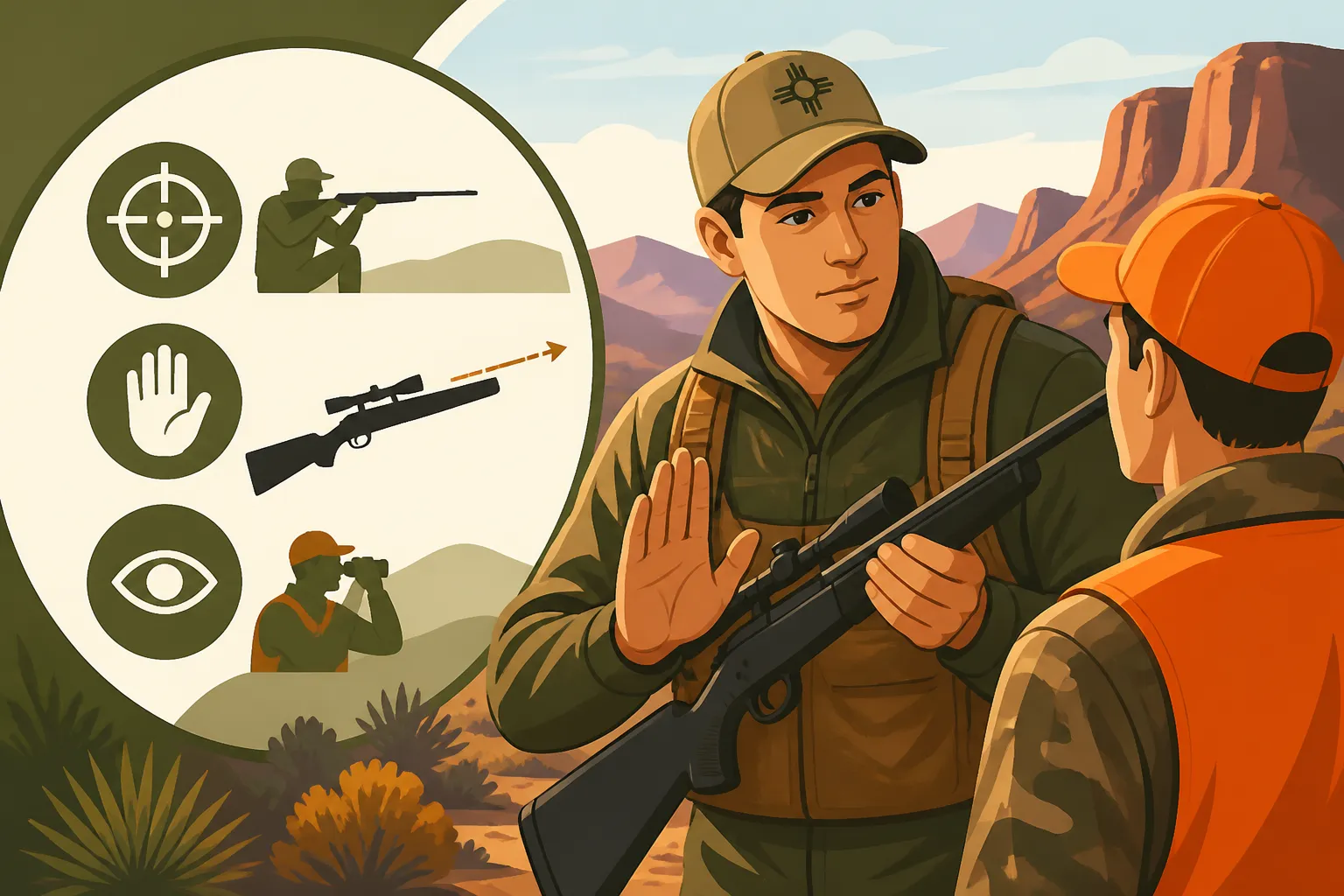
Every reputable hunting guide will expect you to adhere to the core tenets of firearm safety, often referred to as the four cardinal rules. These aren't just suggestions; they are the bedrock of preventing accidents in the field. Your guide will likely reiterate these principles and expect them to be second nature.
The Four Cardinal Rules in the Field
You've probably heard these before, but they bear repeating, especially in the context of a guided hunt where multiple people are moving together:
- Treat every firearm as if it were loaded. This is perhaps the most fundamental rule. Even if you're certain your rifle is unloaded, act as if it's chambered and ready to fire. This mindset prevents complacency. Your guide will appreciate this approach, as it means you're always thinking about muzzle direction and trigger discipline.
- Always point the muzzle in a safe direction. A "safe direction" means a direction where an accidental discharge would cause no injury or damage. This can change rapidly depending on the terrain, your position relative to others, and what's in front of or behind you. When walking, it usually means up or down, never sweeping across your partners. When sitting, it means pointing away from others, towards the ground or sky, or if in a vehicle, securely racked and pointed away from occupants.
- Be sure of your target and what is beyond it. In the excitement of a hunt, it can be easy to focus solely on the animal. Your guide will demand that you take a moment to confirm not just the species and sex of the animal, but also that there are no other animals, people, or structures behind your target. This is especially vital in open country where a bullet can travel for miles. This also ties into Rifle Zero Distance for Canyon Country, understanding how your bullet will perform at various ranges and elevations.
- Keep your finger off the trigger until your sights are on the target and you're ready to shoot. This is the essence of trigger discipline. Your finger should rest outside the trigger guard until the very moment you've made the decision to shoot and have confirmed your target. Fumbling with a safety or just carrying your finger inside the guard is a recipe for disaster, particularly in cold weather with numb hands or during a tense, quick-action encounter.
Understanding When and Where to Load and Unload
This is where a guide's direct instruction will be key. They will often dictate when your firearm should be loaded and unloaded based on the specific circumstances. Typically, rifles will remain unloaded until you are actively beginning a stalk or are in an area where an animal might be encountered, often not until you've left the vehicle. Conversely, they will expect you to unload your firearm immediately upon returning to camp, before entering a vehicle, or when navigating particularly tricky terrain like crossing a fence or climbing into a tree stand (if applicable).
A common practice is to keep the magazine loaded but the chamber empty, only racking a round when game is spotted and a shot opportunity is imminent. Your guide will communicate their preference, and it's essential to follow it. This prevents loaded firearms from being handled unnecessarily in camp or during transport. They might ask to visually confirm your weapon is clear. Don't take offense; they're just doing their job to ensure everyone's safety.
Communicating Clearly About Firearm Status
In the field, clear communication is a lifesaver. Your guide will expect you to verbally confirm the status of your firearm when asked, or proactively when entering or exiting a situation. Simple phrases like "Rifle clear," "Unloaded and safe," or "Loaded, chamber empty" are standard. If you are ever unsure about the status of your firearm, always say so and ask your guide for clarification or assistance. Never assume.
For example, if you finish a morning hunt and are heading back to the truck, your guide might say, "Everyone clear?" and you should respond with "Rifle clear" or "Unloaded." This call-and-response ensures everyone is on the same page. This level of communication is vital, especially when dealing with the unpredictable nature of wild game or difficult terrain. It’s part of the general expectation of What Guides Expect From Their Clients, where clear, concise communication enhances safety and efficiency. Hunting with a guide means constant awareness, and transparent communication about weapon status is a significant part of that.
Real-World Applications: Firearm Handling in Various Hunting Situations
Knowing the rules is one thing; applying them consistently in the dynamic environment of a hunt is another. Your guide will observe how you handle your firearm in various situations and will correct you if your actions pose a risk. These practical scenarios are where your safety habits truly shine.
Safely Moving With Firearms: From Truck to Trail
The moment you leave your vehicle, your guide will be watching how you carry your rifle. In New Mexico, especially in units where you might cover considerable ground, you'll be walking, climbing, and sometimes even crawling. Your guide will expect you to choose a carry method that keeps the muzzle pointed in a safe direction at all times, even if you stumble. This often means a sling carry with the muzzle pointed up or down, or carrying it in the crook of your arm, ensuring it never sweeps across another person.
When you transition from walking to climbing over obstacles, or navigating thick brush, they might instruct you to pause, clear your chamber, or even pass your rifle to them if it’s safer. They're also assessing your grip and overall control. A guide wants to see a client who is deliberate and confident with their firearm, not someone who is struggling or making jerky movements. This also applies to situations like Playing Thermals on a Canyon Stalk, where quiet, controlled movement is essential, and a carelessly handled rifle could be a distraction or a danger. Similarly, when using an outfitter, it’s often their horse or mule strings that provide access to backcountry. They’ll have strict rules about how firearms are handled when mounted, typically unloaded and in scabbards.
Positioning for the Shot and Field of Fire Awareness
When an animal is spotted and it's time to prepare for a shot, the situation can become very exciting, but this is precisely when safety protocols are most critical. Your guide will direct your movements, telling you where to set up for a shot. They'll expect you to move slowly, deliberately, and always with awareness of where your muzzle is pointing. Your guide will also be acutely aware of the "field of fire"—the area where your bullet could potentially travel.
Before you even raise your rifle, they’ll have assessed the background and confirmed it's safe. Once you are in position, they will expect you to keep your rifle pointed at the ground or sky until the final moment, only bringing it to bear on the target when you are ready to acquire your sights and make the shot. They will often confirm the shot is "clear" before giving you the go-ahead. Never override your guide's decision on a shot opportunity; if they say "no," it's for a good reason, usually safety-related. This is also where understanding your weapon's capabilities, like using the Best All-Around Caliber for Gila Elk, comes into play, as proper shot placement is a safety factor.
The Critical Moments: Shot Execution and Follow-Up
The moment of truth arrives when you've lined up your shot. Your guide will expect you to be calm, focused, and apply the rules of trigger discipline. They want a clean, ethical shot that puts the animal down quickly. After the shot, the rifle typically remains shouldered and aimed at the animal, ready for a quick follow-up. This is where How Outfitters Handle a Wounded Animal becomes critical.
If the animal doesn't go down immediately, your guide will likely instruct you to fire again, or they might even take a shot themselves if they are also armed and have a safe line of fire. It's crucial not to unload your rifle prematurely. Keep it ready, safety on, but prepared for another shot until the guide confirms the animal is down for good. Once the animal is clearly deceased and the adrenaline starts to subside, then, and only then, will your guide expect you to clear your rifle and make it safe. The time between the first shot and confirming the animal is down is still an active hunting scenario, and your firearm should be treated as such.
Post-Harvest Protocols and What to Expect
Congratulations, you've successfully harvested an animal! The hunt isn't over yet, and neither are the safety expectations. The guide will have specific protocols for securing your firearm and handling it during the field dressing and transport process.
Securing Your Firearm After the Shot
Once your guide confirms the animal is down and it's safe to approach, their next instruction will usually be to secure your firearm. This means clearing the chamber, engaging the safety, and ensuring the weapon is unloaded. They might even ask to see the empty chamber. This prevents any accidental discharge during the subsequent field dressing, photography, and celebrations.
Often, the rifle will then be placed securely away from the immediate area where you'll be working on the animal. This keeps it out of the dirt, prevents accidental contact, and ensures it's not forgotten. Your guide needs to focus on field dressing and getting the animal prepared, and they shouldn't have to worry about the security of your weapon. This is a moment of high emotion, but it's essential to remain disciplined and follow these instructions carefully. Many hunters search on GoHunt to plan their adventures, and reputable outfitters found there will always prioritize safety, even after the shot is fired.
Transporting a Harvested Animal and Your Weapon
Getting a harvested animal out of the field, especially a large one like an elk from the Gila backcountry, is hard work. Whether you're packing it out on foot, by horse, or with a vehicle, your firearm needs to be handled safely. In most cases, it will be unloaded, broken down if possible, and stored in a soft case or scabbard for transport.
If you're hiking out, your guide will advise on the safest way to carry your now-unloaded rifle, often slung over your shoulder or backpack, ensuring the muzzle is pointed in a safe direction and it won't interfere with your movements. If horses are involved, it will go into a rifle scabbard, often muzzle-down for safety. When loading into a truck or ATV, the firearm will be unloaded and secured in a designated spot, never simply tossed into the bed or back seat. This is not just about safety but also protecting your valuable equipment from damage. This is a key aspect of managing logistics after a successful hunt, and guides are experienced in it.
Addressing Concerns or Unfamiliar Situations
During your hunt, if you ever feel uncomfortable with a situation, have a question about firearm handling, or are unsure of what to do, always speak up. A good guide would much rather you ask a "silly" question than have you act in a way that creates a safety risk. This could be anything from "How do you want me to carry my rifle through this section?" to "Is it safe to cross this fence with a loaded rifle?"
Guides are professionals, and they are there to help. They are accustomed to working with hunters of varying experience levels. Open communication about safety concerns is always encouraged and is a sign of a responsible hunter. Remember, your guide's priority is your safety and the safety of everyone on the trip. Don't hesitate to voice your thoughts, it's a critical part of maintaining a secure and enjoyable hunting experience for all involved. This proactive approach is exactly what a guide is looking for in a client, especially regarding something as serious as firearm safety.
Disclaimer
This article is for general informational purposes only and does not constitute professional advice. Laws, prices and regulations vary by location and change over time. Consult a qualified professional for guidance on your specific situation.