Optics Power for New Mexico’s Open Country
The vastness of New Mexico’s hunting country can be both exhilarating and daunting. You've probably experienced it: squinting into a distant canyon, wondering if that tiny speck is a rock, a stump, or the trophy bull you've been dreaming of. It’s a frustrating scenario that highlights one undeniable truth: without the right optics, you're essentially hunting blind. This guide is all about demystifying optics power, helping you choose and utilize the right binoculars, spotting scopes, and rifle scopes to effectively hunt the Land of Enchantment's expansive landscapes.
The Unforgiving Demands of New Mexico’s Varied Terrain
New Mexico is a land of extremes, from the high, timbered peaks of the Sangre de Cristos to the sweeping, arid plains of the eastern side, and the rugged, broken rimrock of the southern deserts. Each of these environments presents unique challenges for hunters, but one constant remains: the need to see clearly, often at incredible distances. You're not always going to be still hunting dense timber where shots are measured in yards; more often, you’ll be glassing vast basins or endless plains, trying to pick apart terrain that can swallow game animals whole.
Understanding Long-Range Observation Needs
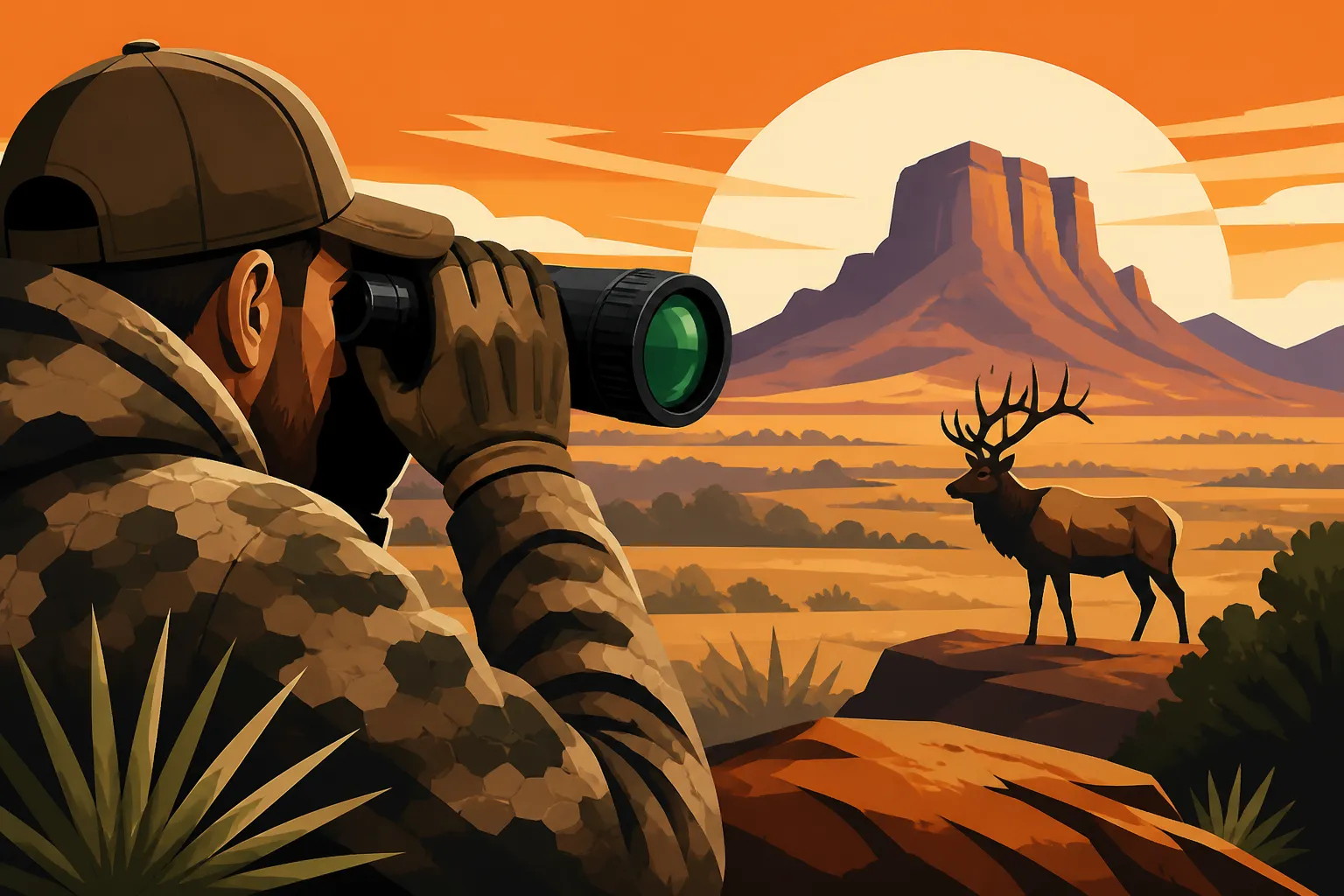
Think about glassing an enormous canyon in the Gila National Forest. You might be looking at a hillside a mile or more away, trying to discern the flick of an ear or the subtle horizontal line of a bedded mule deer in a sea of vertical trees and shadows. Or picture yourself on the open grasslands of eastern New Mexico, scanning for pronghorn that appear as tiny dots on the horizon. These aren't conditions where a cheap pair of 8x binoculars will cut it for serious trophy hunting. You need to identify game, and then, critically, you need to judge that game. Is that mule deer a fork horn or a mature 4×4? Is that elk a raghorn or a bull worth putting a stalk on? Without sufficient magnification and clarity, you're left guessing, and guessing in hunting usually leads to disappointment.
The Challenge of Detail and Resolution
The problem isn't just seeing something; it's seeing enough. You need resolution. You need to be able to pick out antler points, assess body size, and judge the overall quality of an animal before committing to a grueling, hours-long stalk. This is especially true for species like Coues deer in the southern ranges, where a small body size and often distant observations make judging a quality buck a true test of your glass. Many hunters have made the mistake of hiking miles only to realize the "trophy" they spotted was actually a smaller animal or, worse, a juniper bush. The clear air and bright sunlight of New Mexico can play tricks on your eyes, making distant objects seem closer or larger, and it takes good glass to cut through that optical illusion. Understanding Judging a Coues Buck in Southern New Mexico without clear optics is incredibly difficult, often leading to wasted effort.
Binoculars: Your Essential Scouting and Spotting Tool
When it comes to covering ground with your eyes and locating game, binoculars are your first and most frequently used tool. They’re lighter than spotting scopes, quicker to deploy, and offer a wider field of view, making them perfect for initial scans and navigating broken terrain. However, the sheer vastness of New Mexico often pushes the limits of what standard binoculars can do, making power choices critical.
Common Magnifications and Their Sweet Spots
For general purpose hunting in varying terrain, 8×42 or 10×42 binoculars are the workhorses. An 8x magnification offers a wide field of view and is incredibly steady to hold freehand, making it great for dense timber or tracking moving animals at closer ranges. The 10x magnification provides a bit more reach, which is often crucial in New Mexico's more open areas, without a significant penalty in stability or field of view. Many hunters find the 10×42 to be the best all-around choice. However, as you move into truly open country, even 10x can feel limiting.
When you start to explore bigger country, like the wide-open basins of Unit 17 or the high desert plains, you’ll often find yourself wanting more power. This is where options like 12×50 or even 15×56 binoculars truly shine. They allow you to pick apart distant hillsides with much greater detail, identifying game much earlier. The downside, of course, is that higher magnification amplifies hand shake, narrows your field of view, and increases the weight and bulk you have to carry. But for dedicated glassing across canyons and prairies, that extra reach can be absolutely invaluable. Knowing Binocular Size That Survives an All-Day Session is key for comfort and effectiveness.
When to Reach for Higher Power Binoculars
If your hunting style involves a lot of "boots on the ground" and relatively close-range encounters, an 8x or 10x might be perfect. But if you're the type of hunter who loves to climb a high vantage point and systematically pick apart vast areas of public land, often in units known for expansive views like those for pronghorn on the eastern plains or mule deer in the more open desert units, then leaning into 12x or 15x binoculars is a game-changer. These higher-power binos essentially bridge the gap between your standard 10x and a full-blown spotting scope. They allow you to effectively "pre-scout" an area, identifying potential game and even getting a preliminary read on their size before you even consider setting up a spotting scope. This saves immense time and energy.
The trade-off is often weight and the need for stabilization. A 15×56 binocular is a substantial piece of gear, and holding it steady for extended periods will make your arms burn. This is precisely why a good bino harness is essential, not just for carrying the weight comfortably, but also for providing a bit of stability against your chest. For truly long sessions, a tripod adapter and a lightweight tripod are almost mandatory for these higher-power optics.
Stabilizing Your Binoculars for Clarity
Holding binoculars steady, especially those with 12x or 15x magnification, can be a real struggle, leading to image shake that negates the benefits of higher power. This is where good technique and the right accessories come into play. Always try to brace yourself against something solid – a tree, a rock, your knees, or even lying prone with your elbows propped. A quality bino harness will distribute the weight and keep them secure against your chest, reducing bounce and making them readily accessible. Brands like FHF Gear or Kuiu offer excellent harnesses that integrate seamlessly into your kit.
For serious, extended glassing sessions, a tripod adapter for your binoculars is non-negotiable. This simple accessory allows you to mount your binos directly onto a lightweight tripod, instantly eliminating shake and allowing you to meticulously Grid Glassing a Basin Without Missing Bucks without fatigue. When you're trying to pick out the subtle twitch of an ear on a bedded animal a mile away, that rock-solid stability makes all the difference. Many hunters overlook the importance of stability, but it's arguably as important as the glass quality itself, particularly when you're maximizing your optics power for New Mexico's open country.
Spotting Scopes: The Long-Range Detail Extractor
While binoculars are your bread and butter for initial scanning, a spotting scope is the ultimate tool for evaluating game at extreme distances. In New Mexico, where legal shooting distances can sometimes push beyond what's comfortable for a rifle scope, having a spotting scope to confirm details and make ethical decisions is paramount. It's the difference between a speculative stalk and a confident, well-planned approach.
Variable Power for Maximum Versatility
Most modern spotting scopes are variable power, offering a range like 15-45x, 20-60x, or even 27-80x. This versatility is incredibly useful in New Mexico. You might start at the lower magnification to get a wider field of view and locate an animal, then crank up the power to meticulously examine antler size, horn length, or body condition. A 20-60x spotting scope is a popular choice for all-around Western hunting, providing a good balance of magnification, brightness, and portability. For extremely long-range observation, especially in very open units known for big mule deer or pronghorn, an 80mm or larger objective lens with higher magnification (like 27-80x) will give you that critical edge in low light or across vast distances. When considering Spotting Scope Power for Open Country, remember that more power often means a heavier, bulkier scope.
Fixed Power for Brightness and Simplicity
While less common these days, fixed-power spotting scopes do exist, typically in magnifications like 30x or 40x. Their main advantage lies in their simplicity and often superior optical brightness and edge-to-edge clarity compared to variable power scopes of similar quality. This is because fixed-power designs have fewer moving parts and can be optimized for a specific magnification. However, the lack of versatility to zoom in or out makes them a niche choice for most New Mexico hunters who face a wide array of distances and observation needs. They might be favored by birdwatchers or very specialized long-range shooters who know exactly what magnification they need for a specific task, but for general hunting, variable power is almost always preferred for the adaptable demands of the landscape.
Tripods and Heads: The Unsung Heroes of Spotting Scopes
A spotting scope without a stable tripod and a good head is almost useless. Period. You could have the most expensive, clearest glass on the market, but if it's jiggling around, you won't be able to discern anything useful. This is why investing in a quality tripod and fluid head is just as important, if not more important, than the spotting scope itself. Look for tripods that are sturdy enough to handle the weight of your scope without wobbling, yet light enough to pack into the backcountry. Carbon fiber models are excellent for balancing strength and weight. Brands like Manfrotto, Gitzo, or smaller hunting-specific brands like Sirui or Outdoorsman Tripod Systems offer excellent options.
The head is equally crucial. A fluid head, often used by videographers, allows for smooth, precise adjustments and panning, which is vital when following a moving animal or methodically grid glassing. Ball heads can be quicker to adjust but less precise for fine movements. Don't skimp here; a wobbly setup will ruin your long-range observation capabilities every time. Learning Tripod Setup for Glassing From a Ridge will drastically improve your effectiveness.
Digiscoping for Documentation and Sharing
In an age where everyone carries a powerful camera in their pocket, digiscoping – attaching your smartphone or a small camera to your spotting scope – has become incredibly popular. It allows you to capture high-magnification photos and videos of distant animals, which can be invaluable for documenting your hunt, getting a second opinion from a friend, or simply reliving the memory later. Many manufacturers offer dedicated digiscoping adapters for their scopes, making the process relatively easy.
While not strictly about optics power, digiscoping extends the utility of your spotting scope far beyond mere observation. Imagine capturing clear footage of a huge elk bugling in the distance, or a magnificent mule deer feeding unaware. This ability to not just see, but record those incredible moments, adds another layer of enjoyment and practicality to your hunting experience in New Mexico's wild places.
Rifle Scopes: Precision for the Ethical Shot
Once you’ve located and stalked your game, your rifle scope is the final piece of the optics puzzle, ensuring you can place a precise, ethical shot. The vastness of New Mexico often means longer shot opportunities than many hunters are accustomed to, making scope selection a critical component of success.
Variable Power for Diverse Shot Opportunities
Just like binoculars and spotting scopes, variable power is king for rifle scopes in New Mexico. A 3-9×40 is a classic, versatile choice that works well in many situations, offering a wide field of view at lower magnifications for close shots in timber and enough power for most open country shots out to 300-400 yards. However, with the increasing prevalence of longer-range shooting in areas like the eastern plains or expansive desert units, many hunters are opting for scopes with a higher top end, such as 4-16x, 4.5-27x, or even 6-24x.
These higher-magnification scopes give you the ability to zoom in and place your reticle with extreme precision on smaller targets at greater distances. It’s important to remember that more magnification isn't always better. At very high powers, you'll experience a reduced field of view and increased sensitivity to mirage, which can make a shot harder to execute. You need to find a balance that suits your typical hunting environment and personal shooting capabilities. For hunting Elk Quality Inside Unit 16A where shots can be long, more magnification can be beneficial, but not at the expense of field of view at closer ranges.
Understanding Objective Lens Size and Light Gathering
The objective lens, the front lens of your scope, determines how much light enters the scope. A larger objective lens generally means a brighter image, especially in low light conditions like dawn and dusk when game is most active. Common sizes range from 40mm to 56mm. A 50mm or 56mm objective can provide a noticeable advantage in those critical low-light hours, helping you maximize the New Mexico Legal Shooting Hours for Big Game.
However, there's a trade-off. Larger objective lenses mean a heavier, bulkier scope that sits higher on your rifle, potentially affecting cheek weld and rifle balance. For a lightweight backcountry rifle, a 40mm or 44mm objective might be a better choice to keep the overall weight down. The exit pupil (objective lens diameter divided by magnification) is what ultimately dictates perceived brightness, so a 56mm objective at 20x might not be as bright as a 42mm objective at 8x. Consider your hunting conditions; if most of your hunting is in bright daylight, a smaller objective is perfectly fine.
First Focal Plane vs. Second Focal Plane
This is a detail that often confuses newer hunters, but it’s critical for effective long-range shooting with a reticle that offers holdovers (like dots or hashes).
| Feature | Second Focal Plane (SFP) | First Focal Plane (FFP) |
|---|---|---|
| Reticle Size | Appears the same size at all magnifications. | Grows and shrinks with magnification. |
| Holdover Accuracy | Accurate at one specific magnification (usually highest). | Accurate at any magnification setting. |
| Cost | Generally less expensive. | Generally more expensive. |
| Best Use | Dialing for shots, close to mid-range hunting. | Quick holdover shots at varying magnifications, long-range precision. |
In an SFP scope, the reticle stays the same size regardless of the magnification setting. This means that any subtension markings on your reticle (for bullet drop compensation or windage holds) are only accurate at one specific magnification, usually the highest power. If you change magnification, your holdovers become incorrect unless you compensate or dial for elevation and wind. SFP scopes are generally less expensive and simpler, and they work perfectly fine if you plan to dial for your shots or only use them at max magnification.
In an FFP scope, the reticle grows and shrinks proportionally with the magnification. This means that the subtension markings on your reticle remain accurate at any magnification setting. This is a huge advantage for quick holdover shots, especially when hunting dynamic situations where you might not have time to dial or adjust your magnification to a specific setting. FFP scopes tend to be more expensive but offer greater versatility for advanced shooting techniques, which can be invaluable when you're Holding for Wind Across a Deep Canyon or trying to make a quick correction for bullet drop. For most hunters who primarily shoot at known distances and dial their scope, an SFP scope is perfectly adequate. But for those looking to push the boundaries of their effective range or who prefer to use their reticle for holdovers across varying magnifications, an FFP scope is a superior choice.
Making Your Choice: Balancing Power, Field of View, and Weight
Choosing the right optics for New Mexico hunting isn't just about picking the highest power; it's a careful balancing act. You need to consider how you hunt, the specific species you're after, the terrain you'll encounter, and your physical capabilities. There's no single "best" setup, but there is a "best" setup for you.
The Trade-off: Magnification vs. Field of View
It’s a fundamental optical principle: as you increase magnification, your field of view (the width of the area you can see through the optic) decreases. This is a critical consideration in hunting. While high magnification is fantastic for picking apart a distant hillside, a narrow field of view can make it incredibly difficult to locate an animal initially, especially if it's moving or in dense cover. Imagine trying to find a running elk at 15x magnification in thick timber—it's nearly impossible.
This is why many experienced hunters employ a multi-optic approach: lower power binoculars (8x or 10x) for wide-area scanning and quickly locating animals, then transitioning to higher power binoculars (12x or 15x) or a spotting scope for detailed evaluation. Your rifle scope, while offering variable power, should primarily be used to acquire a clear sight picture on the target you’ve already located and judged. For example, if you're Hunting New Mexico's Two Back-to-Back Archery Deer Seasons, you might value a wider field of view for quick target acquisition over extreme magnification.
Weight and Bulk: Every Ounce Counts in the Backcountry
New Mexico offers some incredible backcountry hunting opportunities, particularly in the Gila and Aldo Leopold Wilderness areas. If you plan on packing in miles, every ounce of gear counts. Heavy, high-power optics can add significant bulk and fatigue to an already strenuous hunt. A large objective spotting scope or a massive rifle scope might offer incredible optical performance, but if it's sitting in your truck because it's too heavy to carry, it's useless.
When you're comparing options, consider the total weight of your optics setup: binoculars, spotting scope, tripod, and rifle scope. Sometimes, a slightly less powerful, but significantly lighter, piece of glass is the better choice because you'll actually carry it and use it. Modern optics are getting lighter, with manufacturers using advanced materials like carbon fiber and magnesium alloys, but physics still dictates that bigger glass means more weight. For example, when you're Preparing Physically for a High Elevation Hunt, a lighter setup can make a huge difference.
Budget and Glass Quality
Let's be real: optics can be expensive. From entry-level models to top-tier European glass, the price range is vast. And generally, you get what you pay for when it comes to optical clarity, light transmission, and durability. However, "expensive" doesn't always mean "best for you." A mid-range optic from a reputable brand like Vortex, Leupold, or Maven can offer exceptional performance for most hunters without breaking the bank.
Instead of chasing the absolute highest power, consider investing in the best quality glass you can afford within your chosen magnification range. High-quality glass at 10x will often outperform lower-quality glass at 15x, especially in challenging light conditions. It’s also crucial to remember that good glass is an investment that will last for decades. Read reviews, compare specifications, and if possible, try out different optics in real-world conditions before making a purchase. You can even use resources like GoHunt to research gear reviews and compare different brands to find the best value for your budget.
Practical Tips for Optimizing Your Optics in the Field
Having the right optics is only half the battle; knowing how to use them effectively in the field is where true mastery comes in. New Mexico's diverse environments demand more than just pointing and looking. These tips will help you maximize your glassing time and improve your chances of spotting game.
Mastering the Art of Glassing
Glassing is an acquired skill, and it's far more than just casually sweeping your binoculars across a landscape. It's a methodical, disciplined process. Find a comfortable, stable position—ideally sitting or lying down, braced against something solid. Start by dividing the landscape into smaller, manageable grids. Don't rush. Slowly, meticulously, scan each section, looking for anything that seems "out of place." A horizontal line in a vertical world, a patch of different color, a subtle movement, or a shadow that doesn't quite fit. Then, move to the next section.
One common mistake is scanning too quickly or too broadly. Take your time. Spend minutes on a single grid square if it looks promising. Use your binoculars to identify a larger area, then switch to your spotting scope to pick apart details. Always scan from near to far, and from bottom to top on hillsides. When looking into deep canyons, remember that Reading Wind in a Deep Gila Canyon can help you predict animal movement, which in turn helps you focus your glassing efforts.
Protecting Your Investment
Your optics are precision instruments, and they're often exposed to harsh conditions in New Mexico—dust, dirt, rain, snow, and the occasional bump or fall. Protecting them is crucial for their longevity and performance. Always use lens caps when not actively glassing. Invest in a quality bino harness and a padded case for your spotting scope to prevent scratches and dings.
Keep a lens cleaning kit with you at all times. This should include a soft lens brush to remove dust particles without scratching, a lens cleaning solution, and a microfiber cloth. Never use your shirt or an abrasive cloth to wipe lenses, as this can permanently damage the coatings. Clean your optics gently but regularly, especially after dusty or wet days. A little preventative maintenance goes a long way in ensuring your expensive glass stays clear and functional for years to come.
Training Your Eyes and Practicing With Your Gear
Just like shooting, glassing is a skill that improves with practice. Don't wait until opening day to dust off your optics. Spend time throughout the year practicing with your binoculars and spotting scope. Head to a local park or open space and practice identifying distant objects. Learn to quickly adjust focus, manage your field of view, and transition between binoculars and a spotting scope smoothly.
Practice setting up your tripod quickly and stably. Get comfortable with the weight and ergonomics of your gear. The more familiar you are with your optics, the more efficiently and effectively you'll use them when it truly counts. Moreover, training your eyes to spot game involves more than just seeing; it's about recognizing patterns, understanding animal behavior, and anticipating where animals might be. Using tools like GoHunt for e-scouting helps you understand the topography before you even set foot in the field, allowing you to visualize likely game locations and practice your glassing strategy. Understanding E-Scouting a New Mexico Unit Before the Season can give you a significant advantage. Even when you're planning your hunt by Reading a New Mexico Hunt Code Before You Apply, considering the terrain from satellite imagery can inform your optics choices.
Disclaimer
Always consult the most current New Mexico Department of Game and Fish regulations before planning any hunting trip, as rules and requirements can change. This guide provides general information and recommendations, but it is the hunter's responsibility to adhere to all applicable laws and regulations.