Spotting Scope Power for Open Country
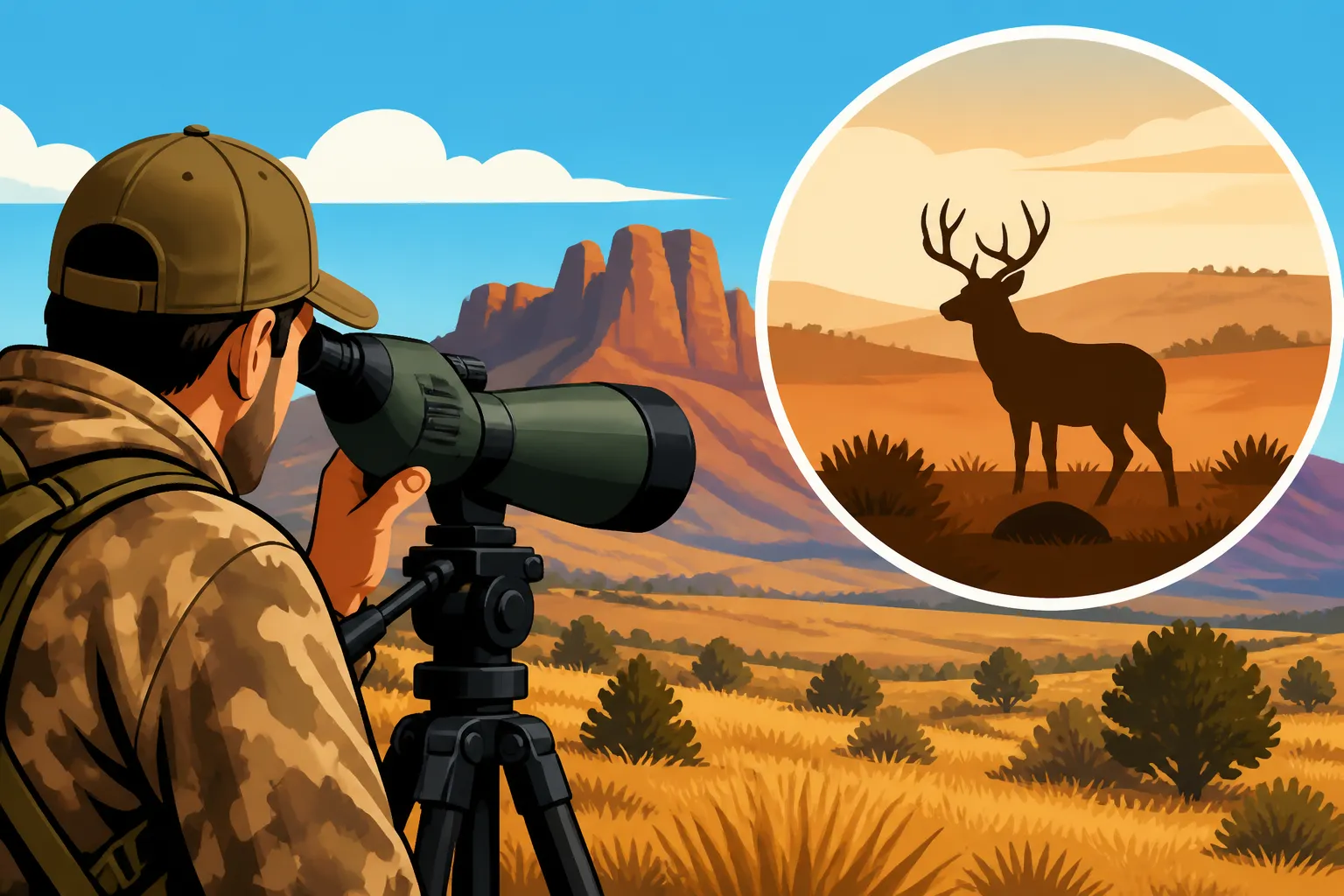
There's nothing quite like the immense, breathtaking vistas of New Mexico's open country, but those same vast landscapes can be incredibly frustrating when you're trying to locate a distant buck or bull. That tiny speck you caught out of the corner of your eye could be a trophy animal or just another rock, and without the right optics, you're left guessing, burning precious daylight, and often, burning your boots. This guide is all about demystifying spotting scope power, helping you choose the perfect magnification to conquer those expansive New Mexico units and turn those distant specks into clear, identifiable game animals.
The Critical Role of Spotting Scopes in New Mexico's Open Country
New Mexico isn't known for dense, timbered forests where you might only need binoculars. Instead, you're often staring across miles of desert flats, rolling foothills, or high mountain basins. In these environments, your ability to efficiently locate and evaluate game from a distance is paramount, and a spotting scope is your most powerful tool. It's not just about seeing further; it's about seeing clearer at those extended ranges, allowing you to make informed decisions without constant, energy-sapping stalks.
Why Magnification Matters for Western Hunting
Imagine you're on a high ridge overlooking a vast basin in the Gila National Forest, or maybe you're scanning the endless plains of eastern New Mexico for pronghorn. Your binoculars, even a good 10x or 12x pair, will show you a lot of terrain, but they'll often fall short when it comes to resolving critical details on an animal miles away. This is where the sheer magnification of a spotting scope comes into its own. We're talking about powers that can jump from 20x all the way up to 60x or even 80x, bringing distant objects into striking clarity.
This magnification is crucial for several reasons. First, it allows you to definitively confirm whether that distant object is indeed an animal. There's nothing worse than hiking two miles only to realize you've been stalking a juniper bush. Second, once you've identified an animal, high magnification is indispensable for field judging. You need to count antler points, assess mass, determine spread, and check for any unique characteristics that make a buck or bull a shooter. Trying to do this with just binoculars in New Mexico's challenging light and vast distances is often a fool's errand. It's the difference between guessing and knowing, saving you countless hours and miles.
Navigating Vast Landscapes and Distant Game
Hunting in New Mexico often involves covering immense amounts of ground with your eyes before you ever move your feet. Whether you're targeting desert mule deer in the southern units or trophy elk in the high country, the animals often blend seamlessly into their surroundings. They've evolved to disappear, and it's your job to un-disappear them. A spotting scope, when used correctly, becomes an extension of your eyes, allowing you to dissect distant hillsides and canyon bottoms with precision.
The ability to methodically glass a basin without missing bucks or bulls is a skill that takes practice, and a good spotting scope makes that practice far more productive. Think about those wide-open areas where a mule deer might be bedded under a solitary mesquite or an oryx could be standing against the backdrop of White Sands. A spotting scope lets you pick apart every shadow, every cluster of rocks, and every patch of scrub, revealing details that would otherwise be invisible. It’s not just about finding game, but finding quality game, reducing the need for speculative stalks and increasing your odds of a successful and ethical harvest.
Understanding Spotting Scope Power Ranges
When you start looking at spotting scopes, you'll quickly notice numbers like "20-60×80" or "15-45×65." These numbers represent the magnification range and the objective lens diameter. Understanding what these mean and how they affect your view is fundamental to choosing the right tool for your New Mexico adventures. It's not just about bigger numbers; it's about finding the right balance for clarity and usability in the field.
Fixed Magnification vs. Zoom Scopes
For hunters, the vast majority of spotting scopes you'll encounter are zoom scopes, offering a variable range of magnification. A 20-60x scope, for instance, allows you to smoothly adjust from 20-power up to 60-power. This versatility is incredibly valuable in the field. You might start at 20x to quickly scan a wide area, get a general idea of movement, or pick up a distant animal. Once you spot something intriguing, you can then crank up the power to 40x or 60x to closely examine it, count points, or assess its size.
Fixed magnification scopes, while offering potentially brighter and sharper images at their singular power due to fewer optical compromises, are generally less practical for hunting. The dynamic nature of hunting, where game can appear at varying distances and in different types of cover, demands the flexibility that a zoom scope provides. In New Mexico's diverse terrain, from the dense timber pockets that dot the high country to the wide-open desert floors, being able to adjust your magnification on the fly is a game-changer. For example, you might use 20x to spot a herd of elk in an open meadow, but then zoom to 60x to identify the herd bull tucked away in the trees at the far edge.
Common Magnification Ranges and Their Applications
Let's break down the typical magnification ranges you'll see on the market and how they apply to hunting New Mexico's unique landscapes:
-
15-45x (or 12-40x): This range is often found in more compact, lightweight spotting scopes. While not offering the extreme reach of higher powers, scopes in this range are excellent for areas where distances aren't quite as extreme, or where portability is a primary concern. If you're hunting slightly broken country, say, in parts of the Cibola National Forest where shots might be 300-600 yards and you're mostly confirming species and basic antler configuration, this power range can be very effective. It offers a wider field of view at its lower settings, making it easier to acquire targets, and still provides enough punch to identify details at moderate distances. A hunter who prioritizes a light pack for an extended backcountry trip might opt for this.
-
20-60x (or 22-65x): This is arguably the most popular and versatile range for Western big game hunting, and for good reason. It hits a sweet spot, offering enough magnification to resolve fine details on distant animals, while still providing a usable field of view and manageable light transmission. For most of New Mexico's open country hunting – whether you're trying to judge an elk in the Gila, a mule deer across a wide canyon, or a pronghorn on the plains – a 20-60x scope is an excellent choice. The 60x end is powerful enough to tell if a specific point is broken or if a brow tine is legal for a specific hunt code from a mile or more away, which is critical when you're glassing from a distant ridge using tools like the GoHunt app to understand the unit's topography. The lower 20x setting is perfect for initial sweeps.
-
25-75x (or 30-90x): These higher-power scopes push the boundaries of magnification. They are ideal for hunters who consistently operate in extremely open, vast country where game can be spotted at truly incredible distances, such as hunting oryx on the White Sands Missile Range or scouting vast desert ranges for barbary sheep. The trade-off, however, is often a narrower field of view, increased sensitivity to atmospheric conditions (like heat shimmer), and a larger, heavier instrument. At maximum magnification, image quality can also degrade slightly, and they demand an exceptionally stable tripod. While the extra reach can be invaluable for pinpointing specific features on a ram perched two miles away, for everyday Western hunting, the 20-60x range often provides a better balance of power, clarity, and ease of use.
Finding the Right Power for Your New Mexico Hunt
Choosing the right spotting scope isn't just about picking the highest power you can afford. It's a nuanced decision that balances magnification with other crucial optical properties and the specific demands of your hunting style and the New Mexico terrain you'll be navigating. There are always trade-offs, and understanding them helps you make an informed choice that will serve you best in the field.
Balancing Power, Field of View, and Image Quality
When you dial up the magnification on a spotting scope, several things happen simultaneously. You see the object larger, but your field of view (how much area you see through the scope) shrinks. This can make it harder to find and track animals, especially if they are moving. Additionally, higher magnification often means a dimmer image because the light gathered by the objective lens is spread over a larger area. Atmospheric conditions, like heat shimmer or mirage, also become much more pronounced at higher powers, causing the image to blur or waver.
Image quality is also paramount. A 60x image that's blurry or has poor color rendition is far less useful than a sharp, clear 40x image. High-quality glass (like ED or HD glass) and advanced lens coatings are essential for maintaining image brightness, contrast, and true color fidelity across the magnification range. Brands like Swarovski, Kowa, and Vortex offer excellent optical performance that makes a real difference in challenging light conditions, such as during those crucial first and last hours of legal shooting light.
Therefore, the "right" power isn't necessarily the highest power. It's the maximum power at which you can consistently achieve a clear, usable image for judging game, given the conditions you hunt in and the quality of your optics. It’s a delicate balance, and often, a slightly lower, clearer image beats a higher, fuzzier one every time. When you're glassing in harsh desert sun, or during the dusty, windy conditions common in New Mexico, these factors become even more critical.
Terrain-Specific Power Recommendations
New Mexico's diverse geography demands a thoughtful approach to spotting scope power. What works best in one area might be overkill or underkill in another.
-
High Mountain Wilderness (e.g., Gila, Aldo Leopold, Carson National Forest): For these expansive, broken, and often timbered high-country units, a versatile 20-60x80mm (or similar objective lens size) scope is typically ideal. The ability to zoom from 20x to scan large bowls and distant ridgelines for elk and mule deer, then crank it up to 60x to pick apart timber edges or judge a bull bedded a mile away, is invaluable. The larger 80mm objective lens will gather more light, which is a huge advantage in the deep shadows of canyons or early morning/late evening. When you're reading wind in a deep Gila canyon, you need maximum clarity to confirm an animal's position before making your move. For the best performance, pair this with a sturdy tripod.
-
Open Plains and Rolling Foothills (e.g., Eastern Plains for Pronghorn, parts of northern New Mexico for Mule Deer): In these truly wide-open areas where game might be spotted at extreme distances (2-3+ miles), a higher power might seem tempting. However, the atmospheric conditions (heat shimmer, dust) often limit the effective usable power. A 20-60x65mm or 20-60x80mm scope still excels here. The 65mm objective will be lighter, which can be a consideration if you're covering a lot of ground by foot. While a 75x or 90x might give you more reach on paper, the practical clarity might not improve significantly due to the mirage. The key here is often not just power, but the quality of the glass to cut through that shimmer. When you're trying to field judge a pronghorn buck from distance, resolution is king.
-
Southern Desert Ranges (e.g., Bootheel for Coues Deer, Florida Mountains for Ibex, other units for Desert Mule Deer): These areas often feature steep, rocky, and deeply cut canyons. While not "plains-flat," the distances can still be significant, and game animals are masters of concealment. Again, a 20-60x65mm or 20-60x80mm is a strong contender. For specific, once-in-a-lifetime hunts like Ibex in the Florida Mountains, where extreme detail on a small, distant animal is critical, some hunters might lean towards the higher end of the 20-60x range or even consider a compact 25-75x for specific, long-range glassing stations. The larger objective helps gather light in those deep, shadowed arroyos where game might be bedded during the day.
Maximizing Your Spotting Scope's Performance
Having a powerful spotting scope is only half the battle. To truly unlock its potential in New Mexico's challenging hunting environments, you need to understand how to use it effectively, manage its weaknesses, and integrate it into your overall glassing strategy. It's a tool that works best when paired with proper technique and the right supporting gear.
Tripod Stability and Setup
Let's be blunt: a spotting scope without a rock-solid tripod is about as useful as a chocolate teapot. Even at 20x magnification, the slightest tremor will make your image jump and blur, rendering higher powers completely unusable. For hunting in New Mexico, especially in windy conditions or on uneven terrain, a robust, lightweight carbon fiber tripod is a non-negotiable accessory.
When setting up your tripod:
- Choose a stable base: Find level ground if possible. If not, adjust the leg lengths to create a stable platform. Spread the legs wide enough to provide a strong base, especially in wind.
- Adjust height for comfort: You should be able to comfortably view through the eyepiece without craning your neck or slouching excessively. This usually means sitting on a small pad or stool, or finding a natural rest.
- Use a quality head: A fluid pan head or a quality ball head designed for optics will allow for smooth, precise adjustments. Cheap heads will frustrate you to no end as they drift or stick.
- Hang weight (optional): In very windy conditions, hanging your backpack from the center column hook (if your tripod has one) can add stability.
- Minimize contact: Once your scope is set, try to avoid touching the tripod or scope itself unnecessarily. Even small vibrations from your hand can cause the image to shake at high magnification.
Practicing your tripod setup at home will make you much more efficient in the field. Remember, a tripod setup for glassing from a ridge is an art form that pays dividends in comfort and effectiveness.
Environmental Factors and Glassing Techniques
New Mexico throws a lot of challenges at your optics. Heat shimmer (mirage) is one of the biggest. On a sunny day, especially over dark ground or during midday, heat radiating from the earth creates distortions that can make even a high-quality scope look blurry at maximum power. There's no magical fix for mirage, but here are some tips:
- Time your glassing: The best glassing conditions are often early morning and late evening when temperatures are cooler and the sun is lower. The best time of day to glass for elk, for example, is often at dawn and dusk.
- Lower magnification: If mirage is bad, drop your magnification. A clearer 30x image is better than an unreadable 60x image.
- Angle of view: Glass across canyons or from slightly elevated positions rather than directly over vast, flat, heated plains if possible.
Beyond mirage, dust and glare can also be an issue. Always use lens caps when not in use and carry a lens cleaning kit. A good lens shade (often built into spotting scopes) helps with glare.
When it comes to actual glassing techniques, remember that you're not just scanning aimlessly. Employ a systematic approach like the grid glassing method, step by step, which involves breaking down a distant hillside or basin into smaller, manageable sections and meticulously scanning each one. Start with your binoculars to cover a broad area, and when something catches your eye or you want to pick apart a specific section, transition to your spotting scope. Using the GoHunt mapping platform for e-scouting a New Mexico unit before the season can help identify key terrain features, drainage systems, and bedding areas where you'll want to focus your glassing efforts. Patience is a virtue in this game; spend long periods behind the glass, letting your eyes relax and looking for patterns, shapes, and movements that seem out of place. Often, a tiny flick of an ear or the horizontal line of an animal's back will be your first clue.
Disclaimer
The information provided in this article is for general guidance and informational purposes only. Hunting regulations, seasons, and requirements can change frequently. Always consult the official New Mexico Department of Game and Fish regulations booklet or website for the most current and accurate information before planning any hunt.