Field Judging a Mule Deer Buck Quickly
We've all been there: that heart-stopping moment when a mule deer buck materializes out of nowhere, stops for just a second, and then vanishes back into the scrub or timber. In the blink of an eye, you have to decide if it's the buck you've been dreaming of, the one worth spending your precious tag on. Making that call quickly, under pressure, is one of the toughest parts of mule deer hunting in New Mexico, where opportunities can be few and far between. This guide is all about giving you the tools and knowledge to quickly field judge a mule deer buck, making sure you can confidently pull the trigger—or let him walk—when every second counts.
The Challenge of Rapid Field Judging in New Mexico
Mule deer in New Mexico are notorious for being elusive. Whether you're chasing high-country bucks in the Sangre de Cristos or trying to pick out a desert ghost in the Chihuahuan, these animals often don't offer long, leisurely looks. You might get a glimpse through a thicket, a quick scan across a distant ridge, or a fleeting moment as they cross a road. This necessitates a rapid assessment, relying on a few key indicators rather than a lengthy, detailed score sheet.
The Fleeting Nature of Opportunity
Think about a classic New Mexico scenario: you've been Glassing a Basin Without Missing Bucks for hours, scanning every shadow and contour of a vast canyon. Suddenly, a flash of antler. The buck steps out, takes two steps, and then pauses, head up, before slipping behind a juniper. You might have had five, maybe ten seconds. In that brief window, you're trying to process a lifetime of experience, compare it to your mental picture of a trophy, and decide if this is the one. It's exhilarating, stressful, and requires a skill set that goes beyond just spotting deer. The pressure to make the right call is immense, especially if you've been waiting years for a tag in a good unit.
Why Every Second Counts
When a buck steps into view, your brain immediately goes into overdrive. Adrenaline surges, and your vision might even tunnel slightly. This isn't the time to pull out a B&C scoring chart or get bogged down in counting points one by one. You need a mental checklist, a system that allows you to assess the animal's potential quickly. Is he mature? Does he have impressive width? Are his tines long enough? These are the questions you're asking yourself instantaneously. Missing the shot because you hesitated, or worse, taking a shot at a buck you regret, are both outcomes we want to avoid. The faster and more accurately you can judge, the better your chances of a successful and satisfying hunt. This rapid evaluation also helps conserve your energy and focus for the actual shot process, rather than lingering on the decision.
Key Indicators for Field Judging Mule Deer
When time is short, you need to focus on the biggest, most obvious indicators of a buck's age and antler quality. Don't get caught up in details that are hard to see from a distance or in low light. Instead, train your eyes to instantly recognize a few critical characteristics.
Body Size and Maturity
This is often the first and most reliable indicator of a mature buck. A truly old, mature mule deer buck will have a distinctly different body profile than a young 2- or 3-year-old.
- Barrel-Chested and Heavy Neck: Younger bucks tend to be more slender, with a noticeable waistline and a thinner neck. A mature buck, especially as the rut approaches, will look like a tank. His chest will be deep and full, his stomach will often sag slightly, and his neck will be thick and muscled, blending almost seamlessly into his shoulders. It gives him a "front-heavy" appearance. This shift in body proportion is often more obvious than antler size, especially when a buck is facing away or quartering. You'll see this in Mule Deer Across New Mexico's High Country and Desert, where nutrition allows for robust growth.
- Leg-to-Body Ratio: Younger bucks often look "leggy," with their legs appearing long in proportion to their body. Older bucks, with their deepened chest and heavier frame, will appear more compact, with shorter-looking legs. This is a subtle cue, but when you train your eye, it becomes a powerful comparative tool. Picture a 2-year-old walking next to a 5-year-old; the difference is striking.
- Overall Mass and Bulk: Beyond just the neck and chest, consider the entire animal. A mature buck carries significant bulk throughout his frame. He moves with a deliberate, heavy gait, unlike the more nimble, almost delicate movements of a younger deer. Learning to recognize these physical differences before even looking at the antlers can instantly tell you if a deer is in the trophy class. This is particularly useful in areas like the Best Units to Draw for a Mature Mule Deer, where bigger bodies often correlate with bigger antlers.
Antler Width Beyond the Ears
Width is a crucial factor for many hunters, especially those chasing a "wide" buck. It's also one of the easiest characteristics to judge quickly, even at long distances.
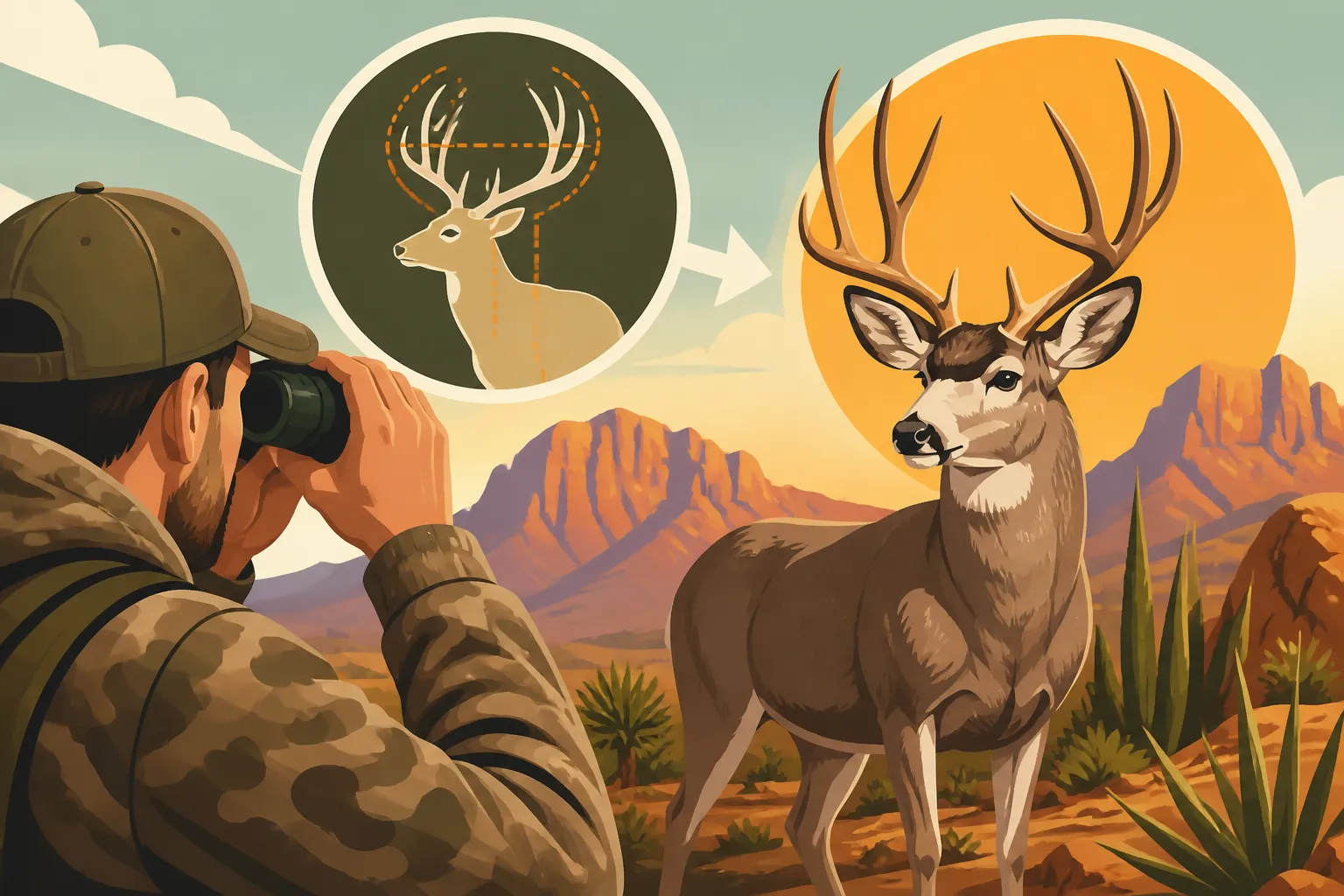
- Ears as a Reference: The ears of a mule deer buck are an excellent, consistent reference point. When alert, the ears of an average mule deer are typically about 18-22 inches wide from tip to tip. This provides an instant mental measuring stick.
- "Past the Ears" Rule: For a truly wide buck, you want to see his main beams extending noticeably beyond the tips of his ears. If his antlers are inside his ears, he's likely a younger buck, or at least not exceptionally wide. If they are just at his ears, he's respectable, but probably not a giant. The further past his ears the main beams extend, the wider he is. This can be a game-changer when you're quickly scanning a group of deer, trying to pick out the biggest one. This is especially true when hunting Desert Mule Deer in Southern New Mexico, where bucks can sometimes grow exceptional width without massive mass or tine length.
- Frame and Spread: Look at the overall antler frame. Is it narrow and upright, or does it have a broad, sweeping appearance? A buck whose antlers appear to "stretch" out to the sides, clearing his ears by several inches, is a good candidate for a mature, wide deer. This can be assessed in a fraction of a second, even through dense cover or at the tail end of legal shooting light.
Tine Length and Mass
While harder to judge quickly than width, tine length and mass contribute significantly to a buck's overall score and impressiveness. Focus on the most prominent tines.
- G2 and G3 Length: These are the most common tines hunters look for. Are they long and dagger-like, or short and stubby? A mature buck will typically have G2s and G3s that are considerably longer than his ear length. When you see tines that appear to stretch upward, almost matching the length of his ears or longer, you're looking at a buck with good potential.
- Basal Mass and Carries-Through Mass: Mass refers to the circumference of the antlers. Does the antler base look thick, like a baseball bat, or thin, like a pencil? The best bucks carry that thickness throughout their main beams, not just at the base. You might see a buck with good width and tine length, but if his antlers are thin throughout, he might not be as old or genetically superior as one with significant mass. Mass is a strong indicator of age and maturity, as older bucks often put more resources into growing thicker antlers.
- Overall Antler Configuration: While not a scoring criterion directly, pay attention to the overall "busyness" of the antlers. Do they have multiple points (a 4×4 or better)? Do they have noticeable eye guards (G1s)? Are there kickers or cheaters? While you can't count every point quickly, a rack that looks "heavy" and "full" instantly signals a mature buck. This is particularly relevant when considering the different growth patterns you might see in Where Mule Deer Range in Northern Units.
Here's a quick reference table for rapid field judging:
| Feature | Immature Buck (1-3 yrs) | Mature Buck (4+ yrs) | Quick Assessment |
|---|---|---|---|
| Body Size | Leggy, slender, noticeable waist | Barrel-chested, thick neck, deep body | "Is he thick like a bull or skinny like a doe?" |
| Antler Width | Inside or just at ear tips | Significantly past ear tips (18-22" reference) | "Are his antlers wider than his ears?" |
| Antler Mass | Thin, pencil-like, lacks bulk | Thick at base, carries mass throughout beams | "Do his antlers look heavy or spindly?" |
| Tine Length | Shorter G2s/G3s, often stubby | Long, well-defined G2s/G3s | "Are his points long, or are they nubs?" |
| Overall Impression | Young, less imposing | Dominant, imposing presence | "Does he look like the king of the mountain?" |
Situational Awareness and Practice
Field judging isn't just about knowing what to look for; it's about being prepared to apply that knowledge instantly in the field. This involves constant practice, understanding different hunting scenarios, and using your gear effectively.
Training Your Eye at Home
You don't need to wait for hunting season to practice. Spend time looking at photos and videos of mule deer, specifically focusing on distinguishing between young and mature bucks.
Websites and apps like GoHunt offer extensive photo galleries and harvest reports that can be invaluable. Don't just glance; actively try to "score" them in your head. Guess their age and key antler features, then compare your assessment to any available information. This kind of deliberate practice helps engrain the key indicators in your mind, making it second nature when a real buck appears. When you're E-Scouting a New Mexico Unit Before the Season, take extra time to study images of bucks harvested in that specific area – you'll start to recognize common antler characteristics.
Utilizing Optics Effectively
Your binoculars and spotting scope are your best friends for field judging. They can amplify those fleeting glimpses into clearer images, giving you the precious seconds you need.
- Binoculars for Quick Scans: For immediate, close-to-mid-range sightings, your binoculars are paramount. A good pair of Binocular Size That Survives an All-Day Session allows you to quickly zoom in on a deer, assess its body, and get a better look at its antlers. Practice quickly raising your binoculars and finding the deer, then focusing on the key judging points. Don't waste time fiddling with focus; smooth, efficient movements are critical.
- Spotting Scope for Distance: If a buck is at a significant distance, especially across a canyon or on a far ridge, a spotting scope mounted on a Tripod Setup for Glassing From a Ridge becomes indispensable. While it takes longer to set up, it provides the clearest, most detailed view, allowing you to confirm mass, tine length, and even subtle kickers that might be invisible with binoculars. Use it for those longer observations when a buck is feeding or moving slowly, confirming your initial binocular assessment.
- Knowing When to Stop Judging and Shoot: This is perhaps the hardest lesson. Once you've identified a buck that meets your criteria, stop judging! Shift your focus entirely to the shot process. Continuing to nitpick details can lead to hesitation, a missed opportunity, or even a rushed, poor shot. Have your "go/no-go" criteria firmly established before the hunt. If he meets them, it's time to execute.
Adapting to Different Terrains and Light Conditions
New Mexico's diverse landscape means you'll be judging deer in everything from wide-open plains to dense timber. Each environment presents its own challenges.
- Open Country: In areas like the eastern plains or high desert mesas, deer can be spotted at extreme distances. Here, width and body size are your primary indicators, as fine details are lost. Early morning and late evening light, while beautiful, can play tricks on your eyes, making antlers appear larger or smaller than they are. The sun can create halos around antlers, obscuring mass. This is where understanding Hunting New Mexico From 4,000 Feet to 10,000 feet comes into play, as the clearer air can sometimes extend visible distances.
- Timber and Brush: In the thick ponderosa of the Gila or the oak brush of the Sacramento Mountains, you might only get glimpses through openings. Here, body size becomes even more critical, as antlers might be partially obscured. Look for the "bulk" of the deer moving through cover. Any visible antler should be quickly assessed for width beyond the ears and general mass. Learning Using Draws and Benches to Close Distance can help put you in better judging positions.
- Light and Shadow: Low light conditions at dawn and dusk are prime mule deer movement times, but they make judging incredibly difficult. Antlers can appear as dark silhouettes, making mass and tine length hard to discern. In these situations, rely heavily on body size and overall impression. If you can't confidently judge, it's often best to wait for better light or let the buck walk. Remember how a How Drought Affects Desert Deer Numbers can sometimes influence where deer concentrate, making certain areas more productive for spotting.
Common Mistakes and How to Avoid Them
Even experienced hunters can fall prey to common misjudgments when the pressure is on. Being aware of these pitfalls can help you avoid them and make more accurate decisions.
"Ground Shrinkage" vs. "Optics Magnification"
This is a classic hunter's lament. You see a buck through your binoculars, and he looks like a giant. You shoot him, walk up, and suddenly he seems to have "shrunk." This phenomenon, often called "ground shrinkage," is real and usually stems from one of two things:
- Optics Magnification Bias: The magnification of your binoculars or spotting scope can sometimes create an illusion of greater size, especially if you're not used to judging through high power. A buck at 400 yards through 10x binoculars might appear larger than he truly is when compared to what you expect. The key here is consistent practice, getting your brain used to what a truly large buck looks like through your optics.
- Lack of Reference Points: When a buck is alone, especially in open country with no other deer or objects nearby, it's easy to lose perspective. His antlers might look huge because there's nothing to compare them against. Always try to find a reference point – his ears, another deer if possible, or even a nearby bush or rock of known size – to help anchor your judgment.
- How to Counteract: Be conservative in your judgment. If you think he's a borderline shooter, he's probably not. Aim for a buck that clearly exceeds your mental benchmark. If you're using an app like GoHunt for mapping, use the measurement tools to get a sense of distances and potential scale before a hunt to help calibrate your eye.
Overlooking Body Size for Antler Size
It's natural to immediately look at the antlers. They're the defining characteristic of a trophy buck. However, as discussed, body size is often a more reliable indicator of maturity, especially for a quick assessment.
- Young Bucks with Good Genetics: Sometimes, a younger buck (2-3 years old) will have surprisingly good antler growth – decent width, maybe even long tines. But if you look at his body, he'll still be slender, without that mature, barrel-chested bulk. This buck has great potential, but he's not fully mature yet. Taking him means taking an animal that could be truly exceptional in another year or two.
- Older Bucks with Average Antlers: Conversely, an old buck past his prime might have regressed antlers, but his body will still show his age. He'll have the thick neck, deep chest, and overall heavy appearance. While his antlers might not be a "trophy," he's a fully mature animal, and a valid harvest for some hunters.
- The Power of the Combined Picture: Train yourself to look at the whole animal, not just the head. First, assess the body. Does he look mature? If yes, then move to the antlers for confirmation. This holistic approach will prevent you from being fooled by a young buck with "good stickers" or passing on an old, heavy-bodied buck because his antlers aren't flashy. This is especially important when you're looking at pictures in the Reading a Herd Unit Management Plan and trying to understand the age class structure.
Rushing the Shot After a Quick Decision
Making a quick field judgment is one thing; rushing the shot because you're excited or worried the buck will disappear is another. Once you've made the "go" decision, the judging part is over.
- Re-Focus on Fundamentals: Transition immediately to your shooting fundamentals. Control your breathing, find a solid rest, ensure good trigger control, and place your shot precisely. The hardest part of the decision-making is done; now, execute the most important part of the hunt.
- Patience is Still a Virtue: Even with a quick judgment, a few extra seconds to ensure a stable shot can be the difference between a clean kill and a wounded animal. Wait for the buck to clear obstacles, offer a broadside shot, or present a comfortable angle. Don't let the excitement or the fleeting nature of the opportunity override your ethics and shooting discipline. A good mental approach, often discussed in resources like GoHunt, is to separate the judging phase from the shooting phase. Your brain can only do one thing well at a time under pressure.
- Know Your Personal Limits: Be honest with yourself about your effective shooting range and your ability to make a precise shot under pressure. If the buck is too far, or the shot too risky, let him walk. There will always be another opportunity, and maintaining your ethical standards is paramount. Knowing your unit, and understanding the Reading a Land Ownership Layer Correctly, helps you find good spots to set up for better opportunities.
Field judging a mule deer buck quickly in New Mexico is a skill honed through practice, keen observation, and disciplined decision-making. By focusing on body maturity, antler width, and overall mass, and by constantly training your eye, you'll be ready when that trophy buck steps out of the shadows and into your crosshairs.
Disclaimer
This article is for general informational purposes only and does not constitute professional advice. Laws, prices and regulations vary by location and change over time. Consult a qualified professional for guidance on your specific situation.