Binocular Size That Survives an All-Day Session
There’s nothing quite as frustrating as being out in the vast, beautiful, and often unforgiving landscape of New Mexico, spotting a faint glimmer of antlers on a distant ridge, only to realize your binoculars feel like lead weights around your neck, or worse, they’re just not cutting it for the detailed glassing you need. We've all been there, lugging optics that are either too heavy, too weak, or just plain uncomfortable for a full day of serious hunting. This guide is all about helping you navigate the sometimes-overwhelming world of binoculars to choose a size that not only provides excellent performance but also "survives" an all-day session without leaving you with a sore neck and missed opportunities.
The Tricky Dance Between Magnification, Size, and Comfort
When you're sifting through binocular options, it quickly becomes clear that there's a constant push and pull between power, objective lens size, and how that translates to weight and ergonomics. It’s like trying to find that perfect hunting boot—you want support, durability, and comfort, but you can’t have one without some impact on the others. For New Mexico hunters, where glassing is often key, especially in expansive country, finding that sweet spot is absolutely critical.
Understanding Magnification and Objective Lens Diameter
Every pair of binoculars comes with a set of numbers, like 10×42 or 8×32. The first number, the "10x" or "8x," tells you the magnification power. A 10x binocular makes distant objects appear 10 times closer than they are to the naked eye. More magnification sounds great, right? In theory, yes, but it also amplifies hand shake, narrows your field of view, and often requires a larger, heavier objective lens to gather enough light.
The second number, the "42" or "32," refers to the diameter of the objective lens in millimeters. This lens is the one farthest from your eye, and its primary job is to gather light. A larger objective lens gathers more light, which translates to a brighter, clearer image, especially in low-light conditions like dawn and dusk—prime hunting times. However, a larger objective lens also means a heavier, bulkier binocular. So, a 10×42 offers good magnification and light gathering, making it a popular all-around choice. But for all-day carry, especially when you're covering serious ground or climbing steep terrain, that weight can add up. For example, if you're trying to spot an elk in the deep timber of the Gila National Forest, good light gathering is essential. However, if you're packing an elk out of the Gila alone, you’ll be acutely aware of every ounce you carried in.
The Real Impact of Weight and Neck Fatigue
Let's be honest, whether you're still-hunting through thick junipers for mule deer or trying to pick apart a distant hillside for a coues buck in southern New Mexico, your binoculars are going to be in your hands or around your neck for hours on end. A difference of just a few ounces can feel like pounds by the end of a long day. I’ve seen countless hunters, myself included, start the day with enthusiasm, swinging their heavy 12x50s around, only to have them rattling against their chest by midday because their neck is screaming.
Fatigue isn't just about discomfort; it directly impacts your effectiveness. When your arms are tired from holding up heavy glass, or your neck is aching, you're less likely to glass as thoroughly or for as long as you should. That means you could miss that subtle flicker of an ear or the edge of a bedded animal that a fresh pair of eyes would have caught. This is especially true when you're trying to execute a precise Grid Glassing a Basin Without Missing Bucks technique, which requires sustained, focused effort. Remember, New Mexico terrain can range dramatically, and if you're Hunting New Mexico From 4,000 Feet to 10,000, every extra ounce is amplified by elevation.
Field of View and Light Gathering for Different Scenarios
The field of view (FOV) is how wide an area you can see through your binoculars at a certain distance, usually expressed in feet at 1,000 yards. Generally, lower magnification binoculars have a wider FOV. This is incredibly helpful when you're scanning large areas, trying to locate a moving animal, or just getting a lay of the land. For example, if you're looking for Mule Deer Across New Mexico's High Country and Desert, a wider FOV can help you cover more ground quickly.
Light gathering, as we discussed, is tied to the objective lens size. More light means a brighter image, which is crucial during the low-light periods that are often the most productive hunting times. Early mornings or late evenings in the canyons and timber can be incredibly dark, and having binoculars that can pull in every last photon can make the difference between seeing an animal and simply seeing shadows. This becomes even more critical when you're trying to glass for New Mexico Elk Are Why the Gila Draws Everyone right at first light before they bed down.
Popular Binocular Sizes and Their Best Uses in New Mexico
Let's break down the common binocular sizes you'll encounter and where they shine (or fall short) for the typical New Mexico hunter. There's no single "best" option, but rather the right option for your specific hunting style and target species.
Compact and Ultra-Compact (8×25, 10×28)
These are your featherweights, often pocket-sized.
- Pros: Extremely lightweight, easy to carry, minimal bulk. You'll barely notice them around your neck or in a chest pouch. They're great for quick peeks or verifying targets at closer ranges.
- Cons: Small objective lenses mean limited light gathering. They struggle significantly in low light, making early morning or late evening glassing challenging. Lower magnification models (like 8×25) might not offer enough power for long-range identification in open country. The small size can also mean reduced eye relief and a less comfortable viewing experience for some.
- Best for New Mexico: These might be suitable as a secondary, backup pair, or for very specialized hunts where minimal weight is the absolute priority, like a fast-and-light hike-in for javelina in the desert where you only expect close encounters. For most serious big game hunting in New Mexico, they often lack the performance needed.
Mid-Size (8×32, 10×32)
A solid step up from compacts, these offer a better balance.
- Pros: Still relatively lightweight and compact, but with a noticeable improvement in light gathering and image brightness compared to smaller models. They're much more comfortable for all-day carry than larger binoculars. Good for covering ground and quick target acquisition.
- Cons: While better than compacts, their light-gathering capabilities still won't match full-size models, especially as dusk deepens. Magnification might still feel a bit limiting for truly expansive glassing in wide-open country.
- Best for New Mexico: Excellent for archery hunters who prioritize minimal weight and shorter-range target acquisition, or for general-purpose hunting in timbered or broken terrain where extreme long-range glassing isn't the primary method. They’re a great choice if you're stalking close and need to confirm yardage and identify shooting lanes without a heavy setup. A 10×32 can be a nimble companion for hunting New Mexico's Gila for trophy bulls during archery season.
Full-Size (8×42, 10×42, 12×50)
The workhorses of the hunting world, especially the 10×42.
- Pros: Excellent light gathering, providing bright, clear images even in challenging conditions. Good balance of magnification and field of view for most hunting scenarios. The 10×42 is often considered the most versatile all-around hunting binocular. A 12×50 bumps up the magnification and light gathering, offering a more powerful view without a massive jump in bulk.
- Cons: Heavier and bulkier than mid-size options. While manageable for all-day carry, they will definitely be felt, especially the 12x50s. Hand-shake can become more noticeable with 12x magnification, potentially requiring a tripod for extended viewing.
- Best for New Mexico: For many, the 10×42 is the gold standard, offering enough power for scanning vast distances and sufficient light gathering for early and late hunting. If you spend a lot of time glassing open country or trying to pick apart shadows, like when searching for Coues Deer in New Mexico's Southern Ranges, a 10×42 or even a 12×50 (often paired with a tripod adapter) might be your sweet spot. For those hunting in areas like the eastern plains, where pronghorn can be spotted at extreme distances, something like a 12×50 could give you an edge. Many serious hunters, myself included, rely on a 10×42 for most big game applications.
Large Aperture (15×56+)
These are specialized tools, built for dedicated, long-range glassing.
- Pros: Unmatched magnification and light-gathering power. They reveal incredible detail at extreme distances, allowing you to thoroughly scrutinize every rock and shadow on a far-off slope. Essential for serious backcountry glassing.
- Cons: Very heavy and bulky. They absolutely require a tripod for stable, effective viewing; trying to hand-hold these for more than a few seconds is an exercise in futility. They are not designed for quick, on-the-go scanning. Their narrow field of view can make initial target acquisition difficult.
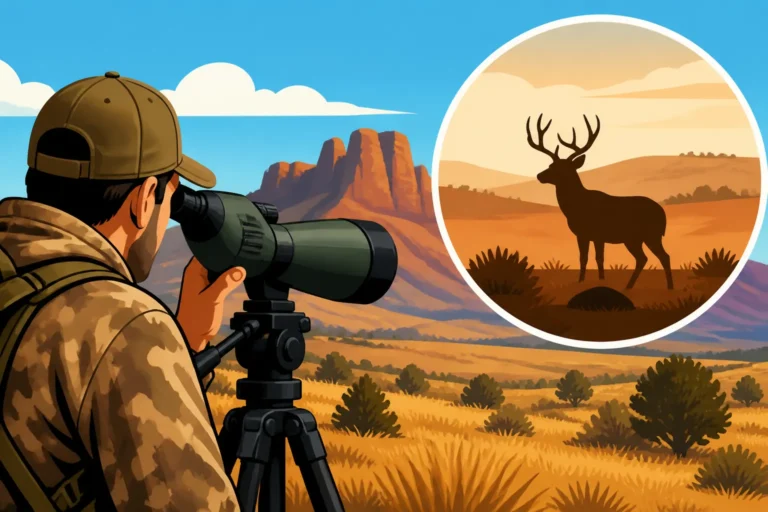
- Best for New Mexico: If your primary hunting strategy involves extensive glassing from a stationary position, breaking down vast basins and mountainsides, these are indispensable. Think of glassing for Pronghorn on New Mexico's Eastern Plains from a vantage point, or trying to pick out a bedded mule deer on a distant, sun-drenched slope. When coupled with a spotting scope, these create an unparalleled long-range observation system. For hunters utilizing platforms like GoHunt for their unit research, understanding when to deploy such powerful optics for specific New Mexico units is key. If you're planning a Tripod Setup for Glassing From a Ridge, these are the binoculars you'll want to mount.
Here's a quick comparison of common binocular sizes:
| Size (Magnification x Objective) | Typical Weight (oz) | Light Gathering (Relative) | Field of View (Relative) | Ideal New Mexico Use Case |
|---|---|---|---|---|
| 8×25 / 10×28 | 8-12 | Low | Wide (8x) / Medium (10x) | Minimalist, backup, close-range stalking in dense cover |
| 8×32 / 10×32 | 16-20 | Medium | Wide (8x) / Medium (10x) | Archery, timber hunting, mobile hunters |
| 8×42 / 10×42 | 22-28 | Good | Medium | All-around big game, versatile, balance of power & portability |
| 12×50 | 28-35 | Very Good | Narrow | Open country, long-range glassing (often tripod-assisted) |
| 15×56+ | 40+ | Excellent | Very Narrow | Dedicated glassing, extreme long-range, tripod mandatory |
Note: Weights are approximate and can vary significantly between brands and models.
Enhancing All-Day Comfort and Performance with Accessories
Even the perfect binocular size won't feel great if you're not pairing it with the right accessories. These are the unsung heroes that turn a good piece of glass into an all-day companion.
The Game Changer: Binocular Harnesses
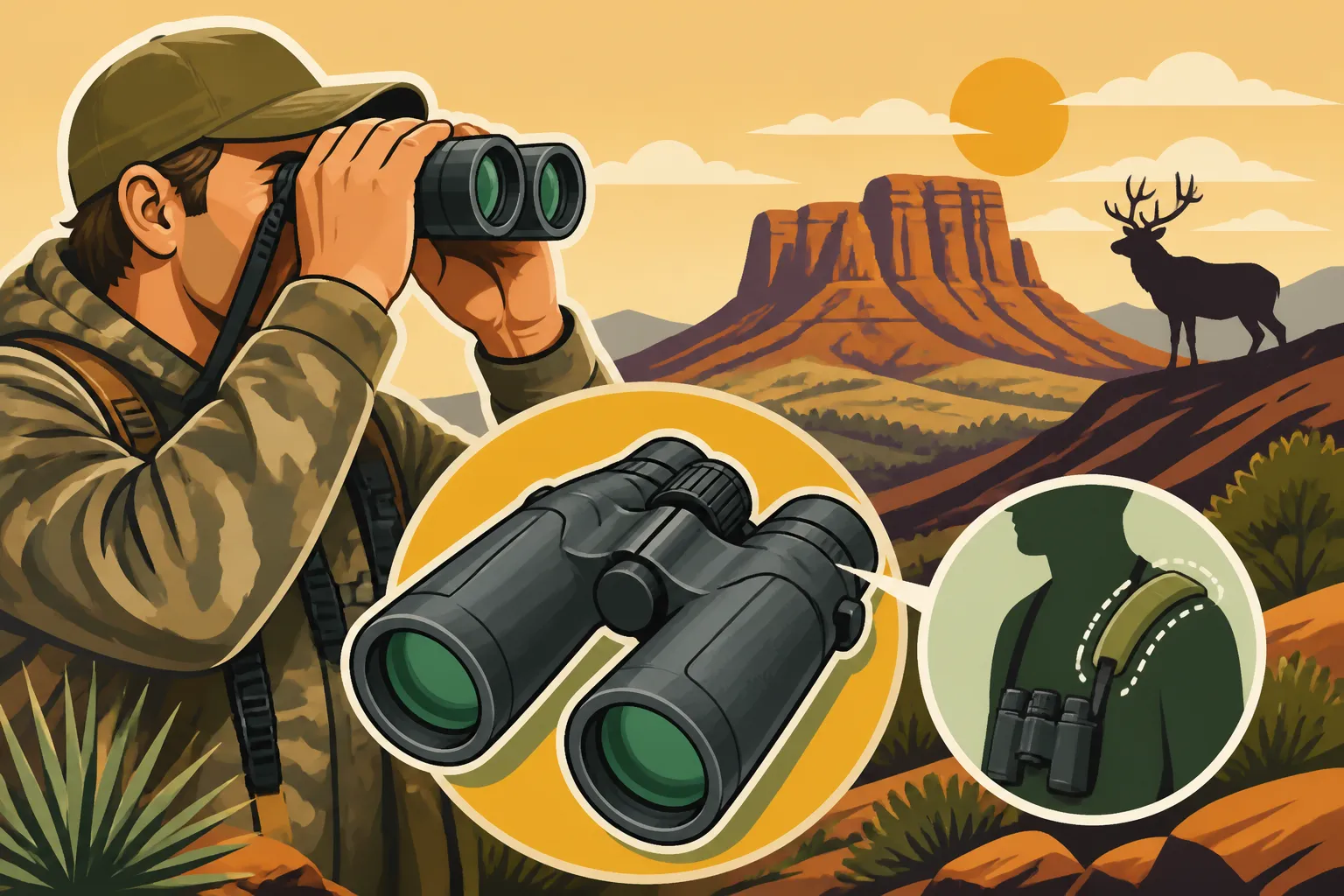
Forget the flimsy neck strap that came with your binoculars. If you're going to carry them for hours, a quality binocular harness is non-negotiable. Instead of hanging around your neck and bouncing around, a harness distributes the weight across your shoulders and back, keeping your binoculars secure and close to your chest. This significantly reduces neck strain and prevents your glass from swinging wildly as you hike or crawl. Many harnesses also offer integrated pockets for calls, wind-checkers, or lens cleaning cloths, making them even more functional. Look for models with comfortable, breathable straps and easy one-handed access to your binoculars. Brands like FHF Gear or Kuiu offer excellent options that secure your optics while allowing quick deployment.
When to Bring a Tripod Adapter
For anything 10x magnification and above, especially if you're doing extensive glassing, a tripod adapter can dramatically improve your viewing experience. Even a slight wobble from hand-holding can obscure fine details at long distances. A tripod provides rock-solid stability, allowing you to truly pick apart distant terrain and identify subtle movements. This is absolutely crucial for high-magnification binoculars like 12x50s or 15x56s. Many 10×42 users also find a small, lightweight tripod with an adapter invaluable for those extended sessions trying to locate Best Time of Day to Glass for Elk or judging a buck on a far-off slope. You'll often find that the most successful glassers in New Mexico are those who leverage a tripod for their primary optics.
Eye Relief and Adjustable Eyecups
Eye relief is the distance your eye needs to be from the eyepiece to see the full field of view. If you wear eyeglasses, you'll need longer eye relief (typically 15mm or more) to see the entire image without having to remove your glasses. Adjustable eyecups are a must-have feature, allowing you to set the perfect eye relief, whether you wear glasses or not. Twist-up or click-stop eyecups are generally preferred for their durability and ease of adjustment compared to simple rubber fold-down cups. Proper eye relief prevents eye strain and ensures a comfortable, full image, which is vital during those long, scrutinizing sessions.
Weatherproofing and Durability for New Mexico Conditions
New Mexico weather can be unpredictable, swinging from hot, dusty days to sudden thunderstorms or even snow in the high country. Your binoculars need to be able to handle it. Look for models that are fully waterproof and fog proof, typically achieved through O-ring seals and nitrogen or argon purging. This prevents moisture, dust, and internal fogging, protecting your investment and ensuring clear views in any conditions. Additionally, robust armor, often rubberized, provides impact protection and a secure grip, which is essential when you're navigating rough terrain or handling your optics with gloved hands. Dependable gear, like that often reviewed on platforms such as GoHunt, stands up to these challenges.
Making Your Final Decision: Matching Binos to Your Hunt
Ultimately, the "best" binocular size for an all-day session is deeply personal and depends entirely on your specific hunting style, the terrain you’ll cover, and the species you're pursuing in New Mexico. There are no shortcuts here; you have to consider what truly matters for you.
Considering the Terrain and Habitat
The type of country you primarily hunt in New Mexico dictates a lot. If you're spending most of your time in the dense timber pockets of the northern mountains, hunting New Mexico Elk Are Why the Gila Draws Everyone, a lighter, wider field-of-view binocular like an 8×32 or 10×42 might be perfect. You'll be making shorter-range observations and probably won't be glassing across vast canyons as much. However, if you're regularly heading to the wide-open basins of Unit 16D or Unit 17, or the desert plains for antelope, a 10×42 or even a 12×50 becomes almost essential for long-distance spotting. Remember, New Mexico holds Over 30 Million Acres of Public Hunting Land, and each region presents its own optical challenges. GoHunt is a fantastic resource for researching unit topography before you even apply for a tag, helping you anticipate your optical needs.
Species-Specific Needs: Elk vs. Coues Deer
Different species often require different glassing strategies.
- Elk: For elk, especially in timbered or broken terrain, you might prioritize light gathering and a decent field of view for spotting movement in dense cover or at dawn/dusk. A 10×42 is a very popular choice. If you're in open, steep country, glassing clear cuts or burns, stepping up to a 12×50 on a tripod could give you an advantage. The key is often finding them first, before planning your How Far to Stalk a Bedded Mule Deer or elk.
- Mule Deer: Mule deer can be found in a huge variety of habitats across New Mexico. In the high country, where they might be picked out on distant slopes, a 10×42 or 12×50 with a tripod is often preferred. For desert mule deer, where they can blend seamlessly into the cholla and rock, intense scrutiny at long distances is common, again favoring more powerful optics with tripod stability.
- Coues Deer: These "gray ghosts" are notorious for blending in. Hunting them effectively, especially when Judging a Coues Buck in Southern New Mexico, often involves a lot of sitting and glassing. For Coues, many hunters gravitate towards 10×42 or even 12×50 paired with a tripod, as you're typically picking apart brushy hillsides for hours on end, needing to resolve fine details. Paired with a Spotting Scope Power for Open Country, these larger binoculars let you dissect an entire mountainside without missing a thing.
Personal Strength and Endurance
This is perhaps the most overlooked factor. Be honest with yourself about your physical condition. Can you comfortably carry a 35-ounce binocular around your neck or in a chest harness for 10-12 hours a day, day after day, while also packing a rifle, water, and other essentials? If a heavy binocular causes undue fatigue early in your hunt, it's a liability, not an asset. It's far better to have slightly less magnification in a binocular you will use consistently and comfortably, than a powerful one that ends up bouncing unused against your waist.
The Importance of Hands-On Testing
Before you commit to a size, try to get your hands on a few different models. Go to a reputable sporting goods store, step outside, and put them through their paces. Hang them around your neck with a harness. See how they feel after 15 minutes. How quickly can you get them to your eyes and acquire a target? Does the image feel steady? How do they perform in varied lighting conditions, if you can test them at different times of day? If you really want to dive deep into optics, online resources often provide detailed reviews, and you can even compare different options using tools on sites like GoHunt. This hands-on experience, even if it's just in a parking lot, is invaluable for making an informed decision about what size binocular truly "survives" an all-day session for you.
Disclaimer
This guide is intended for informational purposes only and does not supersede official hunting regulations. Always consult the most current New Mexico Department of Game and Fish regulations prior to any hunting activity. Hunting involves inherent risks, and safety should always be your top priority.