Terrain That Hides an Approach at 10,000 Feet
When you're making a play on an animal high up in New Mexico's mountains, say 10,000 feet or more in elevation, it's a whole different ballgame. The air is thin, your lungs are burning, and the terrain often feels vast and exposed. You know that feeling when you finally spot that bull or buck you’ve been chasing, only to realize there's seemingly nowhere to hide between you and them? That frustration is real, and it’s why understanding how to use the high-country landscape to your advantage for a stealthy approach is absolutely critical. This guide will help you decipher the unique challenges and opportunities of high-altitude terrain, teaching you how to use every fold, rock, and patch of timber to get within striking distance.
Understanding High-Altitude Terrain Features
Hunting at 10,000 feet and above in New Mexico means entering a world where the rules of the low country often don't apply. The landscape itself becomes both your greatest obstacle and your most potent ally, if you know how to read it. Areas like the Sangre de Cristo Mountains in the north or the higher reaches of the Mogollon Rim within the Gila National Forest demand a keen eye for subtle changes in elevation and vegetation.
The Unique Challenges of Alpine Elevations
The most immediate challenge at these dizzying heights is the sheer scale and openness. Below the timberline, you might rely on dense forests or rolling hills to conceal your movements. Up here, especially in the vast alpine bowls and meadows, cover can be sparse. Animals, particularly mature deer and elk, are often accustomed to spotting threats from a distance. They've evolved to use these wide-open spaces to their advantage, relying on their keen eyesight and the prevailing winds to detect danger long before it gets close. This means your approach must be meticulously planned and executed.
Adding to this, the physical demands are immense. The thin air impacts not just you, but the sounds you make. Every rustle of clothing, every misplaced step on loose rock, can carry farther than you'd expect in the crisp, still air of dawn or dusk. Recognizing these unique aspects is the first step in formulating a successful high-altitude strategy. It’s not just about walking quietly; it’s about understanding the entire sensory environment from the animal’s perspective.
Identifying Key Topographical Elements
To move stealthily through high-elevation terrain, you need to become a master of topography. Ridges, draws, benches, and saddles are not just lines on a map; they are highways for game and critical concealment corridors for hunters. For example, a sharp ridge line can hide your ascent, allowing you to peek over the top without silhouetting yourself. Draws, those natural depressions that funnel water, often serve as animal travel routes and offer excellent cover from above. Benches, those flat sections on a mountainside, are prime bedding and feeding areas, and their distinct contours can shield your approach.
Modern e-scouting tools are invaluable here. Before you even set foot on the mountain, services like GoHunt offer detailed topographical maps and satellite imagery that allow you to virtually "walk" the terrain. You can identify potential bedding areas, escape routes, and, most importantly, the exact folds in the earth that can hide your movement. Learning to read a New Mexico Hunt Code Before You Apply will help you narrow down your choices, but understanding the terrain within those units is the real key to success. Don't just look for where the animals might be; look for the routes that allow you to get to them undetected.
Analyzing Vegetation Zones and Their Cover Potential
As you ascend New Mexico's mountains, the vegetation changes dramatically, and with it, the types of cover available. Below 9,000 feet, you might find dense ponderosa pine forests or thick oak brush. Around 9,000 to 10,000 feet, you'll encounter mixed conifer stands, often including Douglas fir and Engelmann spruce, alongside beautiful aspen groves. Above 10,000 feet, particularly in units like those in the Pecos Wilderness, you transition into spruce-fir forests, subalpine meadows, and eventually the krummholz zone – stunted, wind-whipped trees that offer surprisingly good cover in otherwise open areas.
Each vegetation type presents its own set of advantages and disadvantages for a stealthy approach. Dense timber provides excellent visual concealment and muffles sound, but can limit your line of sight. Aspen groves, while visually stunning, can be incredibly noisy underfoot with dry leaves and brittle branches. High alpine meadows, while offering wide fields of view for spotting game, provide minimal cover, making long, careful stalks through subtle depressions or behind rock outcrops essential. Knowing these distinctions allows you to choose the path of least resistance – or, more accurately, the path of most concealment.
Leveraging Natural Cover for Stealthy Approaches
The mountains are full of nature's hiding spots, if you know how to see them. It’s not about finding a perfect blind, but rather about using the existing landscape to become a ghost in the high country.
Utilizing Ridge Lines and Saddlebacks
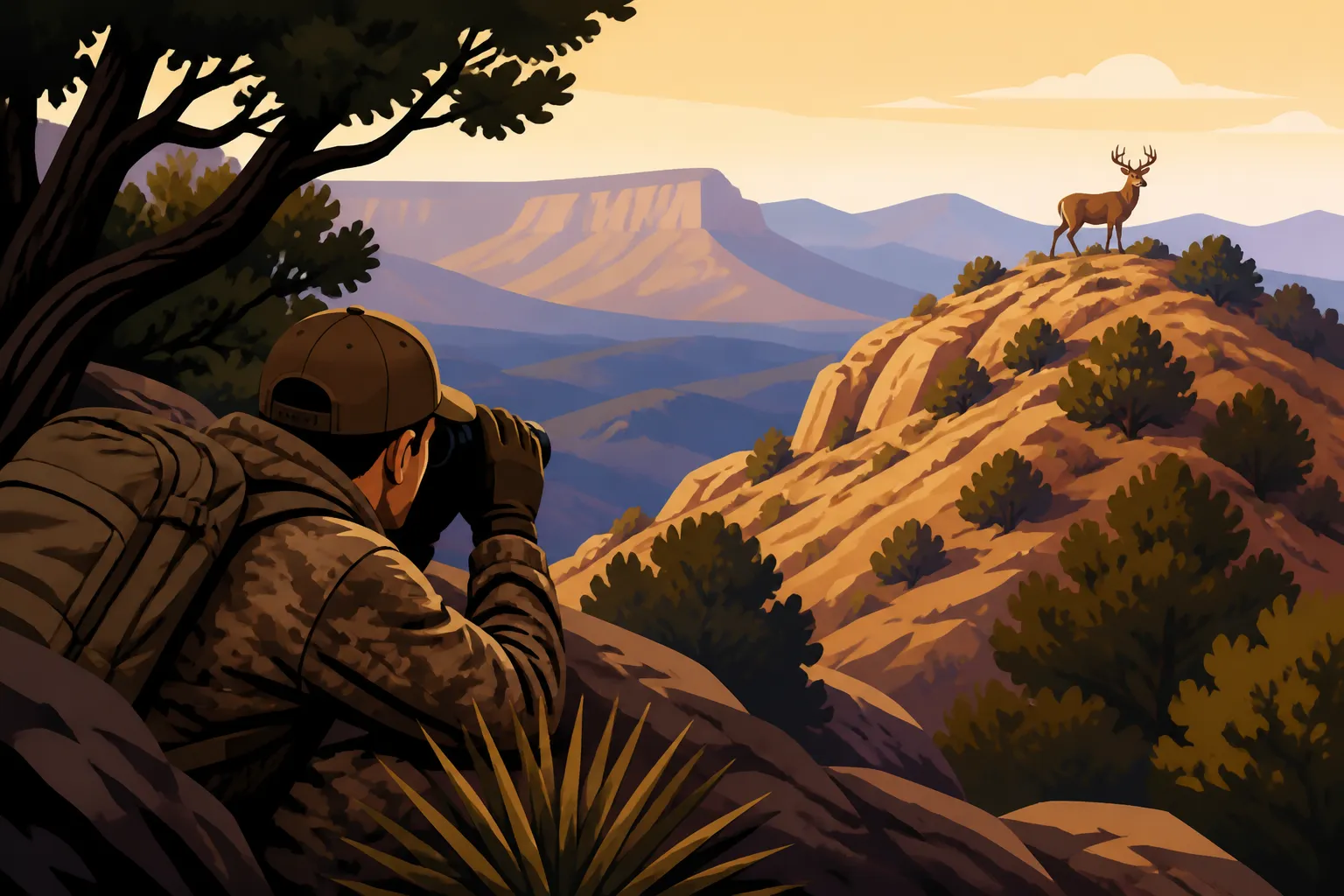
Ridge lines are a double-edged sword. They offer incredible vantage points for glassing vast expanses, but skylining yourself on a ridge is a surefire way to spook every animal for miles. The trick is to stay just below the crest, using the leeward side (away from the prevailing wind) to conceal your movement. When you need to peek over, do so with extreme caution, moving slowly and exposing only your head and optics. A good technique is to crawl to the crest, using a rock or a patch of krummholz for maximum concealment. Think of the ridgeline as a wall, not a pathway.
Saddles, the low points between two peaks on a ridge, are natural travel corridors for game. Animals will often use saddles to cross from one basin to another, especially at dawn and dusk. These are ambush points, but they also offer a strategic advantage for your approach. You can often use the terrain leading up to a saddle for cover, slowly working your way into a position where you can intercept animals moving through. Patience is paramount here; many a hunter has rushed a saddle and blown their opportunity.
Navigating Timbered Slopes and Aspens
Dense stands of timber, particularly on steep slopes, are your best friends when it comes to closing the distance on an animal. The thick canopy and undergrowth provide excellent visual concealment. More importantly, the soft duff on the forest floor can make for incredibly silent travel. This is where the slow, deliberate "hunter's walk" really pays off. Pick up your feet, place them softly, and always check for crunchy leaves or snapping twigs before committing your weight.
Aspen groves, while beautiful, present a different challenge. Their smooth, light-colored trunks offer great visual break-up, making it hard for an animal to discern your outline. However, in the fall, the fallen leaves can be incredibly noisy. If you're hunting during the September archery seasons, the dry aspen leaves will crunch loudly underfoot. Your best bet in aspens is to move during wetter conditions, or to use the sound of a rustling breeze or an animal's own movements to mask your steps. Sometimes, just waiting for a gust of wind is the smartest move.
Exploiting Benches and Bowls
Benches are those relatively flat, terraced areas that break up a steep mountainside. They are absolute magnets for game, offering easier travel, better forage, and comfortable bedding areas. Animals will often bed down on benches where they have a commanding view of the terrain below and above, relying on their vantage point to detect threats. When approaching a bench, think like a cat. Use the contours of the terrain – small rises, rocky outcrops, or thickets of timber – to stay out of sight. Remember to use a tripod setup for glassing from a ridge overlooking benches, allowing you to thoroughly pick apart the terrain before committing to a stalk.
Bowls are large, natural depressions in the landscape, often found high in the alpine. They can be incredibly productive for glassing and hunting, but their open nature means you need to be extra cautious. If you're approaching an animal bedded in a bowl, you'll want to use the rim of the bowl, or any internal fingers of timber or rock, to maintain concealment. Often, the best approach is from above, using the downward slope and features within the bowl to get close. Consider internal links like Glassing Benches and Parks for Elk as you plan these approaches, because knowing where to look is just as important as knowing how to approach.
Reading Wind and Thermals in Mountainous Environments
The wind at 10,000 feet isn't just a breeze; it's a dynamic, unpredictable force that can make or break your hunt. Mastering its nuances is paramount, especially when your target animal's nose is its most potent defense.
Mastering the Updrafts and Downdrafts
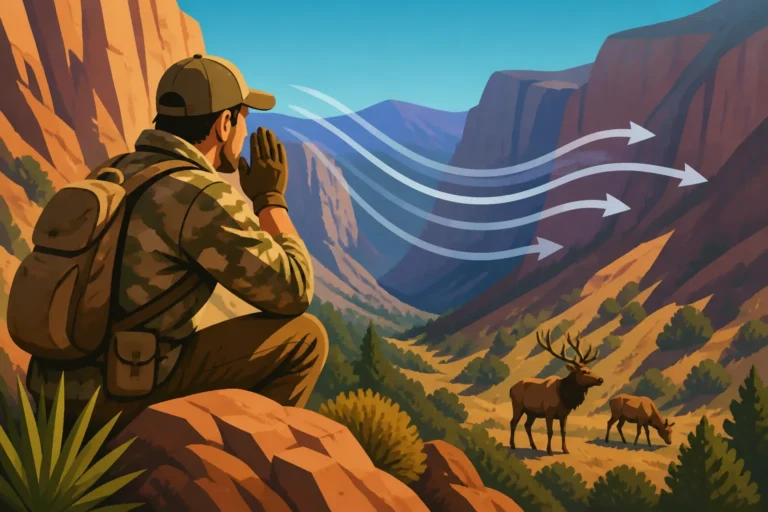
In mountainous terrain, wind behavior is heavily influenced by thermals – predictable air currents driven by temperature changes. As the sun rises and heats the earth, warm air begins to rise, creating an updraft. This means scent will travel up the mountain. Conversely, as the sun sets and the earth cools, cold air sinks, creating a downdraft that carries scent down the mountain. These thermals are most pronounced during the calmest parts of the day, typically early morning and late evening.
Understanding this cycle is crucial for planning your approach. If you're trying to get to a bedded animal high on a slope in the morning, you'll want to approach from above, using the rising thermal to carry your scent away from them. In the evening, an approach from below or parallel might be more effective as the downdraft pulls your scent downward. However, never rely solely on thermals; they can be fickle. Always carry a wind checker and use it constantly. For a deeper dive, check out Reading Wind in a Deep Gila Canyon.
Predicting Wind Currents in Complex Topography
While thermals provide a general guideline, the complex topography of high-altitude New Mexico creates localized, swirling wind currents that can defy simple predictions. Deep canyons, narrow draws, and varied slopes can create micro-thermals and eddies that make the wind behave erratically. You might have a steady updraft on one side of a ridge, only to find swirling, unpredictable winds in a small basin just over the crest.
This unpredictability is why continuous wind checking is non-negotiable. Use powder, milkweed, or even a small piece of string on your bow or rifle to constantly monitor wind direction. Pay attention to how the wind interacts with the terrain. Is it being funneled through a saddle? Is it bouncing off a sheer rock face? These observations, combined with your general knowledge of thermals, will help you make real-time adjustments to your approach. Sometimes, the only safe approach might be a circuitous route that keeps you consistently downwind.
The Impact of Sun Exposure on Thermals
The sun's position and the aspect of the slope significantly influence thermal activity. South-facing slopes, which receive more direct sunlight, will heat up faster in the morning, leading to earlier and stronger updrafts. North-facing slopes, often cooler and shadier, will experience weaker and later updrafts, and sometimes retain downdrafts longer. This dynamic can be exploited. If you need to make a move across a north-facing slope in the morning, you might have a longer window before the updrafts fully establish.
Similarly, shadows play a role. As the sun moves, shadows lengthen or shorten, causing localized temperature differences that can create their own mini-thermals. A small, shaded draw might still be experiencing a downdraft even while the exposed ridge above it has strong updrafts. This level of detail in understanding wind is what separates a successful high-country hunter from one who constantly bumps game. It's truly a chess match with Mother Nature, and knowing how the sun affects the board is a major piece of the puzzle. For more insights, consider reading Playing Thermals on a Canyon Stalk.
Strategic Movement and Scent Control at Elevation
Even with perfect wind and terrain knowledge, your movement and scent signature are critical factors. Animals at 10,000 feet are acutely aware of their surroundings, and any misstep can send them bounding out of the country.
Pacing Your Stalk for Optimal Success
When you've spotted your animal and formulated an approach, the next step is execution, and that means patience. A high-country stalk is rarely a sprint; it's a slow, deliberate crawl. Each step needs to be intentional. Think of it as a series of micro-decisions: where to place your foot, how much weight to commit, and when to pause. Stop frequently to glass, listen, and reassess the wind and the animal's behavior. A bull elk might suddenly stand up to stretch or feed, giving you a valuable opportunity to move more aggressively.
Resist the urge to rush, even when you're tantalizingly close. Many hunts are ruined in the last 100 yards because a hunter pushed too fast. If the animal looks alert, freeze. If it turns its head, become a statue. Use the landscape to break up your outline, even if it's just a small shrub or a single rock. This patient, methodical approach not only keeps you hidden but also conserves your energy, which is precious at high altitudes.
Minimizing Noise in Rocky and Timbered Areas
The high country is often characterized by loose rock, scree fields, and fallen timber. Navigating these areas silently requires immense focus. When crossing scree, try to walk on larger, more stable rocks or along game trails where the ground is more consolidated. If you must cross loose rock, shuffle your feet rather than lifting them high, distributing your weight to minimize dislodging stones. In timbered areas, pay attention to deadfall and branches. Step over them, not on them, if possible. If you must step on a branch, do so gently, testing it first.
Your gear can also be a source of noise. Make sure buckles are cinched tight, zippers aren't jingling, and anything loose in your pack is secured. Hunting New Mexico From 4,000 Feet to 10,000 means you'll encounter all sorts of terrain, and ensuring your pack and clothing don't betray you is paramount. A quiet approach isn't just about your footwork; it's about making sure your entire hunting system is optimized for stealth.
Aggressive Scent Management for Close Encounters
At 10,000 feet, where the air is thin and game animals are often more sensitive to foreign odors, aggressive scent management isn't just a suggestion; it's a necessity. While playing the wind is your primary defense, reducing your scent signature adds an extra layer of protection, especially when those unpredictable high-country thermals swirl. Start with clean hunting clothes, preferably washed in scent-free detergent, and store them in airtight bags until you reach camp.
On the mountain, sweat is your enemy. Despite the cooler temperatures at high elevation, the strenuous physical exertion of climbing and stalking will make you sweat. Layering for Gila Temperature Swings is key to managing this; shed layers before you start sweating heavily, and put them back on before you get cold. Use scent-eliminating sprays on your clothes, pack, and boots regularly. Even if you have the wind in your favor, a sudden gust or shift in thermals can carry your scent directly to an animal, ruining hours of careful stalking. Don't take chances; minimize your human odor as much as humanly possible.
Adapting Your Gear for High-Altitude Stalks
The right gear won't guarantee success, but the wrong gear can certainly guarantee failure. High-altitude hunting in New Mexico demands equipment that is reliable, lightweight, and suited to extreme conditions.
Optics for Long-Range Scouting and Short-Range Identification
In New Mexico's expansive high country, good optics are your most important tool, second only to your weapon. The ability to spot animals from a distance, determine their size and sex, and then plan an approach is fundamental. A high-quality pair of 10×42 or 12×50 binoculars are essential for all-day glassing. For truly picking apart distant ridges, meadows, and bowls, a spotting scope (20-60x or 25-75x) on a sturdy tripod is indispensable. GoHunt's mapping features can help you identify prime glassing points even before you leave home.
But it’s not just about finding game far away. Once you’re in close, you need binoculars that can quickly confirm what you’re seeing through timber or at last light. A smaller, lighter pair of binos on your chest harness allows for quick checks during a stalk without fumbling. Don't underestimate the importance of clear, bright glass in the low light conditions often encountered during prime hunting hours in the mountains.
Footwear and Clothing for Varied Conditions
Your feet are your foundation in the mountains, and improper footwear will quickly turn a dream hunt into a painful ordeal. You need sturdy, waterproof boots with excellent ankle support and aggressive tread for navigating steep, rocky, and potentially snowy terrain. Look for boots that are broken in but still have plenty of life left. Choosing Boots for Rocky Desert Ground is a good reference, and the principles apply to high-country rock as well. Make sure you wear quality wool or synthetic socks to manage moisture and prevent blisters.
Clothing in the high country requires a robust layering system. Temperatures can swing wildly from below freezing at dawn to pleasantly warm midday, only to drop sharply again with the setting sun or an afternoon thunderstorm. Start with a moisture-wicking base layer, add insulating mid-layers (fleece or puffy jackets), and top it off with a waterproof/windproof outer shell. Having spare dry clothes in your pack is crucial. Altitude Preparation for a Gila Elk Hunt emphasizes the importance of managing your body temperature, which is key to comfort and safety.
Essential Tools for Navigation and Safety
Even if you're a seasoned backcountry hunter, the high country demands respect. Always carry reliable navigation tools. A GPS device or a smartphone app like onX Maps (especially after E-Scouting a New Mexico Unit Before the Season) with downloaded maps is essential. Always back it up with a physical map and compass, and know how to use them. Cell service is notoriously spotty at 10,000 feet.
Beyond navigation, safety tools are critical. A satellite communication device (like a Garmin inReach or Zoleo) can be a lifesaver for emergency communication. A comprehensive first-aid kit, a headlamp with spare batteries, a fire starter, emergency shelter, and enough water (or a reliable water filter) are non-negotiables. The mountains are beautiful, but they are also unforgiving. Being prepared for the unexpected is part of the experience, ensuring you can focus on the hunt without unnecessary worries. Using onX Layers for New Mexico Public Land is a great way to mark water sources and escape routes before you even step foot in the unit.
Disclaimer
Hunting is an inherently dangerous activity. The information provided in this guide is for informational purposes only and should not be considered a substitute for proper training, experience, or professional guidance. Always prioritize safety, adhere to all local and state hunting regulations, and be prepared for potential hazards in the field. Conditions in New Mexico's high country can change rapidly, and personal responsibility for safety and preparedness rests with each individual hunter.