Pronghorn on the Eastern Plains
Trying to wrap your head around hunting pronghorn on New Mexico's vast Eastern Plains can feel like staring out at an endless ocean of grass, wondering where to even begin. Their incredible eyesight and blistering speed make them one of the most challenging animals to pursue, but also one of the most rewarding. This guide will take you deep into the world of New Mexico's plains pronghorn, helping you understand their habitat, behavior, and how to successfully draw a tag and hunt them.
Understanding New Mexico's Eastern Plains Pronghorn Habitat
The Eastern Plains of New Mexico are a unique landscape, distinct from the rugged mountains and deserts often associated with the state. This expansive region provides the ideal habitat for pronghorn, an animal perfectly adapted to its open, often unforgiving environment. To consistently find and pursue these animals, you first have to understand the nuances of their home.
The Unique Ecosystem of the Eastern Plains
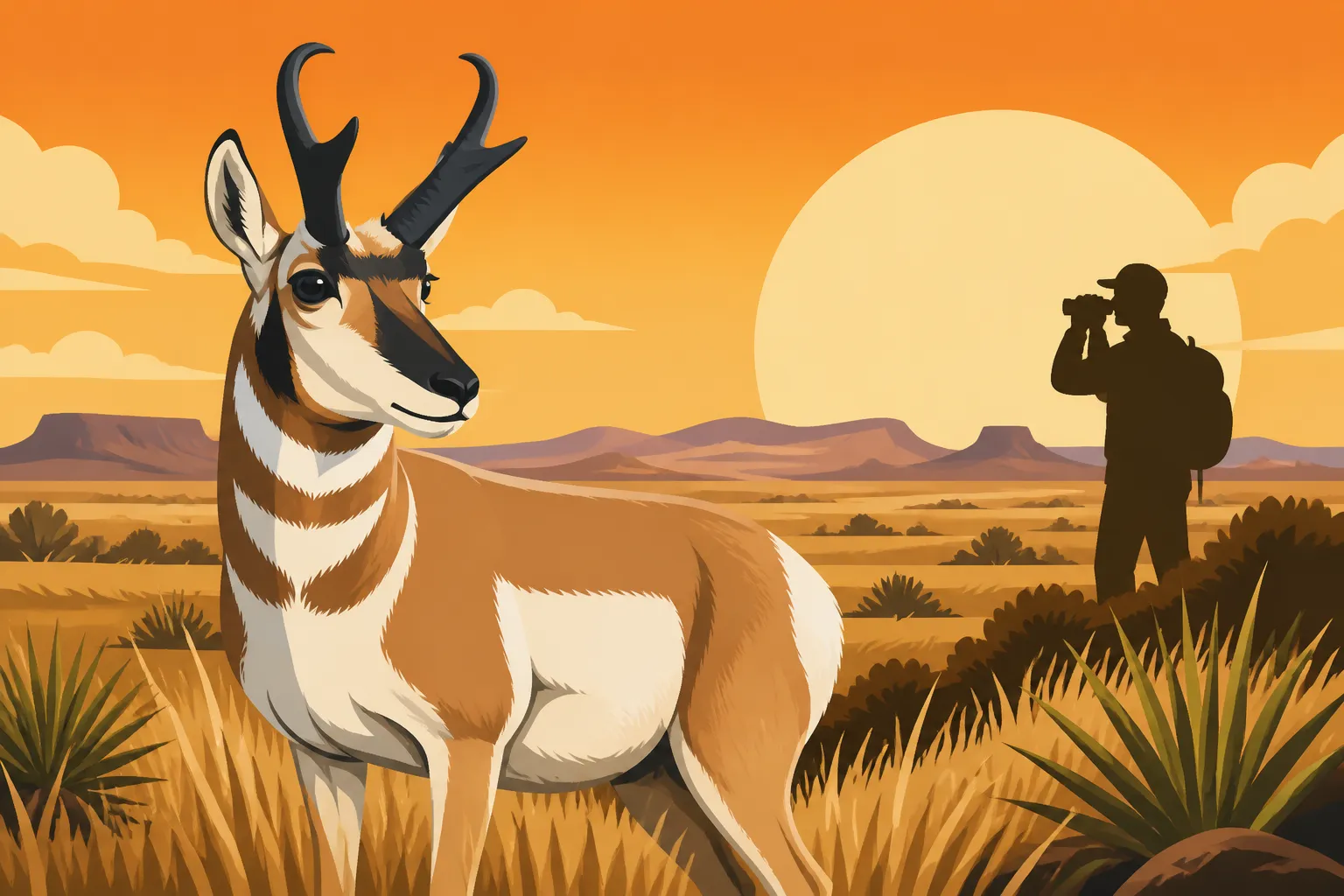
Imagine endless rolling grasslands, dotted with mesquite, cholla cactus, and yucca. This is the heart of the Eastern Plains, stretching across counties like Harding, Quay, Curry, and Union. Unlike the broken country of the western units, this area is characterized by vast, unbroken vistas that can make a hunter feel incredibly exposed. The terrain is generally flat to gently rolling, with few features offering significant cover. Pronghorn thrive here because their primary defense mechanism – incredible speed and vision – is maximized in such open environments. They can see threats from miles away and outrun almost anything that tries to catch them.
However, this seemingly uniform landscape has subtle variations that are crucial for pronghorn. Different grass species, for instance, provide varying levels of forage quality throughout the year. Areas with slightly higher elevation might offer better vantage points, which pronghorn will utilize for bedding and scanning. Understanding these micro-habitats within the larger plains environment is key to locating concentrations of animals. It’s not just flat ground; it’s a complex tapestry of flora and subtle topographical changes that dictate where pronghorn choose to live and feed.
Water Sources and Their Importance
In an arid state like New Mexico, water is life, and nowhere is this more evident than on the Eastern Plains. While pronghorn are incredibly efficient at extracting moisture from the plants they eat, especially forbs and cacti, reliable water sources are still critical, particularly during the hot summer and early fall months. These sources can be natural playas that hold rainwater, intermittent creeks that flow after heavy rains, or, more commonly, man-made stock tanks and windmills.
Identifying and understanding the location of these water sources is absolutely paramount for successful pronghorn hunting. During the dry periods, pronghorn will often concentrate around these tanks, creating predictable patterns of movement. A hunter who has done their homework using satellite imagery and maps to find these hotspots, or who knows how to locate a stock tank legally, will have a significant advantage. Just be mindful that hunting over a stock tank legally requires understanding the rules, as some private landowners might object even if the land around it is public.
Seasonal Movement and Concentration Areas
Pronghorn aren't migratory in the same way elk are, but they do exhibit seasonal movements driven by forage availability, water, and breeding cycles. In the spring and early summer, they might spread out across the plains, taking advantage of new green growth. As summer progresses and things dry out, they'll often tighten their range, focusing on areas with better forage and, as mentioned, closer access to water. This is when they become more predictable around specific water sources.
The rut, typically in September, also dictates movement. Bucks become much more active, chasing does and defending harems, which can make them slightly less cautious. Understanding when the pronghorn rut peaks can inform your hunting strategy, potentially offering opportunities to use decoys or to catch bucks distracted by breeding. Post-rut, as winter approaches, pronghorn will often group up into larger herds, seeking out prime winter ranges that offer protection from the elements and access to vital forage that sustains them through leaner times. Knowing where New Mexico pronghorn concentrate at different times of the year can be a game-changer for planning your hunt.
Key Units for Pronghorn Hunting on the Eastern Plains
New Mexico offers a diverse array of units for pronghorn, but for those specifically targeting the Eastern Plains, certain units consistently stand out. Choosing the right unit is often the first step in a successful hunt, balancing trophy potential with draw odds and access.
Top Producing Units for Trophy Potential
When hunters talk about trophy pronghorn on the Eastern Plains, units like 42, 43, 47, 48, and 49 often come up. These units are renowned for producing bucks with impressive horn length and mass. The habitat in these areas provides excellent forage, allowing bucks to reach their genetic potential. However, with great trophy potential often comes significant competition and tougher draw odds. It’s a classic trade-off in Western big game hunting.
Units in this category typically have a blend of private and public lands, and often the biggest bucks are found on well-managed private ranches. While a public land tag in these units is highly coveted, securing one requires persistence in the draw. Researching recent harvest statistics and understanding the terrain through tools like GoHunt can give you an edge, highlighting specific areas within these units where trophy bucks have been seen or harvested in the past. Remember, finding that elusive public land gem in a trophy unit takes serious legwork, both online and in the field.
Units Offering Better Draw Odds
For many hunters, especially those new to New Mexico or looking for a higher chance of drawing a tag, units with slightly lower trophy expectations but significantly better draw odds are appealing. Units on the fringes of the Eastern Plains or those with higher hunter quotas might fall into this category. These could include units like 37, 38, or parts of 41. While a 90-inch buck might be less common here, opportunities for a solid, representative plains buck are still very good.
These units often have a higher percentage of public access, whether it's BLM land or New Mexico State Trust Land, which can be accessed with a valid hunting license. The experience of hunting pronghorn in these wide-open spaces, regardless of the size of the animal, is itself a reward. It's about getting out there, experiencing the challenge, and filling the freezer. When you're Checking New Mexico Draw Odds Before You Apply, don't just focus on the lowest odds; consider the units that offer a more realistic chance of drawing, especially if you're building experience or trying to secure a tag more frequently.
Public Versus Private Land Dominance
The Eastern Plains are a patchwork of public and private land, and this dynamic heavily influences hunting opportunities. Many prime pronghorn areas are predominantly private, owned by ranchers who might lease hunting rights or manage herds exclusively. This doesn't mean public land hunting is impossible, but it does mean hunters need to be diligent in their research and respectful of land boundaries. Understanding how much public land New Mexico holds is just the start; you need to know where it is.
Units with a higher percentage of BLM (Bureau of Land Management) or State Trust Land offer more open access. However, even on public land, access can be tricky if it's landlocked by private property. Always carry a reliable mapping system, like onX Hunt, and double-check your boundaries. Getting written permission in New Mexico is required to cross private ground to reach public land, and it's a rule that is strictly enforced. Scouting these areas ahead of time, potentially during the 14-day scouting window on Trust Land, is crucial to identifying access points and understanding the lay of the land, helping you avoid accidental trespass issues that can quickly derail a hunt.
| Unit | Primary Terrain | Public Land Percentage (Approx.) | Trophy Potential | Draw Difficulty (Resident) | Notes |
|---|---|---|---|---|---|
| 42 | Rolling Grassland | 30-40% | High | Very High | Known for large bucks, significant private land. |
| 43 | Flat to Rolling | 40-50% | High | High | Good public access in some areas, strong populations. |
| 47 | Rolling Grassland | 20-30% | High | Very High | Trophy unit, tough draw, much private land. |
| 48 | Flat Grassland | 50-60% | Medium-High | Medium-High | Good opportunity for solid bucks, decent public access. |
| 49 | Mixed Grass/Shrub | 20-30% | High | Very High | Excellent trophy potential but very limited public land. |
| 37 | Mixed Grass/Mesquite | 60-70% | Medium | Medium | More accessible, good for first-time pronghorn hunters. |
| 38 | Flat Grassland | 50-60% | Medium | Medium | Good populations, better draw odds than trophy units. |
Pronghorn Biology and Behavior on the Plains
To hunt pronghorn effectively, you have to appreciate the incredible animal they are. Their senses and physical adaptations are finely tuned to survive and thrive in the wide-open plains. Understanding these biological advantages and their behavioral patterns is crucial for crafting a successful hunting strategy.
The Pronghorn's Incredible Speed and Vision
Pronghorn are often mistakenly called "antelope," but they are actually North America's fastest land mammal, capable of speeds up to 60 miles per hour. This speed is their primary defense against predators in an environment with minimal cover. They are built for endurance at high speeds, capable of maintaining 30-40 mph for miles. This means that a pronghorn, once alerted, can vanish over the horizon in a matter of minutes.
Equally legendary is their eyesight. Pronghorn have eyes that are exceptionally large relative to their body size, positioned on the sides of their head, giving them an almost 360-degree field of view. They possess vision equivalent to an 8x binocular, meaning they can detect movement from incredible distances, often spotting you long before you ever see them. This hyper-acute vision is why any stalk in open country feels like a chess match against a master opponent. As a hunter, you must constantly be aware of your silhouette, your movements, and the terrain you're using for cover, because they are certainly aware of you.
Rut Behavior and Timing on the Plains
The pronghorn rut typically kicks off in late August and can run through September, often peaking around the middle of September. This is a fascinating time to observe and hunt them. Dominant bucks establish territories and gather harems of does, constantly defending them from challenger bucks. This intense competition makes bucks much more active and sometimes a bit less cautious than usual, as their focus shifts from survival to perpetuating their genes.
During the rut, you'll see bucks trotting, circling, and engaging in impressive displays of dominance, occasionally even sparring. This heightened activity can present unique hunting opportunities. A buck chasing does might momentarily forget to scan the horizon, or a challenger buck focused on a rival might offer a fleeting shot. It’s also when decoys can be particularly effective, as an aggressive buck might be lured in by the sight of a rival or a lone doe. Understanding when the elk rut peaks in New Mexico offers similar insights for elk hunters; for pronghorn, knowing the nuances of their rut can be your golden ticket.
Daily Patterns and Feeding Habits
Pronghorn are primarily grazers and browsers, with their diet consisting of grasses, forbs, and shrubs. They are selective eaters, preferring high-protein forbs and young shoots, which is why areas with diverse plant life are often prime feeding grounds. Their daily patterns are largely dictated by these feeding needs, water access, and security. Typically, they will feed most actively in the early morning and late afternoon, often bedding down during the heat of midday.
During their active periods, they move across the plains, nibbling as they go. This constant movement can make them difficult to pattern precisely, but general trends can be observed. If you can locate a preferred feeding area, especially one close to water and with good escape routes, you're on your way to narrowing down their movements. Studying maps to identify these transition zones – where bedding cover meets feeding grounds – is a form of E-Scouting a New Mexico Unit Before the Season that can pay off big time when you hit the ground.
Effective Hunting Strategies for Eastern Plains Pronghorn
Hunting pronghorn on the Eastern Plains is a unique challenge, demanding patience, precision, and an intimate understanding of the landscape. Forget the deep timber elk hunts; this is an entirely different game.
Spot and Stalk Tactics for Open Country
Spot and stalk is arguably the most common and effective method for hunting pronghorn in New Mexico's open country. It's a game of chess played across miles, where every move must be carefully considered. The process starts with effective glassing. You'll spend a significant amount of time behind binoculars and a spotting scope, meticulously grid glassing a basin without missing bucks or scanning vast expanses from high points, searching for the tell-tale white patches of a pronghorn. Once an animal is spotted, the real challenge begins: planning an approach.
This is where terrain knowledge becomes paramount. Even in seemingly flat country, subtle folds, dry washes, or rises can provide precious cover. You'll need to use every available piece of topography to break up your silhouette and close the distance. Wind direction is critical; a pronghorn's nose is good, and you don't want to get winded when you're within shooting range. Often, a stalk will involve crawling on your hands and knees for hundreds of yards, making slow, deliberate movements. Patience is your best friend. A failed stalk doesn't mean the hunt is over; it means you learned something and can try again on another animal or from a different angle.
Decoying Pronghorn: When and How
Decoying can be a thrilling and highly effective tactic for pronghorn, particularly during the rut or when bucks are feeling aggressive. The key is timing and presentation. A well-placed pronghorn decoy can turn a distant buck into an animal charging right into your shooting lane. There are various types of decoys, from full-body 3D models to simple 2D silhouettes.
The most successful decoy setups usually involve two hunters. One hunter sets up with the decoy, often a buck or a doe, drawing the attention of an approaching animal. The other hunter positions themselves 50-100 yards behind or to the side, ready for the shot. The idea is that the approaching pronghorn focuses on the decoy, providing the shooter with an opportunity. Wind direction is, again, crucial here. You want the buck to approach into the wind, but you also need to ensure your scent isn't carried directly to him. The excitement of watching a buck come running in, full of curiosity or aggression, is an experience every plains hunter should try.
Sitting Water Sources in Dry Conditions
In parts of the Eastern Plains, especially during drier years, pronghorn can become heavily reliant on specific water sources. This creates an opportunity for a different kind of hunting strategy: sitting water. This involves finding a discreet location near a known water source – a stock tank, a windmill, or a natural seep – and waiting patiently for pronghorn to come in for a drink. This strategy is less about stalking and more about concealment and endurance.
You'll need to set up well before dawn, or plan for an afternoon sit, and remain absolutely still and quiet. A good ground blind or natural cover that blends seamlessly with the environment is essential. Ensure your setup offers a clear shooting lane to the water, but also allows for a discreet entry and exit. While less physically demanding than a spot and stalk, it requires immense mental fortitude and patience. It's also important to remember the ethical considerations of hunting over water, particularly for desert species, and always adhere to local regulations. Remember to carry enough Water You Must Carry on a Desert Day Hunt, as even sitting can be dehydrating in the New Mexico sun.
Draw Odds and Application Strategies for Pronghorn
New Mexico's draw system can be a bit of a mystery, but understanding how it works for pronghorn is crucial for securing one of these coveted tags. There are no preference points, meaning every applicant has the same chance each year, which is both a blessing and a curse.
Understanding New Mexico Pronghorn Draw Odds
New Mexico does not operate on a preference point or bonus point system. This means that whether you're a first-time applicant or someone who has applied for twenty years, your odds of drawing a pronghorn tag are exactly the same in any given year. This can be frustrating for those who accumulate points in other states, but it also offers a fair playing field for everyone. The draw is essentially a random lottery. The primary factors influencing your draw odds are the demand for a specific unit (how many people apply for it) and the number of tags allocated to that unit.
The state splits tags into three pools: 84% for residents, 10% for outfitters, and 6% for non-residents. This means non-residents face significantly tougher odds. To truly grasp your chances, you need to look at historical draw statistics. These statistics, often available through the New Mexico Department of Game and Fish website or third-party platforms like GoHunt, will show how many applicants applied for each unit and how many tags were issued. This data is invaluable for figuring out where your best chances lie.
Maximizing Your Application Choices
When applying for pronghorn in New Mexico, you're typically allowed to list up to five choices. This is where your application strategy truly comes into play. Most experienced hunters recommend starting with your "dream" units – those high-trophy potential units with tough odds – as your first couple of choices. While the odds are slim, if you don't apply, you'll never draw them. After that, you'll want to include "backup" units that still offer good hunting but have more favorable draw odds.
The key is to balance your aspirations with realism. Don't waste all five choices on units with 1% draw odds. Include at least one or two units where the odds might be 10-20% or even higher, especially if your main goal is simply to get a tag and experience a New Mexico pronghorn hunt. Think about units that have decent public land access and consistent harvest success, even if they aren't famous for giant bucks. Reading a New Mexico Hunt Code Before You Apply is vital, as each code specifies the unit, species, weapon type, and season dates, ensuring you're applying for exactly what you want.
Non-Resident Considerations
For non-residents, drawing a New Mexico pronghorn tag is a significant challenge due to the 6% allocation pool. This often means draw odds can be in the single digits, even for less popular units. Because of this, many non-residents consider applying with an outfitter. While applying through the outfitter pool does not inherently improve your odds compared to a resident, it does allocate you to a separate 10% pool of tags. Sometimes, depending on the demand for specific outfitter-backed hunts, this can offer a slightly different pathway, though it requires a signed contract and the financial commitment to a guided hunt.
Non-residents also need to be aware of the New Mexico Game Hunting License fee, which is required before applying, along with the per-species application fee. These fees are typically non-refundable if you fail to draw. Given the high cost and low odds, non-residents should be extra diligent in their research, potentially focusing on units with slightly higher non-resident draw success rates or considering landowner tag opportunities (though these are less common for pronghorn compared to elk).
Essential Gear and Preparation for Plains Pronghorn Hunts
A pronghorn hunt on the Eastern Plains is unlike many other hunts, and your gear and physical preparation should reflect that. The vast, open landscape demands specialized optics, reliable firearms, and a body ready for long days of glassing and stalking.
Optics for Long-Range Scouting
Given the pronghorn's incredible eyesight and the expansive nature of their habitat, high-quality optics are not just recommended, they are absolutely essential. You'll spend hours, if not days, behind glass, meticulously scanning for animals. A good pair of 10x or 12x binoculars with a wide field of view and excellent light-gathering capabilities is your primary tool for initial scanning. Brands like Vortex, Swarovski, and Zeiss are popular choices among serious hunters for their clarity and durability.
However, binoculars alone aren't enough. A powerful spotting scope, typically 60x or 80x magnification, mounted on a sturdy tripod, is critical for identifying specific animals, judging horn size, and confirming that distant speck is indeed a pronghorn and not just a rock. When judging a pronghorn buck in the field from distance, a spotting scope allows you to count inches and assess mass before committing to a long, arduous stalk. Choosing the right Optics Power for New Mexico's Open Country will save you countless wasted steps and increase your chances of success. Without top-tier optics, you'll simply be guessing.
Rifle and Caliber Choices for Open Shots
Pronghorn hunting on the Eastern Plains almost invariably involves long-range shooting opportunities. Shots of 300-500 yards are common, and sometimes even further depending on the situation and your comfort level. This necessitates a flat-shooting rifle caliber and a hunter proficient in long-range marksmanship. Calibers like .25-06 Remington, .270 Winchester, 6.5 Creedmoor, and .300 Winchester Magnum are popular choices, known for their velocity and flat trajectory.
Accuracy is paramount. Your rifle needs to be sighted in perfectly, and you must know your ballistic drops for various distances. A rangefinder is non-negotiable, and understanding how to use ballistic calculators (either on your phone or built into your scope) is crucial. Furthermore, a stable shooting platform, such as a bipod or shooting sticks, is essential for making those precise shots in the prone or kneeling position on the open plains. While a rifle zero distance for canyon country might differ, for the plains, being confident out to 400-500 yards is a significant advantage. Practice, practice, practice at varying distances and from different shooting positions before you ever step foot in the field.
Physical and Mental Preparation for a Plains Hunt
While a pronghorn hunt on the plains might not involve the grueling elevation gains of an elk hunt, it demands its own brand of physical and mental toughness. You'll be doing a lot of walking, often across uneven terrain in potentially hot weather. Long stalks, often culminating in an extended crawl, require good core strength and endurance. You'll also spend hours glassing, which can be mentally taxing.
Prepare for significant temperature swings. Early mornings can be cool, but midday on the plains can be scorching hot. Layering is key, and hydration is critical. Mentally, pronghorn hunting can be frustrating. You will get busted. You will have stalks end abruptly. The key is to remain patient, persistent, and positive. Learn from each attempt, adjust your strategy, and keep pushing forward. The mental fortitude to stay in the game after multiple setbacks is what often separates successful hunters from those who go home empty-handed.
Disclaimer
Please note: Hunting regulations and fees in New Mexico are subject to change. Always consult the most current New Mexico Department of Game and Fish regulations handbook or website before planning your hunt.