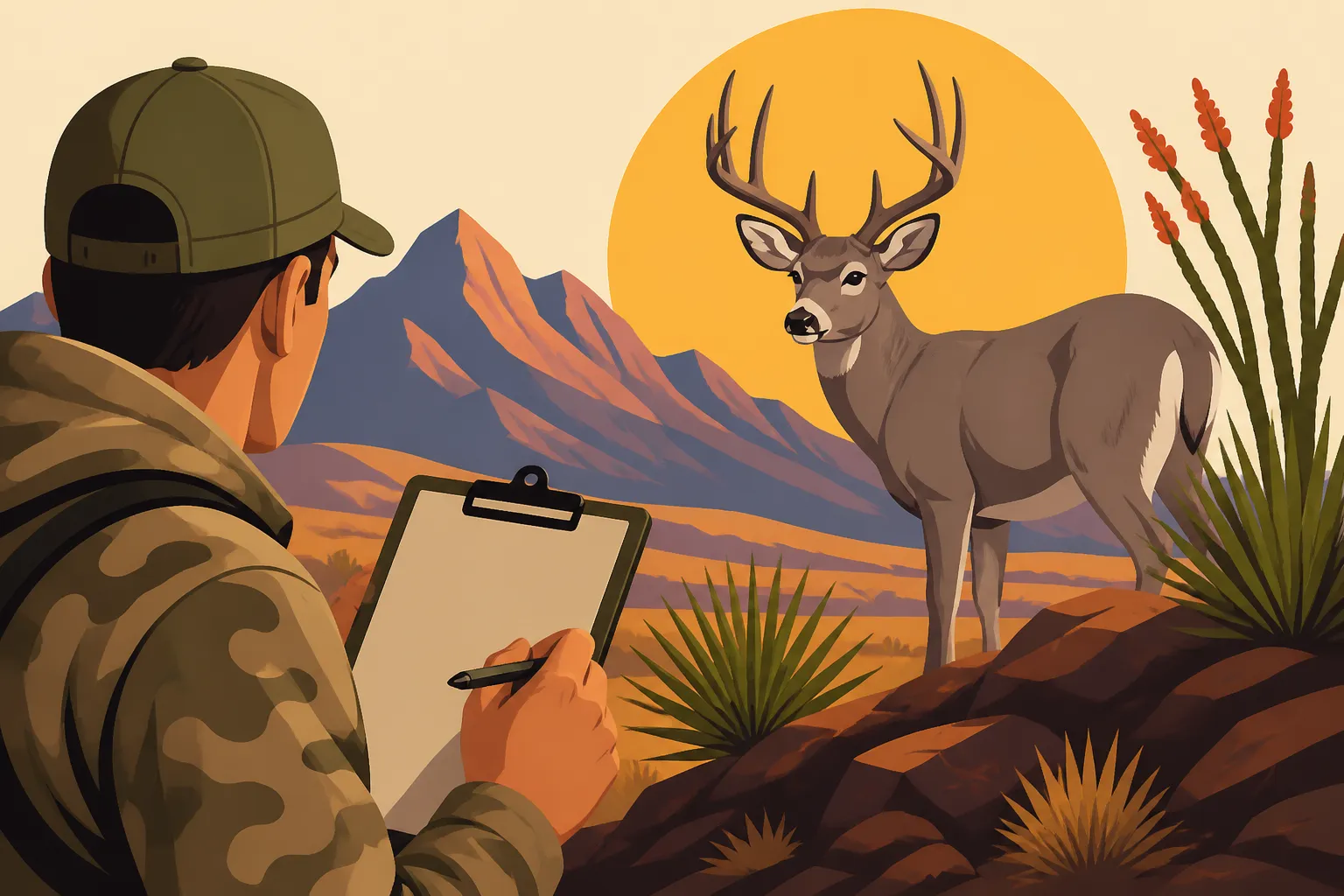
Judging a Coues Buck in Southern New Mexico
Spotting a Coues buck in the vast, broken country of Southern New Mexico is a feat in itself, but the real challenge often comes in those fleeting moments when you have to decide if it's the buck you've been dreaming of. These "grey ghosts" are notoriously difficult to judge on the hoof, especially when they appear and disappear like phantoms through the sparse desert scrub. This guide is dedicated to helping you decipher those critical visual cues, so you can confidently assess a Coues buck when the pressure is on and make the shot count.
The Unique Challenge of Coues Deer Hunting
Coues deer hunting is an exercise in patience, persistence, and often, frustration. These are not your leisurely prairie antelope hunts where you have minutes to study an animal. Every encounter is a test of your observation skills and quick decision-making under duress.
Why Coues Are Called the "Grey Ghost"
It’s no exaggeration when hunters refer to Coues deer as the "grey ghosts" of the desert. Their coat perfectly blends with the sun-drenched, rocky, and brushy terrain of Southern New Mexico. One moment they're there, a distinct shape on a distant hillside; the next, they've vanished as if they were never there at all. This incredible camouflage and their natural wariness make them incredibly difficult to spot, let alone hold in your optics long enough to make a proper judgment. They move silently through thickets of ocotillo, mesquite, and thorny acacia, often only giving you a glimpse as they traverse an open lane or top a ridgeline. The very act of finding one can be so exhilarating that the pressure to make a quick decision about its trophy potential becomes immense.
The Speed of the Encounter
Unlike some larger big game species, where you might have the luxury of observing an animal for several minutes, or even hours, the typical Coues deer encounter is often measured in seconds. You might catch a glimpse of movement, bring your binoculars up, and just as you start to process what you're seeing, the buck has moved behind a mesquite bush or dipped into a wash, disappearing from view. This rapid-fire nature of encounters means you need to have your mental checklist dialed in and be able to run through it in the blink of an eye. There's rarely time for a leisurely debate with your hunting partner about "is he a shooter?" You're almost always on your own for the initial assessment.
Size Deception in Open Country
The sprawling, often featureless terrain of Southern New Mexico plays cruel tricks on a hunter’s perception. What might look like a monster buck at 800 yards through heat shimmer can shrink dramatically to a modest fork-horn when you finally get a closer look. The sheer vastness of the landscape, combined with the lack of familiar reference points like large trees or fence lines, makes judging both distance and the actual size of a deer incredibly difficult. A Coues buck standing on a distant ridge can appear monumental, simply because there's nothing else nearby to offer scale. This phenomenon, often leading to "ground shrinkage," is a common frustration for Coues hunters.
Understanding Coues Buck Anatomy and Key Indicators
To become proficient at judging Coues bucks, you need a solid grasp of their physical characteristics, both in terms of body and antler development. It’s not just about the rack; the whole animal tells a story about its age and potential.
Body Size as a Starting Point
Coues deer are the smallest subspecies of white-tailed deer in North America, often weighing between 80 to 120 pounds for a mature buck. To put that into perspective, a large Coues buck might be comparable in body size to a larger coyote or a smaller domestic German shepherd. When you’re trying to judge a buck, start by assessing its overall body mass. A young buck will typically appear lanky, with a slender neck and a body that looks almost "tucked up" under its frame. A mature buck, especially during the rut, will have a much broader chest, a thicker, more muscular neck that ties seamlessly into its shoulders, and a more substantial, robust body. Look for that broad, heavy chest and a distinct sag in the belly, which often indicates an older, mature animal. If it looks like a small mule deer, you're likely looking at a good Coues. For a detailed comparison, you might find our guide on "Judging Coues Against Mule Deer" particularly insightful.
Antler Characteristics and Growth Patterns
Coues deer antlers, while similar in basic structure to other white-tailed deer (a main beam with tines projecting upwards), are generally smaller in diameter and length. A truly impressive Coues rack will often have exceptional width and good mass, which can be deceiving. Don't be fooled by the number of points alone; a buck with wide main beams and solid tines, even if it's "only" a 3×3, can easily outscore a taller, narrower 4×4.
Here are the key things to look for:
- Width: This is often the most coveted characteristic. A buck whose antlers extend significantly beyond his ear tips (which are typically around 12-14 inches wide) is usually a desirable animal.
- Mass: Look for heavy bases that carry their mass well out along the main beams. Thin, spindly antlers rarely make for high-scoring bucks.
- Tine Length: Long, well-defined G-tines (G1, G2, G3) add significant score. Pay attention to the length of the G2, which is often the longest.
- Main Beam Length: While harder to judge, longer main beams contribute to the overall score and aesthetic.
Many young bucks will be spike bucks or small fork-horns. A "shooter" will typically have a well-developed main frame, with at least two or three strong points on each side, and good width.
Age Indicators Beyond the Rack
While antlers are what we often fixate on, the buck’s overall appearance—its body language, facial features, and even its gait—can tell you a lot about its age.
- Facial Features: A young buck will have a more refined, almost delicate face with a shorter nose. An older, mature buck will typically exhibit a broader forehead, a blockier muzzle, and a much heavier neck that looks disproportionately thick compared to its body, especially during the rut. This heavy neck provides a good indicator of maturity, as it typically develops between 3.5 to 4.5 years of age.
- Body Posture and Mass: As bucks age, their body posture changes. Younger deer are agile and sleek. Older bucks develop a heavier, more saggy belly, their back might appear slightly swayed, and their legs might seem a bit shorter in proportion to their body. They move with a more deliberate, sometimes slower, gait.
- Behavior: Mature bucks tend to be more wary and cautious, often pausing longer to survey their surroundings. They might also be seen alone more often outside of the rut, whereas younger bucks often travel in bachelor groups.
Field Judging Techniques for Coues Deer
Given the challenging nature of Coues hunting, developing effective field judging techniques is paramount. You need a system that allows for rapid, accurate assessment.
The "Eight-Second Rule" and Quick Assessment
In the lightning-fast world of Coues hunting, you might only have a precious few seconds to decide if you want to pursue a buck. This is where the "eight-second rule" comes into play. It's not a hard-and-fast rule, but a mental framework for rapid assessment. As soon as you spot a buck and get your optics on it, run through a quick mental checklist:
- Width First: Does the rack extend significantly beyond its ears? This is often the primary visual cue for a good Coues.
- Mass Second: Do the bases look thick and carry that thickness out? Or do they look spindly?
- Tine Length/Number: Are there clear, strong points? Are they long enough to be impressive?
- Body Size/Age: Does the body look mature? Is the neck thick?
If the buck passes these initial checks, then you know it's worth a closer look or a strategic stalk. If it hesitates, don’t hesitate yourself. You need to know what your minimum "shooter" looks like before you even step into the field.
Utilizing Optics for Detailed Evaluation
Quality optics are not just helpful; they are absolutely indispensable for Coues hunting in New Mexico's wide-open spaces. You'll spend most of your day behind glass, meticulously picking apart distant hillsides.
- Binoculars: A good pair of 10×42 or 12×50 binoculars are your primary scouting tool. They offer a wide field of view and sufficient magnification to spot deer at long distances. For those long days of intense glassing, a stable platform is crucial. Consider mounting your binoculars on a tripod. This drastically reduces fatigue and allows you to pick up subtle movements and details you'd otherwise miss. Our guide on "Binocular Size That Survives an All-Day Session" offers excellent advice on choosing the right pair.
- Spotting Scope: Once you've located a buck with your binoculars, a spotting scope (typically 15-60x or 20-70x) becomes your best friend for detailed evaluation. It allows you to really pick apart the antlers: counting points, assessing mass, and estimating tine length. A good spotting scope, paired with a sturdy tripod, provides the stability needed for those extended sessions of judging. For more on this, check out "Spotting Scope Power for Open Country".
- Glassing Techniques: Don't just scan randomly. Employ systematic glassing methods. "The Grid Glassing Method, Step by Step" can help you thoroughly cover an area without missing details. Once you've found a buck, try to get different angles if possible, or at least watch it move to observe its gait and body shape from various perspectives.
Comparing to Known Reference Points
One of the most effective ways to estimate antler dimensions is to use the buck's own body as a measuring stick.
- Ear Width: A Coues deer's ears are a fairly consistent reference. From tip to tip, they generally measure around 12 to 14 inches. If a buck's antlers are significantly wider than his ears, you're looking at a respectable spread. If they are twice as wide, you're likely looking at a phenomenal buck.
- Ear Length: Individual tine length can be compared to the length of the buck's ear. If a tine is as long as, or longer than, his ear, it’s a good tine.
- Eye-to-Nose Length: This shorter measurement can be used for judging mass at the bases. Does the base appear as thick as the distance from the corner of the eye to the tip of the nose?
Practice makes perfect. Spend time looking at photos and videos of Coues bucks, trying to judge them before checking their actual scores. This helps calibrate your eye and makes you faster and more accurate in the field.
Common Pitfalls and How to Avoid Them
Even the most experienced Coues hunters fall victim to misjudgment from time to time. Knowing the common traps can help you minimize errors.
The "Ground Shrinkage" Phenomenon
Ah, ground shrinkage. It's the bane of every hunter's existence. That buck that looked like a Boone and Crockett contender through your scope often seems to have miraculously shrunk in size by the time you walk up to it. This happens for several reasons:
- Adrenaline: The rush of a hunting encounter can distort perception, making everything seem bigger and more impressive.
- Distance Distortion: As mentioned earlier, long distances can make antlers appear wider or taller than they actually are, especially when viewed against a vast, empty backdrop.
- Lack of Context: Without anything familiar nearby for scale, it's easy for your brain to exaggerate the size of what you're seeing.
To combat this, mentally add a few inches to your estimate in the field. If you think it's a 100-inch buck, aim for one that looks like a 105-inch buck. Always err on the side of caution. If there's any doubt, and you're truly after a trophy, pass on the buck and keep looking.
Distance and Angle Deception
The rugged topography of Southern New Mexico, with its steep canyons and rolling hillsides, is a master of deception.
- Foreshortening: A buck standing directly facing you or quartering towards you can have his antlers appear significantly shorter than they are. Conversely, if he’s quartering away, the antlers might look wider.
- Background: Antlers viewed against a light-colored sky can look larger and more distinct than if they're seen against a dark, busy background of brush.
- Mirage: Heat waves rising off the desert floor can make any distant object shimmer and distort, blurring outlines and making accurate judgment nearly impossible. Wait for clearer viewing conditions if possible, or try to view the animal from a different angle to minimize these effects. For dealing with challenging shot conditions and angles, our article on "Holding for Wind Across a Deep Canyon" provides insights that can be adapted to understanding terrain effects on judgment.
Understanding Score vs. Trophy Qualities
It's easy to get caught up in the numbers game, chasing a specific score. However, a true trophy is often defined by the hunt itself and the personal satisfaction it brings, rather than an arbitrary measurement.
A "scorer" is a buck that will likely meet or exceed certain record book requirements. These are often symmetrical, wide-racked bucks with good mass and long tines. A "trophy," on the other hand, is a buck you are proud of. It might be an old, gnarly-racked deer that survived many seasons, a buck with unique character, or simply the culmination of a tough hunt. Don't let the pursuit of a specific score overshadow the experience and the personal value of your harvest.
When researching hunt units for Coues deer, resources like GoHunt can provide invaluable data on historical harvest success and typical antler size for specific areas in Southern New Mexico. This can help set realistic expectations and inform your strategy for finding a buck that aligns with your definition of a "trophy."
Strategic Considerations for Coues Hunting in Southern New Mexico
Beyond the immediate act of judging, understanding the broader context of Coues hunting in New Mexico will significantly improve your chances of success.
Habitat and Terrain Specifics
Coues deer thrive in the rugged, arid mountain ranges of Southern New Mexico, often at elevations ranging from 4,000 to 7,000 feet. Their preferred habitat is characterized by a mix of chaparral, oak brush, juniper, and various cacti. They are often found in steep, rocky canyons and on brushy hillsides that provide ample cover.
Specific mountain ranges known for Coues include the Peloncillo Mountains, the Animas Mountains (especially in the "Bootheel" region), the Big Hatchet Mountains, and parts of the Burro Mountains. These areas are vast and unforgiving, demanding physical fitness and a keen eye for detail. You’ll be spending a lot of time glassing these slopes. If you're planning a hunt in the southwestern corner of the state, be sure to read our detailed guide on "Coues Hunting in the Bootheel Ranges". The ability to navigate this terrain silently and effectively is key, and sometimes that means practicing "Still Hunting Oak Brush for Coues" to get within range after spotting one.
Best Time to Hunt for Judging Opportunity
While Coues can be hunted throughout their seasons, the late season, particularly during the rut, often provides the best opportunities for judging bucks.
- Increased Activity: During the rut, which typically peaks in New Mexico from late December through January, bucks are far more active. They're on the move, chasing does, and often less cautious, making them easier to spot and observe for longer periods. Our article "When the Coues Rut Peaks" offers more insights into timing your hunt.
- Visibility: The colder temperatures of late season can also lead to clearer air and less heat shimmer, which improves visibility for glassing. The vegetation might also be less dense, offering better sight lines.
- Body Cues: During the rut, bucks will have swollen necks and more pronounced body mass, making age assessment easier.
Hunting during the rut increases your chances of seeing multiple bucks, giving you more opportunities to practice your judging skills and hold out for the right animal.
Scouting and Preparation
Successful Coues hunting, and by extension, successful field judging, begins long before the season opens. Thorough scouting is non-negotiable.
- E-Scouting: Utilize online mapping tools and satellite imagery to identify potential hunting areas, glassing points, water sources, and escape routes. Platforms like GoHunt provide excellent layered maps that can help you understand terrain, access points, and land ownership from your computer. Our guide on "E-Scouting a New Mexico Unit Before the Season" offers comprehensive strategies.
- Pre-Season Field Scouting: If possible, spend time in your chosen unit before the hunt. This allows you to identify game trails, bedding areas, and feeding grounds. More importantly, it helps you understand the scale of the landscape and how distances appear in that specific terrain, which is invaluable for field judging.
- Physical Conditioning: Coues country is steep, rocky, and often involves significant elevation changes and long hikes. Being in good physical shape will allow you to cover more ground, remain clear-headed under pressure, and make better decisions, including judging bucks accurately.
Understanding how to read the landscape, including "Reading Wind in a Deep Gila Canyon" (even if you're not in the Gila, the principles apply to any canyon country) is a critical skill that helps you anticipate deer movement and get into position for a better look.
Coues Buck Judging Reference Guide
Here’s a quick reference table to help you distinguish between a young and a mature Coues buck in the field:
| Characteristic | Young Buck (1.5-2.5 years) | Mature Buck (3.5+ years) |
|---|---|---|
| Body Size | Slender, lanky appearance; long legs; no noticeable sag | Thick, stocky, and robust body; noticeable "pot belly" often; shorter-looking legs |
| Neck | Thin, merges smoothly with shoulders | Thick, muscular, especially during rut; often appears to "tie into" brisket |
| Head/Face | More refined, almost "pointy" muzzle; shorter nose | Broad forehead; blockier, more robust muzzle; heavy jawline |
| Antler Mass | Thin bases; mass often drops off quickly | Heavy, thick bases; mass carried well out along main beams |
| Antler Width | Often inside or slightly outside ear tips | Significantly outside ear tips (14"+ spread is good) |
| Tine Length | Shorter, less developed tines | Longer, well-defined tines (G2 often longest) |
| Behavior | More nervous, often travels in groups | More cautious, deliberate movements; often solitary outside of rut |
Disclaimer
Hunting is an inherently dangerous activity. This guide provides general information for educational purposes only. Always consult the official New Mexico Department of Game and Fish regulations for the most current and accurate rules and laws before planning or embarking on any hunting trip. Hunter safety is paramount; always handle firearms responsibly and be aware of your surroundings.