Santa Fe National Forest Hunting Access
It’s easy to feel overwhelmed when you look at a map of New Mexico’s vast public lands, especially when you’re trying to pinpoint where to actually hunt. The Santa Fe National Forest, while a treasure, presents its own set of challenges for hunters trying to understand access, terrain, and regulations. This guide is here to break down everything you need to know about hunting within the Santa Fe National Forest, helping you navigate its diverse landscape and plan a successful outing.
Understanding the Santa Fe National Forest as Hunting Ground
The Santa Fe National Forest is an incredible resource for hunters in New Mexico, offering millions of acres of diverse terrain, from high-alpine peaks to rolling piñon-juniper foothills. It's a place where you can truly get away from it all, but that wildness also means you need to be prepared and knowledgeable about the area. Many hunters flock here for its reputation for big game, but smaller species also thrive.
What Makes the Santa Fe NF Unique for Hunters?
Unlike some of the more rugged and remote Gila Wilderness areas, the Santa Fe National Forest often feels a bit more accessible, largely due to its proximity to population centers like Santa Fe and Los Alamos, and a more developed network of forest roads. However, don't mistake "accessible" for "easy." You can still find vast tracts of roadless country and steep, challenging terrain that will test your physical limits. The forest also encompasses a wide range of elevations, which means different habitats and game species depending on where you are. You might be hunting elk at 10,000 feet in one area and chasing mule deer in brushy canyons below 7,000 feet in another, all within the same general forest boundary. This elevation change is a significant factor in Hunting New Mexico From 4,000 Feet to 10,000, and it certainly applies here. The sheer scale of it means you could spend a lifetime exploring and never see it all.
The varied topography—from the high peaks of the Sangre de Cristos to the volcanic Jemez Mountains—creates distinct ecosystems, each with its own set of challenges and rewards for hunters. These mountains are often characterized by dense stands of ponderosa pine, mixed conifer, and aspen at higher elevations, transitioning to piñon-juniper and oak brush lower down. Water sources, while sometimes sparse in drier periods, are often found in the form of seasonal creeks, springs, and man-made tanks, which can be critical focal points for wildlife. Understanding these micro-habitats within the larger forest context is key to locating game.
Key Species and Their Habitat in the Santa Fe NF
The Santa Fe National Forest is a magnet for big game hunters, primarily known for its elk and mule deer populations. However, it also hosts black bear, mountain lion, and a variety of small game and upland birds. Understanding where these animals prefer to live within the forest can significantly increase your chances of success.
Elk: Elk are arguably the most sought-after big game animal here. They prefer the higher elevations, often found in mixed conifer and aspen forests, especially during the rut in September. Lush mountain meadows, dark timber, and areas with good water sources are prime elk habitat. During later seasons, they may drop to lower elevations as snow pushes them down, often into south-facing slopes or lower timbered areas. When the bugle starts When the Elk Rut Peaks in New Mexico, the forest comes alive, and knowing their preferred cover and feeding areas is paramount.
Mule Deer: Mule deer are widely distributed throughout the Santa Fe National Forest, from the higher timbered country down into the piñon-juniper and oak brush zones. They tend to be more spread out than elk, often utilizing rimrock, broken terrain, and dense cover for bedding. In the early archery seasons, you might find them in higher country, but as colder weather and snow arrive, they often migrate to lower, brushier wintering grounds. Understanding deer migration patterns, particularly in units with significant elevation changes, can be a game-changer.
Bear and Mountain Lion: Both black bears and mountain lions are present throughout the forest. Bear populations tend to follow food sources, often found in areas with oak brush (for acorns), berry patches, or near water. Mountain lions are more elusive, tracking deer and elk herds, using rugged, broken country for cover and ambush points. While opportunities for these predators are available, they often require specific tags and a dedicated hunting approach.
Small Game and Upland Birds: For those looking for smaller quarry, the Santa Fe National Forest offers opportunities for turkey, grouse, and various small game like squirrels and rabbits. Merriam's turkeys thrive in the ponderosa pine and mixed conifer forests, often found along riparian corridors. Blue grouse inhabit the highest elevation spruce-fir forests.
Here’s a quick overview of primary game species and their typical haunts in the Santa Fe NF:
| Species | Preferred Habitat (Santa Fe NF) | Key Terrain Features |
|---|---|---|
| Elk | Mixed conifer, aspen groves, high mountain meadows | Dark timber, north-facing slopes, proximity to water |
| Mule Deer | Piñon-juniper, oak brush, ponderosa pine, broken country | Rimrock, dense cover, south-facing slopes in winter |
| Black Bear | Oak brush, riparian areas, berry patches, dense timber | Areas with food sources, thick bedding cover |
| Mountain Lion | Rugged canyons, rimrock, areas with high prey density | Steep terrain, dense cover, rocky outcrops |
| Merriam's Turkey | Ponderosa pine, mixed conifer, riparian zones | Roosts in large trees, open feeding areas |
Navigating Access and Regulations in the Santa Fe NF
Hunting in any national forest means understanding the ins and outs of public access and adhering to specific regulations that go beyond just your hunting license. The Santa Fe National Forest has millions of acres, but getting to the best spots and staying legal requires some homework.
Public Access Points and Road Networks
The Santa Fe National Forest is crisscrossed by a network of forest roads, ranging from well-maintained gravel roads to rugged two-tracks that require a high-clearance 4×4. Many of these roads offer excellent access to trailheads that lead into deeper backcountry, while others may get you directly into hunting areas. Always check the current status of forest roads before heading out. Seasonal Road Closures Across New Mexico are common, especially in higher elevations during winter or during periods of heavy rain, which can make even graded roads impassable. The Forest Service also implements seasonal closures to protect roads during spring thaw or to minimize disturbance to wildlife.
When planning your route, be aware that not all roads are open to motorized travel during hunting season, and some may have restrictions on vehicle types or hours of use. It's imperative to consult the official Forest Service motor vehicle use maps (MVUMs) for the specific ranger district you plan to hunt. These maps clearly designate which roads are open, when, and for what type of vehicle. Don't rely solely on general mapping apps; the MVUMs are the authoritative source for motorized travel rules. Understanding Motorized Travel Rules on New Mexico Public Land is crucial to avoid tickets and tread lightly on the land.
Respecting Private Inholdings and Boundaries
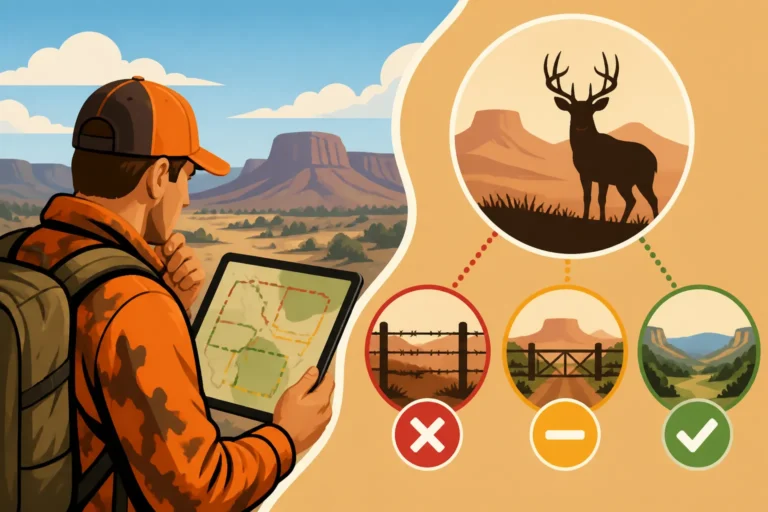
One of the biggest headaches for hunters on public land, and specifically within the Santa Fe National Forest, is the patchwork of private land. Private inholdings—parcels of private land completely surrounded by public land—are common. It’s easy to accidentally trespass if you're not paying close attention. Always remember that simply being on foot doesn't grant you permission to cross private land, even if it feels like a shortcut. Crossing Private Ground to Reach Public Land requires explicit written permission from the landowner, and it's a rule that New Mexico Game and Fish takes very seriously.
This is where detailed mapping tools like onX Hunt or GoHunt become absolutely indispensable. These apps overlay land ownership boundaries directly onto satellite imagery, allowing you to see exactly where public land ends and private land begins in real-time on your phone or GPS device. Spending time E-Scouting a New Mexico Unit Before the Season with these tools is not just a recommendation; it's a necessity. Zoom in, identify potential access routes, and locate any private inholdings that might block your path to public ground. This advanced planning helps you avoid stressful confrontations and legal trouble in the field.
Key Regulations Specific to Santa Fe NF Hunting
Beyond your New Mexico big game license and species-specific tags, there are general rules and regulations that apply when hunting on federal lands like the Santa Fe National Forest.
- Tree Stands and Blinds: If you plan to use a tree stand or ground blind, be aware of Forest Service regulations. Generally, temporary stands and blinds are allowed, but they must be removed within a specific timeframe (often within two weeks of the close of the season or within 24 hours of being placed, depending on the specific district rules). Permanent stands are almost universally prohibited. Always verify the rules for your specific area. Understanding Tree Stand Rules That Apply on Public Land is essential.
- Camping: Dispersed camping (camping outside of designated campgrounds) is generally permitted in the Santa Fe National Forest, but there are usually limits on how long you can stay in one spot (often 14 days) and restrictions on campfires, especially during dry periods or fire bans. Always check current fire restrictions before lighting a campfire.
- Food Storage: If you're in bear country, proper food storage is critical. This means using bear-resistant containers, hanging food from trees, or storing it in a hard-sided vehicle or bear box. This isn't just a suggestion; it’s a crucial safety measure for both you and the bears.
- Target Shooting: While target shooting is generally allowed in many parts of the National Forest, it comes with strict rules regarding backstops, litter, and prohibited items (e.g., exploding targets). Always practice safe firearm handling and be aware of your surroundings.
- Legal Shooting Hours: Like all of New Mexico, hunting in the Santa Fe National Forest must adhere to New Mexico Legal Shooting Hours for Big Game. These are typically from one-half hour before sunrise to one-half hour after sunset. Violating this rule can lead to severe penalties.
Always consult the most current New Mexico Game and Fish hunting proclamation and any specific Forest Service regulations for the district you intend to hunt. These resources provide the definitive word on legalities.
Planning Your Hunt: Tools and Preparations
A successful hunt in the Santa Fe National Forest, like any wilderness area, hinges on meticulous planning and preparation. It's not just about drawing the right tag; it's about knowing the land, being physically ready, and having the right tools.
Essential Mapping and Scouting Resources
In today's hunting world, digital mapping has become an absolute game-changer, especially for vast public lands like the Santa Fe National Forest. Forget the days of getting lost with a paper map (though it's still smart to carry one as a backup!).
- Digital Mapping Apps (onX Hunt, GoHunt, Gaia GPS): These are your best friends. As mentioned earlier, onX Hunt and GoHunt provide critical land ownership layers, showing you public vs. private boundaries, which is invaluable for avoiding trespass. They also offer topographic maps, satellite imagery, and the ability to mark waypoints, track your movements, and measure distances. Use these tools to identify potential glassing points, water sources, bedding areas, and travel corridors. Before you even set foot in the forest, you can spend hours E-Scouting a New Mexico Unit Before the Season, finding hidden benches, saddles, and drainages that might hold game. These apps often allow you to download maps for offline use, which is crucial given the notoriously spotty cell service in remote areas of the Santa Fe NF.
- Forest Service MVUMs: These maps, specific to each Ranger District within the Santa Fe National Forest (e.g., Española, Pecos/Las Vegas, Coyote, Jemez), are essential for understanding motorized access. They clearly delineate which roads are open to vehicles, which are seasonal, and which are closed entirely. Many of these can be downloaded as PDFs or GPX files to integrate with your digital mapping app.
- New Mexico Game and Fish Proclamation: This annual publication is your hunting bible. It contains all the hunt codes, season dates, bag limits, and general regulations for every species and unit in the state. You absolutely need to read and understand the sections relevant to your hunt area and species. Reading a New Mexico Hunt Code Before You Apply is a skill every hunter needs to master.
- Topographic Maps and Aerial Imagery: Whether digital or paper, these maps reveal the lay of the land—elevation changes, drainages, ridges, and potential travel routes. Combine them with aerial imagery to identify vegetation types, old burns, and clearings that might attract game. Look for areas where different habitat types converge, as these are often productive.
- Scouting in Person: While digital tools are powerful, nothing beats boots-on-the-ground scouting. If possible, visit your hunting area a few weeks or months before the season. Look for fresh sign: tracks, rubs, scrapes, droppings, and feeding areas. Pay attention to water sources and potential bedding cover. Even a day trip can give you invaluable insights that satellite imagery simply can’t provide.
Physical Preparation and Safety Considerations
Hunting in the Santa Fe National Forest is often physically demanding. High elevations, steep terrain, and long hikes are common, especially if you plan to get away from the roads.
- Physical Conditioning: Start a training regimen well before your hunt. Focus on cardiovascular endurance (hiking with a pack, running), strength training (especially legs and core), and flexibility. If you're coming from sea level, understand that Altitude Preparation for a Gila Elk Hunt (or any high-elevation hunt) is critical. The air is thinner, and even simple tasks become more strenuous. Arrive a few days early if possible to acclimatize.
- Weather Awareness: Mountain weather is notoriously unpredictable. A warm, sunny morning can quickly turn into a snowy, windy afternoon, even in early fall. Carry appropriate layers, including rain gear and insulated clothing. Layering for Gila Temperature Swings applies just as much to the Santa Fe. Check forecasts frequently, but always be prepared for the worst.
- Navigation Skills: Always carry a compass and know how to use it, even with a GPS. Batteries die, devices fail. Familiarize yourself with your hunting area beforehand and have a mental map.
- First Aid and Emergency Gear: A well-stocked first aid kit is non-negotiable. Carry a headlamp, fire-starting materials, a multi-tool, extra food and water, and a communication device (satellite messenger/PLB is recommended where cell service is absent). Tell someone your exact hunting plan and expected return time.
- Water Management: Identify water sources before your hunt and carry a reliable water filter or purification tablets. Even in seemingly lush areas, water can be scarce, especially during drier years.
Maximizing Your Success in the Santa Fe NF
Success in the Santa Fe National Forest isn't just about finding game; it's about understanding how to hunt the specific landscape and conditions it presents. This means adapting your strategies to seasonal changes and diverse terrains.
Seasonal Considerations and Wildlife Movement
The timing of your hunt significantly impacts where you'll find game and how they behave.
- Early Archery (Late August/September): During the early archery seasons, particularly for elk, animals are often still in higher elevation summer ranges. This is when the elk rut peaks, and bugling activity can be intense. However, weather can still be hot, making game retrieval challenging and requiring diligent meat care. Mule deer might still be fairly high up, often in bachelor groups.
- Mid-Season (October/Early November): As temperatures drop and potentially the first snows arrive, animals may begin to shift. Elk might still be in high country, but deer start to move down to lower, brushier areas, especially as the mule deer rut approaches. This is a great time for rifle hunters, but pressure can be high near accessible roads.
- Late Seasons (November/December): By the late seasons, significant snowfall in the high country typically pushes elk and deer to lower elevations. South-facing slopes that melt off faster become critical, as do wintering grounds in the piñon-juniper belts. Hunting can be challenging due to cold weather and potentially deep snow, but it also offers opportunities to intercept migrating animals.
Understanding these patterns and combining them with your e-scouting can help you pinpoint the most likely areas to find game during your specific hunt dates.
Strategies for Different Terrains
The Santa Fe National Forest is a mosaic of different terrains, each requiring a tailored hunting approach.
- High-Elevation Timber and Aspen: For elk in these areas, particularly during the rut, focus on wallows, dark timber for bedding, and aspen groves for feeding. Still-hunting through dense timber can be effective, moving slowly against the wind. In open parks and meadows, glassing from a distance during early morning and late evening can reveal feeding animals before they retreat to cover. Calling strategies like bugling or cow calls are often effective here during the rut.
- Broken Country and Rimrock: Mule deer often prefer this type of terrain. The key here is patience and thorough glassing. Find a vantage point and systematically pick apart the slopes, canyons, and rimrock with good optics. Use a GoHunt or onX Hunt map to identify likely bedding areas on benches or under cliffs. Once game is spotted, a careful spot-and-stalk approach is often required, using terrain features to conceal your movement.
- Piñon-Juniper and Oak Brush: These lower elevation areas can hold significant numbers of deer, especially in later seasons, and bear throughout the fall. The dense, thorny vegetation makes still-hunting difficult and noisy. Focus on natural travel corridors, game trails, and areas with good visibility like small clearings or ridges within the brush. Sitting over water sources (tanks or springs) can also be productive, especially in drier years. Drives with multiple hunters can work here, but always ensure safety and clear communication.
- Riparian Areas and Stream Bottoms: These areas, even narrow ones, often act as magnets for all wildlife due to the presence of water and lush vegetation. Walk these areas slowly and quietly, paying close attention to fresh sign. Turkeys are particularly fond of these habitats.
No matter the terrain, wind direction is paramount. Always try to approach game with the wind in your face or across your body to prevent your scent from being carried to the animals. In mountainous terrain, thermals—air currents that rise in the morning and fall in the evening—can also influence wind direction, often moving uphill during the day and downhill at night. Factor these into your approach to stay concealed.
Disclaimer
This article is for general informational purposes only and does not constitute professional advice. Laws, prices and regulations vary by location and change over time. Consult a qualified professional for guidance on your specific situation.