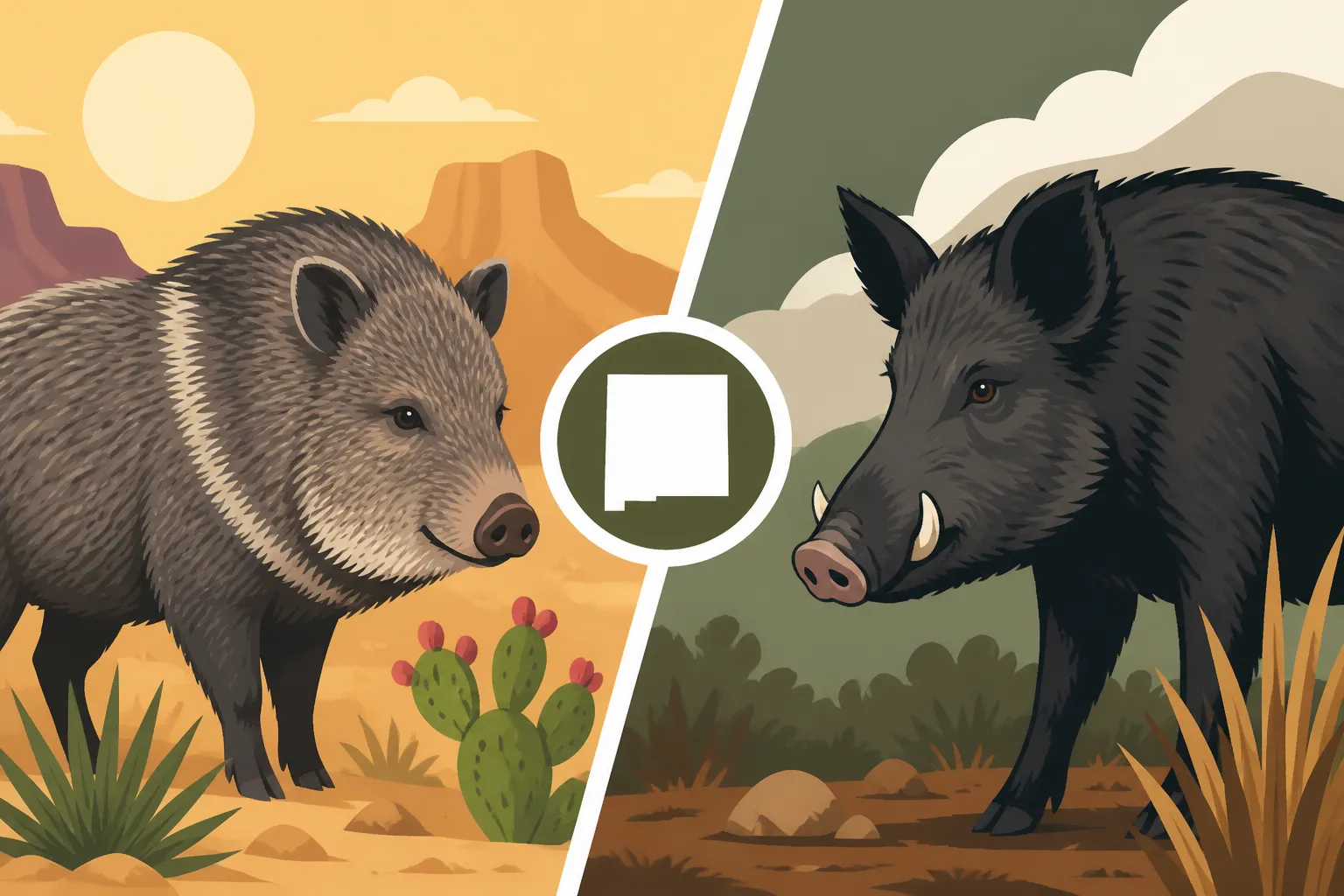
How Javelina Differ From Wild Pigs
It’s a common scenario out here in New Mexico: you’re glassing a mesquite flat or hiking through arroyos in the southern units, and you spot a dark, bristly animal rooting around. Your mind immediately goes to “pig,” but then the questions start. Is it a javelina, that unique desert dweller, or is it one of those destructive wild pigs everyone talks about? This confusion is incredibly common, and honestly, who can blame anyone for mixing them up at a glance? They look remarkably similar, especially from a distance. But for hunters, ranchers, and anyone spending time outdoors, understanding the distinct differences between javelina (collared peccary) and feral wild pigs is absolutely vital, not just for correct identification, but for legal hunting, conservation efforts, and simply knowing what you’re looking at in the field. This guide will walk you through the nuances, ensuring you can tell these two fascinating, yet very different, animals apart.
The Great Southwest Mix-Up: Why Javelina and Wild Pigs Get Confused
Let’s be honest, it’s easy to confuse these two. Both are medium-sized, dark-colored, bristly animals that root around with their snouts and often travel in groups. They share a certain wild, untamed look that tricks the eye. This superficial resemblance is the root of the mix-up, and it’s perpetuated by everything from casual conversation to sometimes even misidentified images online. But dig a little deeper, and their worlds couldn't be more different.
A Shared Aesthetic, But Not Shared Biology
Visually, both javelina and wild pigs possess coarse hair, short legs, and a stout body. They tend to be dark, ranging from grizzled gray to black, and often have a muddy or dusty appearance from their foraging habits. When you catch a glimpse of them darting through scrub brush or hunkered down in a shadowy arroyo, the brain quickly categorizes them as "pig-like." This quick categorization, however, ignores millions of years of evolutionary divergence. While they might look like distant cousins, they are not even in the same biological family. Think of it like comparing a rabbit to a hare – similar at first glance, but fundamentally different animals with distinct life histories and characteristics.
Range Overlap and Habitat Similarities
Another reason for the confusion stems from their shared geography in parts of New Mexico. Both species thrive in arid to semi-arid environments, utilizing similar food sources like roots, tubers, cacti, and insects. While javelina are native to the Southwest, wild pigs are an introduced species that have adapted remarkably well to these challenging conditions. This means that in certain southern New Mexico units, particularly those with mixed brush, arroyos, and access to water, you might find both species occupying the same general habitat. When two different animals inhabit the same areas and share visual similarities, it's only natural for confusion to arise, particularly for hunters who might only encounter them sporadically.
Javelina: The Desert's True Native Peccary
The javelina, or collared peccary (scientific name: Pecari tajacu), is a truly unique animal, and it's a quintessential part of the New Mexico desert ecosystem. They are not pigs, wild or otherwise, but belong to their own family, Tayassuidae, which originated in the Americas. They've been roaming these lands for a very long time, adapting perfectly to the harsh, beautiful landscape.
Biological Distinctives of Javelina
When you get up close, or even with a good pair of binoculars, the biological differences become quite apparent. The most obvious is the "collar" – a lighter band of hair around their neck, which gives them their common name, "collared peccary." This band is usually a grizzled white or yellowish color, sharply contrasting with their darker body fur.
Their snout, while pig-like, is more pointed and proportionally smaller than a wild pig's. Look closely at their teeth: javelina have small, downward-pointing tusks that are sharp but not prominently curved upwards like those of a wild boar. These teeth are effective for cutting through tough vegetation like prickly pear cactus. Their feet are also distinct; javelina have four toes on their front feet and only three on their hind feet, with reduced dewclaws. You won't find a true tail on a javelina, just a tiny nub that's barely visible. Perhaps one of the most interesting biological features is their scent gland located on their back, just above the rump. Javelina use this musk gland to mark their territory and each other, creating a strong, distinct odor that can sometimes be smelled before you see the animals themselves. This scent helps keep the herd together and warns off intruders.
Javelina Behavior and Social Structure
Javelina are highly social animals, living in tight-knit family groups called "herds" or "bands," typically numbering from 5 to 15 individuals, though larger groups can occur. These herds are very cohesive, moving, feeding, and sleeping together. They communicate through a variety of vocalizations, including barks, grunts, and a distinct chattering of their teeth when alarmed. When threatened, a javelina herd will often bunch together, presenting a formidable, bristly front to a predator. They are generally crepuscular, meaning most active during dawn and dusk, but can be seen at any time of day, especially in cooler weather.
Their diet consists primarily of succulent desert vegetation, particularly prickly pear cactus, which provides both food and water. They also eat roots, bulbs, insects, and occasionally small vertebrates. Javelina are excellent at finding scarce water sources, which is crucial in their arid environment. Water Sources and Ethics in Desert Hunting becomes a critical consideration when hunting these animals, as they will often congregate around them. They are generally shy and will try to escape danger, but a cornered javelina can deliver a nasty bite with those sharp teeth.
Javelina Hunting in New Mexico
Hunting javelina in New Mexico is a unique and exciting challenge. These animals are regulated big game, meaning you need a specific tag, and there are designated seasons and bag limits. Opportunities are often limited, and drawing a tag can sometimes require a bit of luck, much like drawing for other desirable species. For hunters interested in pursuing these fascinating creatures, understanding their habits and habitats is key. Resources like GoHunt can be excellent for researching specific units, draw odds, and past harvest success rates. You can delve into New Mexico Javelina Draw Odds to understand your chances.
Wild Pigs: True Swine, Adaptable and Destructive
In stark contrast to the native javelina, wild pigs (also commonly called feral hogs, wild boar, or razorbacks) are an invasive species, and they are true members of the pig family (Suidae). These animals are not native to the Americas and are descendants of domestic pigs that either escaped or were intentionally released over centuries. They have since reverted to a wild state, exhibiting traits that make them incredibly resilient and highly problematic in many ecosystems, including parts of New Mexico.
The True Identity of Wild Pigs
Wild pigs are genetically identical to domestic pigs. They simply act and look wild because they've been living without human intervention for generations. Many populations in the United States, especially in the South, also have genetic influence from European wild boars that were introduced for hunting purposes. This interbreeding has created a super-tough, intelligent, and highly adaptable animal that poses a significant threat to natural habitats and agriculture. Their ability to revert quickly to a wild state, growing thick coats, prominent tusks, and lean, muscular bodies, is a testament to the strong wild genetics still present in domestic swine.
Physical Traits and Genetic Differences
Wild pigs are generally much larger than javelina, with mature boars weighing well over 200 pounds, and some even reaching 400 pounds or more. Their body shape is typically more robust and barrel-chested, often with a higher front shoulder. The most striking difference is their head and snout. Wild pigs have a longer, flatter snout, often disk-shaped at the end, perfectly designed for extensive rooting. Their ears are usually larger and more upright than a javelina's.
Their teeth are also a dead giveaway: wild pigs possess prominent, continuously growing tusks (canine teeth) that protrude from their mouths, especially the lower jaw. These tusks are razor-sharp and can inflict serious damage, used for defense, fighting among themselves, and for rooting. Unlike javelina, wild pigs have a distinct, often long and sparsely haired tail, which they frequently curl or twitch. Their coat color varies wildly, from solid black, brown, or red to spotted or striped patterns, depending on their domestic ancestry. They have four toes on both their front and hind feet, typically with visible dewclaws.
Destructive Behavior and Rapid Reproduction
Wild pigs are ecological wrecking balls. Their most recognizable destructive behavior is "rooting," where they tear up vast swaths of land with their powerful snouts in search of food. This rooting damages native vegetation, crops, infrastructure, and contaminates water sources. They compete with native wildlife for food, destroy wildlife food plots, and can even prey on fawns, ground-nesting birds, and other small animals. Their diet is incredibly broad, including just about anything: acorns, roots, tubers, fungi, insects, eggs, small animals, and carrion.
Their reproductive capacity is staggering. Sows can start breeding as young as 6 months old and can have multiple litters a year, with litter sizes averaging 4-8 piglets. This rapid reproduction allows populations to explode, making control efforts extremely challenging. This is why you'll often hear about them causing Feral Hogs and Where They Are a Problem across multiple states.
Hunting Wild Pigs in New Mexico (and Beyond)
Due to their destructive nature and invasive status, wild pigs are often classified differently than native big game. In many areas, including parts of New Mexico, they are considered an unrestricted nuisance species. This often means no closed season, no bag limits, and various hunting methods are allowed, sometimes even including night hunting or the use of electronic calls. Regulations can vary by county or specific land management areas, so always check the current New Mexico hunting rules and information booklet for the precise regulations in the unit you intend to hunt. Hunting wild pigs is often encouraged as a management tool to mitigate their environmental and agricultural damage, making it a different kind of hunting experience compared to pursuing regulated game animals like javelina.
Side-by-Side: Unmistakable Differences Between Javelina and Wild Pigs
To help consolidate these distinctions, here’s a quick comparison table:
| Feature | Javelina (Collared Peccary) | Wild Pig (Feral Hog/Wild Boar) |
|---|---|---|
| Scientific Family | Tayassuidae (New World Peccaries) | Suidae (Old World Pigs) |
| Origin | Native to the Americas (Southwest US, Central/South America) | Descendant of introduced domestic swine/European wild boar |
| Size (Adult) | Small (30-60 lbs, 18-24" shoulder height) | Large (100-400+ lbs, 24-36"+ shoulder height) |
| Appearance | Dark grizzled coat, distinct white/yellowish "collar" | Highly variable (black, brown, spotted, striped); no collar |
| Snout | More pointed, smaller in proportion to head | Longer, flatter, disk-shaped end, larger proportionally |
| Tusks/Teeth | Small, short, downward-pointing canines | Prominent, outward-curving tusks (especially lower jaw) |
| Tail | Vestigial nub, almost invisible | Distinct, often long, sparsely haired tail |
| Feet | 4 toes front, 3 toes hind (reduced dewclaws) | 4 toes front, 4 toes hind (prominent dewclaws) |
| Scent Gland | Present on rump (strong musk odor) | Absent (typical pig smell, but no distinct gland) |
| Social Structure | Tight-knit, stable family herds (5-15 animals) | Larger, less stable "sounders" (variable size, often 20+) |
| Reproduction | 1-2 litters/year, 1-3 piglets/litter | 2-3 litters/year, 4-8+ piglets/litter |
| Ecological Impact | Native, generally minimal impact on ecosystem | Invasive, highly destructive to habitat/agriculture |
| Hunting Status | Regulated big game (tag, seasons, limits) | Often unrestricted nuisance species (check local regs) |
Why Understanding the Distinction Matters for New Mexico Hunters
Knowing the difference between javelina and wild pigs isn't just an academic exercise; it has real, tangible implications for anyone who hunts or spends time in the New Mexico outdoors. Mistaking one for the other can lead to legal issues, misinformed hunting strategies, and a misunderstanding of your role in wildlife management.
Legalities and Regulations
This is perhaps the most critical reason to understand the difference. Javelina are a regulated big game species in New Mexico. This means you need to apply for a tag, often through a draw system, and must adhere to specific season dates, legal shooting hours, and bag limits. Hunting a javelina without a valid tag, or out of season, is a serious violation. For example, if you have a valid javelina tag, you cannot use it to take a wild pig, and vice-versa. Reading a New Mexico Hunt Code Before You Apply will clarify these regulations for specific hunts.
Wild pigs, on the other hand, are often treated as an exotic or nuisance species. As mentioned, they frequently have year-round seasons, no bag limits, and may be hunted using methods not permitted for native big game. Regulations can change, and they vary from unit to unit, or even private land to public land. Always consult the most current New Mexico Department of Game and Fish regulations. Ignorance of the law is never an excuse, and harvesting the wrong animal, or the right animal under the wrong regulations, can result in significant penalties.
Strategy and Approach
Beyond the legal aspects, the hunting strategies for javelina and wild pigs differ considerably. Javelina are herd animals with a strong sense of smell and hearing, but often poor eyesight. They rely on their tight social structure and the desert terrain for cover. Hunting them often involves spot-and-stalk tactics in broken country, focusing on areas with prickly pear cactus or known water sources. Their small size and defensive group behavior mean a different shot placement and approach than a large wild boar.
Wild pigs, especially large boars, can be much more aggressive, particularly if wounded or cornered. They are incredibly tough animals. Their rooting behavior makes them relatively easy to find, but their nomadic nature and vast home ranges can make patterning them a challenge. Baiting and trapping are common methods for wild pig control, and in some areas, night hunting with thermal optics is allowed. The sheer size and power of a wild pig mean a different caliber of weapon might be preferred, and tracking a wounded hog can be a dangerous endeavor. Understanding which animal you are pursuing will directly inform your gear, tactics, and safety considerations. Don't go into a wild pig hunt with a javelina mindset, or vice versa; the animals, and the hunt, are entirely different.
Disclaimer
This article is for general informational purposes only and does not constitute professional advice. Laws, prices and regulations vary by location and change over time. Consult a qualified professional for guidance on your specific situation.