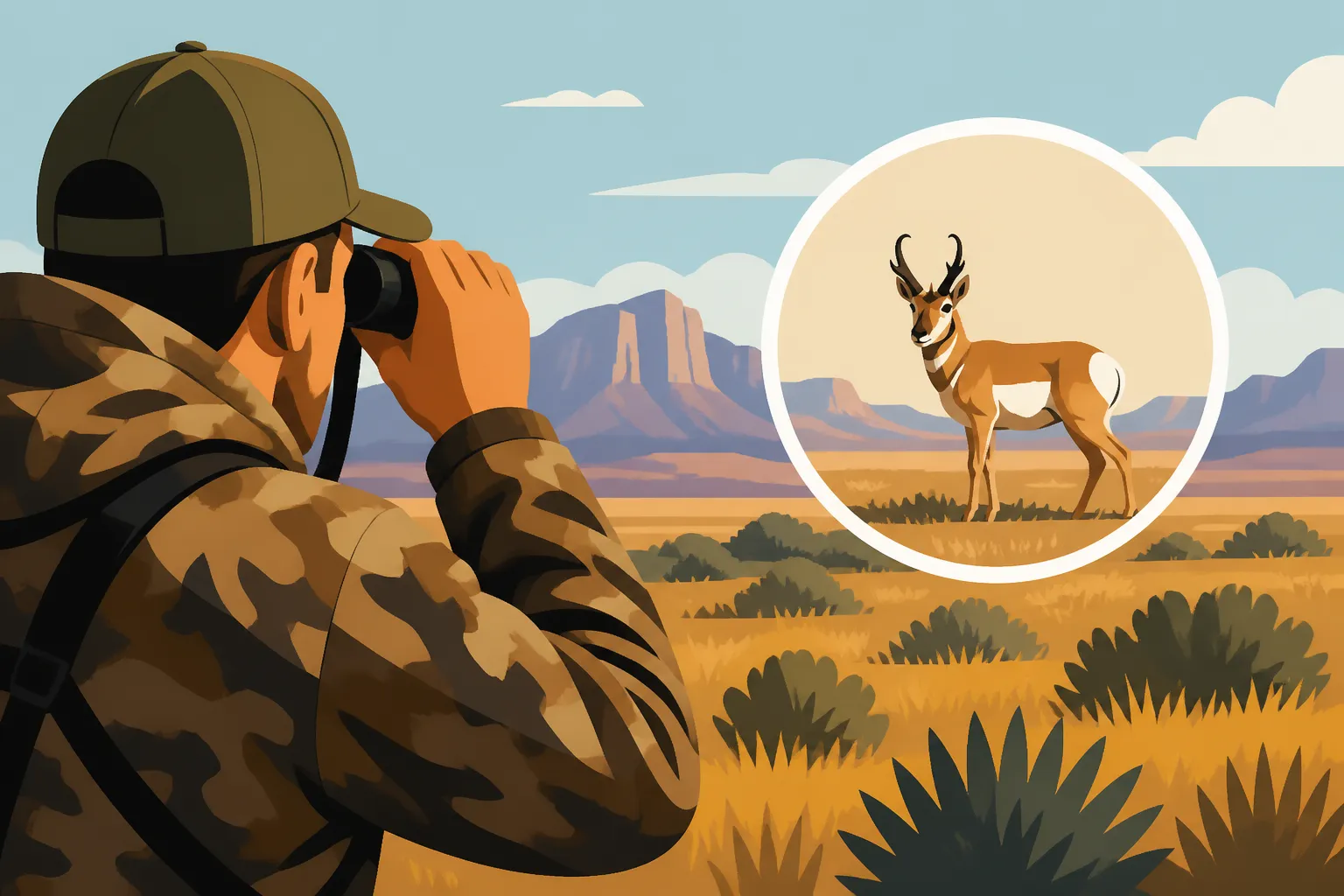
Field Judging a Pronghorn Buck From Distance
The vast, sun-drenched plains of New Mexico are a sight to behold, but they also present a unique set of challenges for hunters, especially when it comes to pronghorn. You're out there, glassing a distant rise, and suddenly, a herd of those lightning-fast prairie rockets materialize. Your heart starts pounding, but then the real work begins: is that a buck worth pursuing? From hundreds of yards away, in the shimmering heat haze, telling a solid buck from an average one can feel like trying to solve a riddle in a mirage. This guide is all about helping you cut through that optical confusion, offering practical tips and a framework for accurately judging a pronghorn buck from a distance, so you can make confident decisions when it counts.
The Unique Challenges of Judging Pronghorn
Hunting pronghorn is an experience unlike any other. They live in wide-open spaces, moving with incredible speed, and their unique physiology and habitat make them particularly tricky to field judge. It’s not like trying to pick apart a mule deer in timber or an elk in dark canyons; the environment itself is a major factor working against you.
Why Distance Plays Tricks on Your Eyes
Imagine looking across miles of rolling grassland or a flat, dusty mesa. The air shimmers, especially mid-morning or afternoon, creating a visual distortion known as mirage. This isn't just an inconvenience; it actively warps what you see through your optics. A buck's horns can appear longer, shorter, thicker, or thinner than they actually are. A pronghorn might look like it’s floating above the ground one second, then disappear into the heat waves the next. This constant visual interference makes consistent judgment incredibly difficult. The sheer scale of the landscape also compounds the issue. What looks like a mere 300 yards through your scope might actually be 450, further shrinking and distorting the animal. Your brain tries to compensate for the distance, but often it leads to overestimating or underestimating key features.
The Speed and Agility Factor
Pronghorn are often called the fastest land animal in North America for a reason. They can cover ground at astonishing speeds, and they rarely stand still for long. You might spot a buck, get your glass on him, and just as you start to analyze his horns, he’s trotting off, or worse, sprinting over the next rise. This means you often have very limited windows to make a judgment. Unlike a bedded deer that might give you hours of observation, a pronghorn buck could offer you mere seconds. This pressure to make a quick call can lead to mistakes, especially when you're trying to process multiple visual cues under duress. The agility of these animals also means they can change their angle in an instant, offering only fleeting glimpses of their profile, which is often the best view for judging horns.
The "Ghost of the Plains" Reputation
Pronghorn are masters of camouflage in their environment. Their tan and white coats blend seamlessly with the sun-baked earth, dried grasses, and scattered brush of the plains. They can seemingly vanish into nothing, especially if they drop into a slight depression or behind a clump of sagebrush. On top of that, their relatively small size compared to an elk or large mule deer makes them harder to pick out in vast expanses. When you're trying to discern intricate horn details like prong length or mass, a buck that keeps disappearing or presenting only a partial view feels like it's actively trying to confound you. This "ghostly" quality, combined with the mirage, means you spend a lot of time searching and often less time critically evaluating.
Key Indicators for Judging Pronghorn Bucks
Once you've spotted a buck and managed to get a steady look at him, it's time to break down his features. You can't just look for "big horns"; you need to understand what makes pronghorn horns "big" or, more accurately, score well. This takes practice and a systematic approach.
Horn Height and Mass
These are arguably the most critical elements when judging a pronghorn, especially if you're looking for a trophy-class animal.
- Height: The first thing to evaluate is the overall length of the horn. A good rule of thumb is to compare the horn height to the length of the buck's ear. Pronghorn ears are typically around 5-6 inches long. A mature, respectable buck will have horns that extend noticeably above his ears. If the horns are barely taller than the ears, or just one ear length above, he's likely a younger or average buck. To be considered exceptional, you're often looking for horns that are twice the length of his ear or more, often appearing as if they're reaching for the sky. The length is measured from the base along the curve to the tip, which can be hard to judge precisely from a distance, but the overall impression of height is key.
- Mass: Mass refers to the circumference of the horn, particularly at the base and up to the prong. This is where many hunters make mistakes. From a distance, horns can look long but pencil-thin, or appear massive due to a trick of light. Look for a horn that appears thick and heavy, not just long. The base should be wide, almost bulging, above the skull. This mass should carry well up the horn, ideally past the prong. If the horn tapers dramatically right above the base, he probably lacks the mass to be a top-tier buck. A good indicator of mass is the darkness of the horn itself; the thicker the horn, the more horn material there is, and often the darker it appears, especially the black outer sheath. This is about real girth, not just the illusion of it.
The "Prong" Itself: Location and Length
The "prong" is the forward-facing fork or point on a pronghorn's horn, and it's absolutely vital for scoring. It’s what gives them their unique look and contributes significantly to their overall score.
- Location: The prong typically emerges from the main beam about two-thirds of the way up the horn from the base. Pay close attention to this placement. If the prong is very low on the horn, or too high, it might not score as well, even if the horn length is decent. A well-placed prong is one that looks balanced and distinct.
- Length: This is where many bucks fall short. You want a distinct, strong prong that extends forward. Think of it as a significant "thumb" coming off the main beam. Many young bucks will have just a tiny bump or an "eyelash" of a prong – barely noticeable from a distance. A trophy buck will have a prong that is at least 3-4 inches long, sometimes more, and it should be clearly visible and projecting outward. When a buck turns his head, look for that distinct forward projection. The length of the prong is measured along its upper edge, from where it leaves the main beam to its tip. A solid prong often suggests overall horn health and maturity. If you're using resources like GoHunt to research specific units, you'll often see photos of harvested bucks where the prong is a standout feature, and that's what you should be looking for in the field.
Horn Curvature and Taper
Beyond height, mass, and prong, the overall shape and how the horns taper can tell you a lot.
- Curvature: Pronghorn horns often have a distinct backward sweep, then a forward curve at the tips, creating a subtle S-shape. Some bucks will have horns that sweep back dramatically, almost like a scimitar, while others might be more upright. The width of the spread between the horns can also be a factor, though often harder to judge precisely from far away. Look for a pleasing, symmetrical curve. Avoid bucks with horns that look too straight or that curve in an awkward, asymmetrical way.
- Taper: As mentioned with mass, how the horn tapers is crucial. Ideally, you want the mass to carry well up the horn before it begins to taper rapidly toward the tip. Many bucks look impressive for the first few inches, but then the horns quickly thin out, losing significant mass. This fast taper is a common characteristic of younger bucks or those that just won't score high. A truly mature buck will hold its mass and thickness for a considerable portion of the horn's length.
Here's a quick reference table to help visualize these points:
| Feature | Young/Average Buck | Mature/Trophy Buck |
|---|---|---|
| Horn Height | Slightly above ear length (5-7 inches) | Noticeably taller, often 2x ear length or more (12-16+ inches) |
| Mass | Tapers quickly, narrow base | Thick, bulky base, carries mass well up the horn |
| Prong | Small bump, "eyelash," or poorly defined | Distinct, well-defined, 3-5+ inches long |
| Location | Low or high on the horn | Typically 2/3 up the main beam from the base |
| Curvature | Straight or awkward; often lacks symmetry | Graceful backward sweep, forward tip, good symmetry |
| Taper | Rapidly thins above the base | Maintains thickness, tapers gradually |
| Body Size | Slender, lean neck | Broader chest, deeper body, thick neck |
Body Size and Age Clues
While not directly contributing to score, body size and overall appearance can be strong indicators of a buck's age and maturity, which in turn correlates with horn development.
- Mature Body: Older bucks tend to have a more developed, blockier body. Look for a deeper chest, a broader shoulder, and a thicker neck, especially during the rut. A young buck will appear lankier, with a thinner neck and a less substantial frame. This is similar to judging a mule deer buck where a big body often means an older, more developed animal.
- Behavioral Cues: Older bucks often act differently. They might be more wary, less prone to running carelessly, and might keep to themselves or with a few does, rather than being part of a large, skittish herd of younger bucks. While not a definitive judging tool, it's another piece of the puzzle.
Practical Field Judging Techniques on the New Mexico Plains
It’s one thing to know what to look for; it’s another entirely to execute that judgment in the field. The vastness of New Mexico’s pronghorn country demands specific techniques and the right gear.
Optimal Optics for Pronghorn Country
Your optics are your best friend when hunting pronghorn. You need high-quality glass and the stability to use it effectively.
- Binoculars: A good pair of 10×42 or 12×50 binoculars are essential for initial spotting and some basic judging. They offer a wide field of view and are quick to deploy. For extended glassing sessions across wide-open country, you might even consider 15x binoculars, but these almost always require a tripod for steady viewing.
- Spotting Scope: This is where the detailed work happens. A 20-60x or 20-70x spotting scope is invaluable. You need the magnification to pick out those crucial details like prong length and mass carry. Don't skimp here. The clearer the image, the more confident your judgment will be. When you’re trying to determine something as subtle as the exact location of a prong on a horn, that extra clarity makes all the difference. For more insights on choosing the right magnification, check out "Spotting Scope Power for Open Country".
- Tripod: Absolutely non-negotiable for stable glassing, especially with a spotting scope or higher-power binoculars. A shaky image in a mirage is useless. A sturdy tripod allows you to lock onto a buck, eliminate movement, and truly study his horns. Investing in a good tripod, and knowing how to set it up quickly and effectively, is key. If you're looking for stability, consider the advice in "Tripod Setup for Glassing From a Ridge."
Utilizing the Landscape for Scale
Since you can't walk up to the buck and measure him, you have to use what's around him as a reference.
- Comparing to Ears: As mentioned, a buck's ears are your built-in ruler. How many "ear lengths" tall are his horns? How far does the prong stick out compared to the width of his ear?
- Other Animals: If there are does nearby, use them as a baseline. Does typically have smaller bodies and no horns or very tiny, unbranched horns. A buck that looks significantly larger in body and has clearly defined horns compared to the does is generally a good sign.
- Vegetation and Structures: A fence post, a tall yucca plant, a specific rock formation – these can all serve as temporary reference points if the buck stands near them. Estimate their known size, then compare the buck's features to them. This is especially helpful in the featureless parts of the plains, where landmarks can be scarce.
Patience and Multiple Angles
This might be the hardest part for an excited hunter, but patience is crucial.
- Wait for the Profile: A buck facing you or directly away offers limited information. You need to see him in profile to accurately judge horn length, curvature, and prong definition. Wait him out. He will move eventually, and that might be your only chance to get a clear, unobstructed view.
- Observe Movement: As he grazes or walks, his head will shift, offering different angles and light conditions. Take advantage of every subtle turn. Sometimes a horn that looks thin from one side will reveal surprising mass from another. This is also where a good understanding of "Reading Wind in a Deep Gila Canyon" can apply to pronghorn in plains as both share the unpredictable nature of how air moves and affects animals' behavior.
- Study Through the Mirage: The mirage is a pain, but sometimes you can "read" through it. Wait for moments when the heat waves briefly subside, or a slightly different angle clarifies the image. It’s a dance between the animal, your optics, and the environment.
When to Make the Decision (or Pass)
Ultimately, the decision to take a shot or pass is yours. Don't let buck fever or the pressure of the moment force a bad judgment.
- Confidence is Key: Only commit when you are genuinely confident in your assessment. If you have doubts about his size or score potential, it's often better to pass and wait for another opportunity. New Mexico has healthy Pronghorn on the Eastern Plains.
- Define Your "Shooter": Before you even leave camp, have a clear idea of what a "shooter" buck looks like to you. Is it based purely on score, horn length, or just the experience of a good hunt? Having this defined beforehand helps prevent on-the-spot regret. This might mean knowing that you’re looking for a buck with horns that extend more than two ear lengths above his head and clearly visible prongs, for instance.
Common Mistakes and How to Avoid Them
Even experienced hunters can fall prey to the illusions of pronghorn judging. Being aware of these common pitfalls can save you from disappointment.
The "Long Horn" Illusion
This is probably the most common mistake. When a buck is standing on a distant ridge, or at a slightly upward angle, his horns can appear significantly longer than they actually are. The skyline often makes horns "pop" and seem stretched. Always try to get him on level ground or against a consistent background for a truer read. If he's on a ridge, try to view him from a position above him if possible, to eliminate that upward angle distortion. This is a crucial element for hunters pursuing Pronghorn on the Eastern Plains Units.
Misjudging Mass from the Front
A buck facing you head-on can look incredibly massive at the base of his horns. This frontal view, especially with the dark horn material contrasting against the lighter bone pedicle, often creates an illusion of exceptional mass. Always wait for a broadside or quartering view to accurately assess how much mass truly carries up the horn. A wide, dark base doesn't mean much if it tapers to nothing in an inch or two.
The Rush to Judge
Pronghorn season is often short, and tags can be hard to come by, as any look at New Mexico Pronghorn Draw Odds will tell you. The pressure to fill a tag or the excitement of seeing a buck can make you rush your judgment. Take a deep breath. Slow down. Use your tripod. If the buck is moving, let him settle. If you only get a fleeting glance, hold off. It's better to pass on an unknown buck than to shoot one you regret later. Remember, you might only have a few days during New Mexico Pronghorn Season Dates, but patience still pays off.
The Importance of Practice
Just like shooting, field judging is a skill that improves with practice.
- Preseason Scouting: Spend time before the season scouting with your optics, even if you don't have a tag in your pocket. Identify different bucks, try to judge them, and then, if possible, get closer to verify your initial assessment. You can do a lot of this from home using tools like GoHunt, which can provide satellite imagery for E-Scouting a New Mexico Unit Before the Season.
- Study Photos and Videos: Look at pictures and videos of harvested bucks, particularly those with known scores. Try to guess their measurements based on the visual cues, then check the actual stats. This trains your eye to recognize the subtle differences.
- "Armchair Hunting": Even during the offseason, you can practice. Watch hunting shows or nature documentaries focusing on pronghorn. Pause the video and practice your judgment. It might sound silly, but it builds a mental database of what to look for.
Ultimately, field judging a pronghorn buck from a distance in New Mexico's wide-open spaces is one of the most challenging but rewarding aspects of the hunt. It takes keen eyesight, high-quality optics, immense patience, and a solid understanding of what makes a pronghorn buck truly stand out. By focusing on horn height, mass, prong definition, and overall body characteristics, and by being aware of common optical illusions, you can significantly increase your chances of making an accurate judgment. Take your time, enjoy the incredible landscape, and make a confident shot when that special buck finally presents himself. For more general guidelines, always refer to "Reading the New Mexico Rules and Info Booklet" to ensure you're compliant with all regulations.
Disclaimer
This article is for general informational purposes only and does not constitute professional advice. Laws, prices and regulations vary by location and change over time. Consult a qualified professional for guidance on your specific situation.