Using Draws and Benches to Close Distance
There's nothing quite like the rush of spotting a magnificent animal in New Mexico's vast, wild landscapes. But let's be honest, seeing it is one thing, and getting within ethical shooting range for a clean shot is an entirely different beast. Too often, hunters get busted when trying to close that last bit of distance, turning a promising opportunity into a frustrating memory. This guide will walk you through the essential tactics of using natural terrain features like draws and benches to make silent, concealed approaches, significantly increasing your chances of success on your next New Mexico hunt.
Understanding New Mexico's Diverse Terrain Challenges
New Mexico's hunting grounds are incredibly diverse, from the high, timbered peaks of the Sangre de Cristos to the sweeping grasslands of the eastern plains and the rugged, broken desert ranges down south. Each landscape presents its own unique challenges, but one constant across almost all of them is the difficulty of closing distance without being detected.
The Problem with Open Country Stalks
Imagine you've just spotted a majestic bull elk feeding in a wide-open park in the Gila National Forest, or perhaps a wary mule deer buck bedded on a sun-drenched slope in Unit 2B. Your heart starts pounding. The distance is 800 yards, too far for a shot, but seemingly close enough to try and cut the gap. You start to move, trying to stay low, picking your way through sparse junipers or scattered ponderosa. But in minutes, the animal's head snaps up, ears swiveling, eyes locked onto your position. They've seen you, heard you, or more likely, smelled you.
New Mexico's open terrain, especially in areas like the eastern plains for pronghorn or the more sparsely timbered sections for mule deer, offers very little continuous cover. Animals here are hyper-aware, relying on their keen eyesight and sense of smell to detect threats from far off. A slight rise might hide you for a moment, but then you crest it, silhouetting yourself against the sky. The wind, often swirling and unpredictable, can carry your scent in unexpected directions, especially when you're exposed on a ridge. It’s a game of cat and mouse where the mouse often has the home-field advantage. The frustration of getting "eyed" by a deer or an elk that was seemingly out of sight is a common rite of passage for many hunters here.
How Draws Offer Hidden Pathways
This is where understanding terrain becomes your secret weapon. Draws, also known as washes or arroyos in the desert, are natural depressions or channels in the landscape, typically formed by water erosion. They can range from shallow, barely perceptible swales to deep, rugged canyons. What makes them invaluable for hunters is their inherent ability to provide natural concealment.
Think of a draw as a hidden pathway laid out by nature, offering a defilade from the animal's line of sight. These features are essentially folds in the earth that allow you to drop below the horizon and move without being seen. In timbered areas, draws often collect denser vegetation, providing even more visual cover. In open, arid landscapes, even a subtle wash can offer enough relief to keep you out of sight from an animal scanning the horizon. Animals themselves often use these draws as travel corridors, bedding areas, or escape routes, which is a big hint that you should too. They understand the protection these features offer. The trick is to identify them, understand their characteristics, and learn to navigate them silently and strategically.
Benches as Natural Staging Points and Cover
Beyond the low-lying draws, benches are another phenomenal terrain feature that can be your best friend during a stalk. Benches are relatively flat, often stepped or terraced areas on a hillside or mountain face. Imagine a mountain that looks like it has giant steps built into its side – those are benches. They are incredibly common in New Mexico's mountainous units, from the Gila to the northern Sangre de Cristos.
Benches offer several key advantages. First, they break up the steepness of a slope, making travel less arduous than a direct ascent or descent. This means you can often move more quietly and with less effort. Second, benches frequently accumulate deeper soils, leading to more lush vegetation – sometimes thicker timber, sometimes richer grass or browse. This denser cover provides crucial visual concealment. Third, animals often use benches for feeding, bedding, and simply traveling because they offer easier movement and access to resources. A bench might hold a secluded pocket of timber that's perfect for a midday bed, or a grassy park where elk can feed in peace.
For hunters, benches can act as natural staging points. You can traverse a bench, staying hidden, to gain ground or get to a better vantage point. You might use one to circumnavigate a ridge, or to slowly work your way uphill towards a bedded animal you've spotted from afar. Learning to identify these stepped features, both on a map and in the field, is a critical skill for hunting New Mexico's elevation changes.
Mastering the Art of Using Draws for Your Stalk
Successfully using draws for a stalk isn't just about dropping into one and hoping for the best. It requires careful planning, keen observation, and precise execution.
Reading a Draw on Your Map and in the Field
The first step to effectively using a draw is knowing how to find it and understand its characteristics. Before you even set foot in the field, spend significant time e-scouting a New Mexico unit before the season. Tools like GoHunt's mapping platform are invaluable here. Look for contour lines that dip sharply and run parallel, indicating a drainage. The closer the contour lines, the steeper and deeper the draw. Satellite imagery will show you the vegetation density within these draws, helping you assess potential cover.
Once you're in the field, confirm what you've seen on the map. A draw that looks deep on paper might be relatively shallow but still offer enough concealment if the vegetation is thick. Conversely, a draw that appears to offer great cover might be choked with loose rock or deadfall, making silent movement impossible. Pay attention to the draw's width; a narrow draw might offer more concealment but restrict your movement and sightlines, while a wider draw provides more maneuverability but potentially less cover. Look for pinch points or areas where the draw bends, as these can offer excellent opportunities to peek over the edge without exposing yourself.
Always be aware of the wind. A deep canyon or draw can create its own microclimates and wind currents. You'll need to develop your ability to read wind in a deep Gila canyon, as it can swirl and change direction more frequently than on an open ridge, potentially betraying your presence to a downwind animal.
Executing a Successful Draw Stalk
Once you've identified a promising draw and assessed the wind, it's time for the stalk. This is where patience, slow movement, and meticulous attention to detail become paramount.
First, your entry point into the draw is critical. Try to enter from a lower, concealed side, avoiding skylining yourself on the rim. Once inside, stay as low as possible. This often means moving in a crouch or even crawling in sections. Utilize every bit of natural cover – rocks, bushes, downed timber, and changes in the draw's contour. Imagine you're a part of the landscape, not just moving through it.
Movement within the draw must be agonizingly slow. Take one step, pause, check the wind, listen, scan ahead, and then take another step. Place your feet heel-first, gently rolling them forward to test for loose rock or noisy debris before committing your full weight. In New Mexico's arid country, dry leaves and brittle twigs can sound like gunshots if you're not careful. If you're moving through a particularly noisy section, consider waiting for a gust of wind to cover your sound.
When approaching a bend or a slight rise within the draw, anticipate what might be on the other side. Do not just pop your head up. Instead, use a small hand mirror, a pair of binoculars on a tripod, or simply move with extreme caution, slowly raising your head or peeking around the corner to scan the area ahead. This is where the last 50-100 yards are won or lost. For bowhunters, getting to that 40-yard range requires the ultimate stealth. Remember, how close a bowhunter needs to get on elk is often within 60 yards, demanding near-perfect execution.
When to Avoid a Draw Stalk
While draws are excellent tools, they aren't always the answer. There are situations where attempting a draw stalk can put you at a distinct disadvantage.
One major factor is unpredictable wind. If the wind is swirling erratically, especially in a complex canyon system like those found in the Gila, your scent can easily be carried to the animal, no matter how deep you stay in the draw. If you notice constant shifts, it might be better to back out and try a different approach or wait for more stable conditions.
Another issue arises if the draw is too open or shallow, offering insufficient cover. A draw in the eastern plains might be little more than a wide, grassy swale, providing minimal concealment from a vigilant pronghorn. Similarly, if the draw is directly in line with where the animal is bedded, and you have no way to get past them without detection, it could be a trap. The animal could spot you as you try to emerge or even be bedded directly in your path, leading to an immediate bust.
Finally, consider the noise factor. A draw filled with loose scree, dry leaves, or heavy deadfall might make silent movement impossible. If every step sounds like a stampede, that "hidden pathway" quickly becomes a very loud one. Sometimes, a more exposed but quieter ridge might be a better option if the noise within the draw is uncontrollable.
Utilizing Benches to Gain Advantage and Close In
Just as draws offer hidden routes, benches provide strategic elevated platforms for navigating steep terrain and getting closer to game.
Identifying Productive Benches for Stalking
Learning to spot productive benches, both on a map and in the field, is a skill that pays dividends. On topographical maps, benches appear as wider spaces between tightly packed contour lines on a slope. On satellite imagery, they often stand out as areas with different vegetation density or patterns than the steeper slopes above and below them.
In the field, look for visual cues: a sudden leveling off of the terrain, an increase in timber density, or perhaps a greener patch of vegetation indicating deeper soil. These are often the spots where animals will bed, feed, or travel because they offer easier going and often better forage. For example, in New Mexico's Gila units, elk frequently feed on grassy benches in the morning and evening, then bed in the timbered sections of those same benches during the day. Northern units for mule deer also see them using these features extensively.
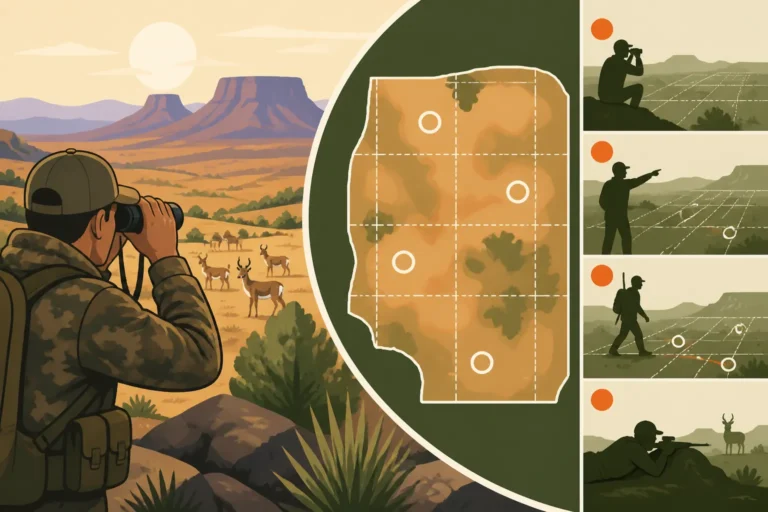
Using your optics from a distant ridge to glass benches and parks for elk is an excellent strategy. Spend time systematically scanning these areas with your binoculars or spotting scope, looking for movement, flicking ears, or the tell-tale horizontal line of a bedded animal. Often, the best way to approach an animal on a bench is to gain a parallel elevation, then use the bench's own features to close the gap.
Stalking Along a Bench Effectively
Stalking along a bench requires a different approach than stalking through a draw, primarily because you're often moving at a higher elevation, with potential visibility both above and below you.
When moving along a bench, try to stay just below the crest of the bench itself, using the slight rise for concealment. This keeps you out of sight from animals above and often below you. If the bench is timbered, use the trees and underbrush to break up your outline and hide your movements. When you need to peek over the crest to scan, do so slowly and carefully, using a tree trunk or a rock as cover.
The varying elevation of benches can be used to your advantage. If the bench undulates, use those rises and dips to stay out of sight. You might move from one low point to another, always remaining conscious of your silhouette against the skyline. When crossing open patches on a bench, be prepared to get low and crawl, or use brief bursts of movement if the animal's head is down, then freeze completely. Remember that the wind can be tricky here too; while often more stable than in deep draws, it can still swirl, especially as thermals begin to change, like when playing thermals on a canyon stalk.
Combining Draws and Benches for Complex Stalks
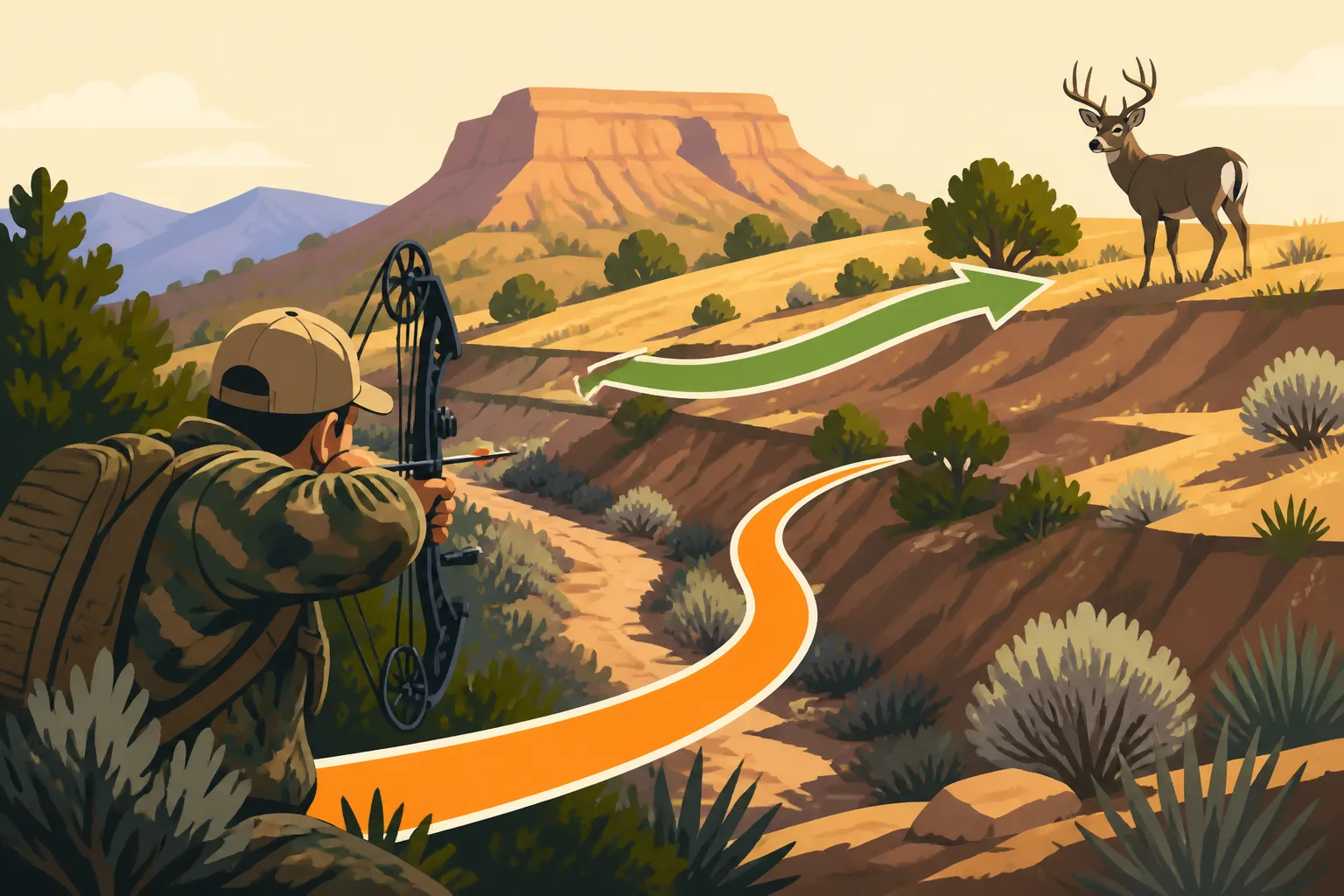
The truly masterful stalkers know how to combine these terrain features. Often, the most effective approach isn't a straight line but a winding path that leverages every bit of available cover.
Imagine you've spotted a mule deer bedded on a timbered bench halfway up a mountain in the Latir Wilderness. A direct ascent is too steep and open. Instead, you might use a deep, vegetated draw to gain elevation, working your way unseen up the mountain face. Once the draw tops out near the elevation of the bench, you can then transition out of the draw, perhaps using a small ridge or a clump of pines, and begin moving horizontally along the bench.
This kind of multi-stage stalk allows you to break down a long, difficult approach into smaller, manageable segments, each optimized for the specific terrain. You might use a draw to get behind a ridge, then pop out and use a series of small benches to work your way along the backside of the ridge, ultimately bringing you within range. It's like navigating a maze, but instead of walls, you have natural contours and vegetation. This is where detailed mapping tools, like those offered by GoHunt, become invaluable for visualizing these complex routes before you ever leave camp.
Essential Considerations for Any Close-Distance Approach
Beyond understanding the terrain itself, several critical factors must be managed to ensure a successful close-distance approach in New Mexico's wildlands.
Wind, Thermals, and Scent Management
This cannot be stressed enough: wind is king. All the stealth in the world won't matter if an animal smells you. Animals, especially elk and deer, rely heavily on their sense of smell, which is exponentially more acute than a human's. Always approach from downwind, or at least crosswind.
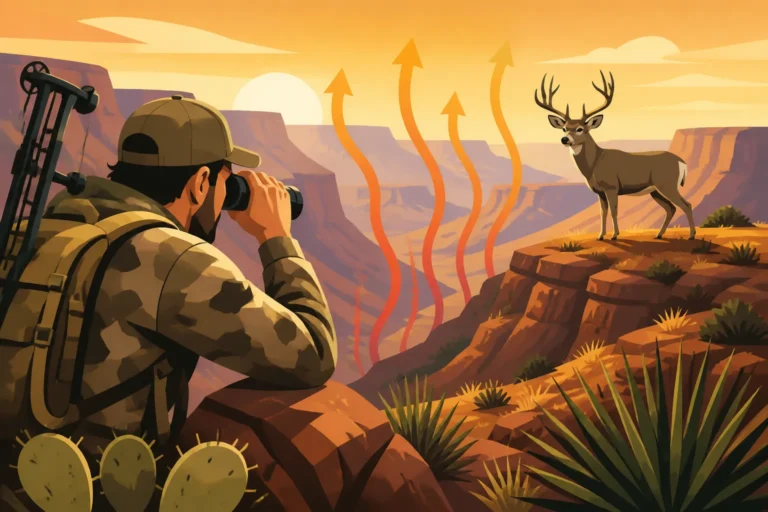
In mountainous terrain, thermals play a huge role. In the morning, as the sun warms the earth, air currents (thermals) typically rise. This means your scent will be carried uphill. In the evening, as the air cools, thermals fall, carrying scent downhill. This means if you're stalking uphill in the morning, your scent will likely rise above you, potentially alerting animals higher up. Conversely, in the evening, your scent will drop, making an uphill stalk more favorable if the animal is above you. Always be aware of these dynamics and plan your approach accordingly. Playing thermals on a canyon stalk can be particularly complex and requires constant vigilance.
Scent control is also paramount. While you can't eliminate human scent entirely, you can minimize it. Wear clean hunting clothes that have been washed in scent-eliminating detergents. Avoid strong-smelling foods, colognes, or deodorants before and during a hunt. Store your hunting clothes in airtight bags to keep them free of foreign odors.
Noise, Movement, and Visual Concealment
Even if the wind is perfect, a clumsy approach will ruin your hunt. Noise is your enemy. Every step should be deliberate, every movement slow and controlled. As you move, listen to the sounds around you – a snapping twig from a squirrel, a sudden gust of wind, or the distant call of a raven. Use these ambient sounds to mask your own quiet movements.
Movement needs to be minimized and, when it does occur, it should be fluid and natural. Avoid quick, jerky motions that can catch an animal's eye. If an animal's head is up and they're looking in your direction, freeze completely. Don't resume movement until their head is down or they've turned away. Break up your silhouette by moving from cover to cover. Never walk directly on a skyline. If you must cross an open area, crawl or move quickly when the animal's attention is diverted, then immediately find cover. Blending into the terrain by wearing good camouflage that matches the local vegetation is also crucial.
Gear for a Successful Stalk
Having the right gear won't guarantee success, but it will certainly improve your odds and comfort.
- Footwear: Choose quiet, comfortable boots with good ankle support and grip, especially important on New Mexico's rocky, uneven ground. Boots that allow you to feel the ground slightly can help prevent noisy missteps. Look for something that suits choosing boots for rocky desert ground.
- Optics: A good pair of compact binoculars (10×42 or 8×42) is essential for constantly scanning ahead without raising your head too much. A rangefinder is non-negotiable for quickly and accurately determining distances.
- Clothing: Select quiet fabrics that won't rustle or swish as you move. Layering is key for New Mexico's unpredictable weather, allowing you to shed or add clothing to manage heat and reduce sweating.
- Backpack: A smaller, lightweight daypack is often sufficient for a stalk, carrying only essentials like water, snacks, first-aid, and an emergency kit. Make sure it's packed tightly so nothing rattles or clangs.
- Mapping Device: A reliable GPS device or a smartphone app with downloaded offline maps (like GoHunt) is crucial for navigating, marking the animal's location, and planning your approach. The ability to pull up detailed topographical maps and satellite imagery on the fly is a game-changer. E-scouting a New Mexico unit before the season is a great start, but having those maps accessible in the field makes a world of difference when you need to confirm terrain features.
Developing a consistent practice routine before opener will ensure you're physically and mentally ready to execute these demanding stalks. Whether it’s honing your glassing skills with the grid glassing method, step by step, or simply walking quietly through varied terrain, preparation is key.
Stalking Considerations: Draws vs. Benches
Let's break down the advantages and disadvantages of each terrain feature for stalking:
| Feature | Advantages | Disadvantages | Ideal Use Case |
|---|---|---|---|
| Draws | Excellent concealment from sight | Can have swirling winds, difficult for scent control | Approaching animals at lower elevations or gaining ground |
| Often provide direct routes | Noisy with loose rock/vegetation if not careful | Good for moving through broken country | |
| Animals frequently use them for travel & cover | Limited visibility once inside, can be a tunnel | ||
| Benches | Easier movement than steep slopes | Can be exposed if sparse cover | Traversing hillsides, reaching higher vantage points |
| Often hold feeding/bedding areas | Wind can still be a factor, especially on edges | Staging points, getting parallel to game | |
| Good vantage points when peeking over crests | Requires careful movement to avoid skylining |
Ultimately, becoming proficient in using draws and benches to close distance comes down to practice, patience, and a deep understanding of both the terrain and the animal you're pursuing. New Mexico's diverse landscapes offer endless opportunities to apply these skills, and with each successful stalk, you'll feel the unique satisfaction of truly outsmarting your quarry.
Disclaimer
Please note that hunting regulations, license fees, and season dates are subject to change. Always consult the official New Mexico Department of Game and Fish website or the latest "Rules & Information Booklet" before planning any hunting trip. This guide is for informational purposes only and does not supersede official regulations.