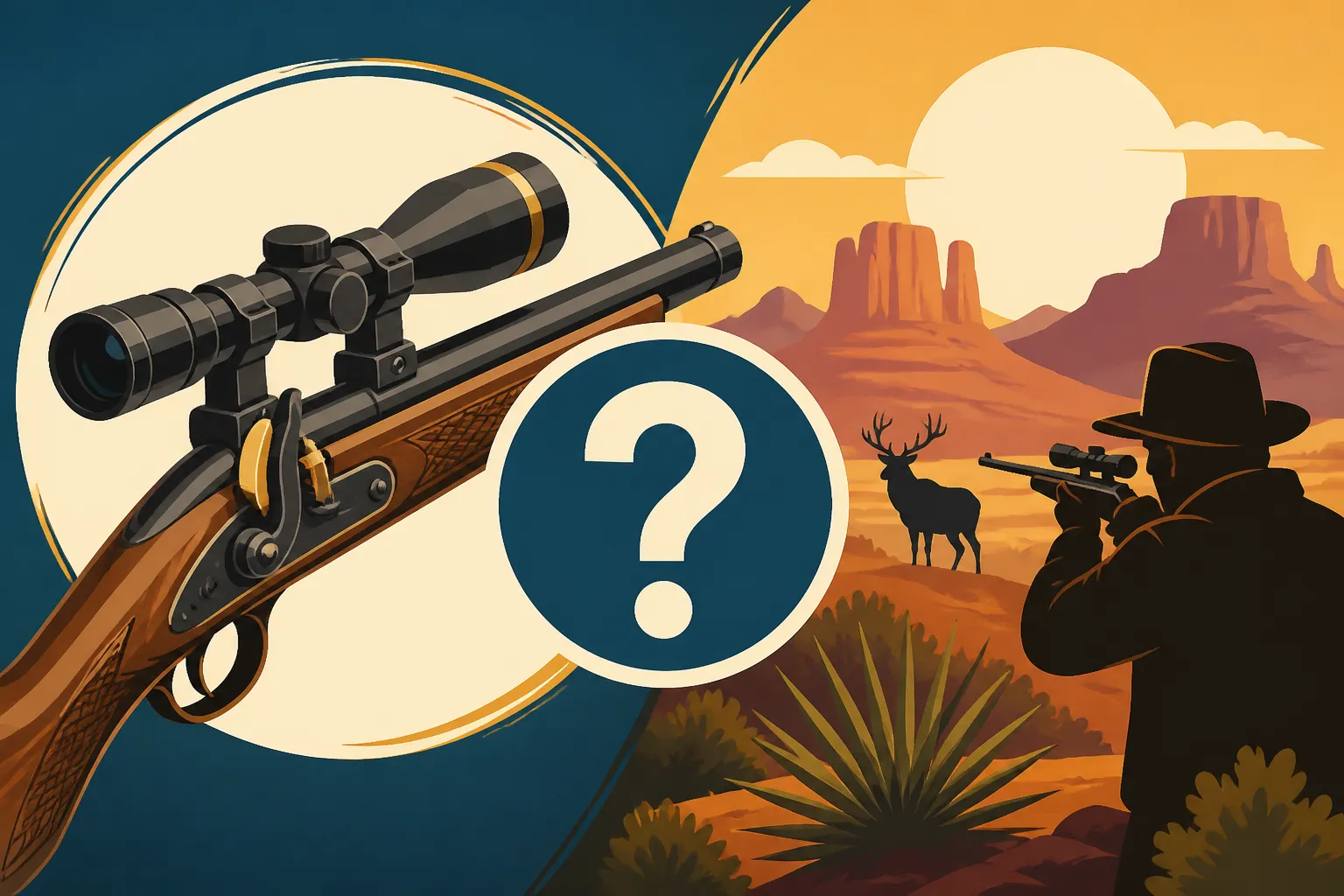
Can You Use a Scope on a Muzzleloader?
There's a common question that pops up around campfires and in online forums here in New Mexico, especially when hunters start thinking about muzzleloader season: "Can I put a scope on this thing?" It’s a completely valid question, fueled by years of evolving regulations and personal preference. The truth is, the answer isn't a simple yes or no; it depends heavily on the specific hunt you've drawn and the game and fish regulations for that particular season. This guide will unravel the intricacies of using scopes on muzzleloaders in the Land of Enchantment, helping you understand the rules, make informed gear choices, and ultimately, become a more ethical and successful hunter.
The Evolving Rules for Muzzleloader Optics in New Mexico
For generations, the image of a muzzleloader hunter has been one of tradition, often conjuring up notions of open sights, black powder smoke, and a reliance on close-quarters skill. But just like every other aspect of hunting, things change. Technology advances, and regulations adapt—sometimes quickly, sometimes slowly, leaving many of us scratching our heads trying to keep up.
A Look at Traditional Muzzleloader Hunting
Think back to the "good old days," or even just a couple of decades ago, when muzzleloaders were almost exclusively associated with open sights. We're talking about iron sights – a simple post or bead in the front and a notch in the rear. For many, this was the essence of primitive hunting. It forced you to get closer, to hone your stalking skills, and to truly understand your rifle's capabilities at very limited ranges. There’s a beautiful purity to it, a connection to hunting history that many purists still cherish.
However, let's be realistic: not everyone’s eyes are what they used to be. As we age, or for those who started hunting later in life, acquiring a clear sight picture with open sights can become a significant challenge. The frustration of missing an ethical shot because you simply couldn't see the target clearly is a deeply disheartening experience, one that can make you feel like you're being pushed out of a sport you love. The desire to extend one's effective range and ensure a clean kill is paramount for any responsible hunter, and open sights, for many, present a very real limitation.
When Scopes Became an Option
New Mexico, like many other states, has gradually come to recognize these challenges and has, in many cases, adapted its regulations. For a long time, if you were hunting during a "primitive weapon" season, a scope was a definite no-go. The term "primitive" inherently suggested a limitation on modern optics. But as muzzleloader technology advanced – with in-line ignition, faster twist rates, and more aerodynamic projectiles – the lines started to blur.
Eventually, New Mexico Game and Fish began to differentiate between "primitive weapons" hunts and general "muzzleloader only" seasons. This distinction is absolutely crucial. In most "muzzleloader only" hunts, modern optics, including scopes, are indeed permitted. This change was a game-changer for many hunters, opening up opportunities they might have felt were closed off due to vision limitations or a desire for increased precision. It allowed hunters to leverage the accuracy potential of their modern muzzleloaders, making ethical shots at distances previously unthinkable with iron sights.
The Impact on Hunter Success and Accessibility
The allowance of scopes on muzzleloaders has profoundly impacted hunter success and, perhaps more importantly, accessibility. For hunters whose eyesight isn't as sharp as it once was, or for those with certain physical limitations that make precise open-sight aiming difficult, a scope can mean the difference between drawing a tag and enjoying a hunt, or staying home. It’s about being able to participate fully and effectively.
Of course, this shift hasn't been without debate. There's a strong contingent of hunters who believe that allowing scopes on muzzleloaders dilutes the "primitive" spirit of the hunt. They argue it makes the hunt "too easy" or removes a fundamental challenge. On the other hand, many argue that the primary goal is a clean, ethical harvest, and if a scope helps achieve that, it should be embraced. Ultimately, New Mexico's regulations aim to strike a balance, often by restricting scopes in specific "primitive weapons" seasons while allowing them in others. This nuanced approach acknowledges both the desire for tradition and the practical realities of modern hunting.
Understanding New Mexico's Muzzleloader Regulations
Navigating hunting regulations can sometimes feel like trying to solve a puzzle written in a foreign language. When it comes to muzzleloaders and scopes in New Mexico, it's particularly important to pay close attention to the details. The devil is truly in the specific wording of your hunt code.
Primitive Weapons vs. Muzzleloader Only Seasons
This is the cornerstone of understanding scope legality. New Mexico Game and Fish makes a very clear distinction, and if you get this wrong, you could be facing serious penalties.
-
Primitive Weapons Seasons: These hunts are designed to limit the technological advantage, harkening back to more traditional hunting methods. Generally, in these seasons, scopes are not allowed. You're typically limited to open, metallic sights, or fiber optic sights that do not contain any magnification. It's about getting back to basics. For instance, if you're looking at a hunt that specifies "primitive weapons" you need to know What Makes a Weapon Primitive Under the Rules. These hunts are often specifically for units or seasons where the department wants to maintain a higher degree of challenge or manage harvest in a particular way.
-
Muzzleloader Only Seasons: This is where scopes typically get the green light. These seasons allow hunters using muzzleloaders to employ modern optics. The intent here is to provide a dedicated season for muzzleloader enthusiasts without necessarily imposing the same "primitive" restrictions. It's still a specific weapon type hunt, but not necessarily a "primitive" hunt in the strictest sense. This means you can benefit from the accuracy and range-finding capabilities a scope provides, helping you make a more precise shot.
The crucial takeaway is always, always, to consult the current New Mexico Hunting Rules & Info booklet. Never assume, and never rely solely on word-of-mouth. The official regulations are your bible.
Specific Hunt Codes and Their Interpretations
Your hunt code is more than just a sequence of letters and numbers; it's a precise legal definition of when, where, and how you can hunt. For muzzleloader hunters, understanding how to read a New Mexico hunt code is absolutely paramount. Each code will specify the weapon type. If it says "Muzzleloader," it generally implies scopes are allowed. If it says "Primitive Weapon" or has a specific caveat about "iron sights only," then leave your scope at home.
For example, imagine a hunt code like "ELK-1-101." You need to break down what each part means: species, unit, and most importantly, weapon type and season. The game and fish department publishes detailed breakdowns of these codes, and many hunters use tools like GoHunt to quickly filter and understand the specific requirements for different hunt codes, including weapon legality. This level of detail ensures you're compliant and prepared. Being able to correctly interpret your hunt code before you even apply is essential, and this goes for every hunt you consider, not just muzzleloader seasons. Take the time to practice Reading a New Mexico Hunt Code Before You Apply.
Other Muzzleloader Requirements
Beyond the scope question, New Mexico has other specific regulations for muzzleloaders that are worth knowing:
- Minimum Caliber: For big game like deer, you'll need a minimum of a .45 caliber muzzleloader. For elk, the minimum jumps to .50 caliber. This is designed to ensure sufficient kinetic energy for a clean kill. Understanding Muzzleloader Caliber Minimums for Elk is critical for anyone pursuing larger game in New Mexico.
- Projectile Type: While not explicitly regulating scopes, projectile rules indirectly affect accuracy and hence, the utility of a scope. New Mexico allows both saboted projectiles (a smaller bullet encased in a plastic sleeve that falls away after exiting the barrel) and full-bore conical bullets. Sabots tend to offer better ballistic coefficients and accuracy, especially at longer ranges, which pair well with a scope. Conicals are heavier and hit harder, favored by some for their historical accuracy and terminal performance. The choice often comes down to your rifle's twist rate and what it shoots most accurately.
- Ignition Type: Most modern muzzleloader seasons permit in-line ignition systems, which are more reliable and hotter than traditional percussion caps or flintlocks. This modernization also contributes to the increased accuracy that makes scopes so beneficial.
By thoroughly checking the regulations for your specific hunt, utilizing resources like the GoHunt platform to cross-reference hunt codes, and understanding all the associated weapon requirements, you can approach your muzzleloader hunt with confidence.
Choosing the Right Scope for Your Muzzleloader
Once you've confirmed that a scope is legal for your New Mexico muzzleloader hunt, the next step is selecting the right optic. This isn't just about grabbing any old scope; muzzleloaders have unique characteristics that demand specific features in a scope.
Magnification and Objective Lens Considerations
When we talk about scopes for muzzleloaders, we're generally not looking at high-power sniper optics. Muzzleloaders, even modern ones, typically have a practical ethical range of 150-250 yards for big game, depending heavily on the shooter, rifle, and load. This means you don't need a 20x or 25x magnification.
- Magnification: A scope in the 1-4x, 2-7x, or 3-9x range is often ideal. Many hunters even find a fixed 4x or 6x perfectly sufficient. This allows for quick target acquisition at closer ranges in timber, while still providing enough magnification for precise shot placement at the upper end of a muzzleloader's effective range. Remember, too much magnification can make it harder to find your target quickly, especially in dense cover or when an animal is moving. For more on how scope power relates to the terrain, you might want to consider Optics Power for New Mexico's Open Country.
- Objective Lens: A larger objective lens (the front lens) gathers more light, which is invaluable during those crucial low-light periods at dawn and dusk when game is most active. However, larger objective lenses also mean heavier, bulkier scopes that sit higher off the bore, potentially affecting cheek weld and balance. A good balance might be a 32mm or 40mm objective for most muzzleloader applications.
Durability and Recoil Resistance
Muzzleloaders, especially those firing stout loads, can generate significant recoil. This isn't your average .223. The forward thrust and abrupt stop can be brutal on optics not designed to handle it.
- Robust Construction: You need a scope built tough. Look for scopes with a one-piece tube design, aircraft-grade aluminum, and purged (nitrogen or argon) and O-ring sealed for fog-proof and waterproof performance. Brands known for their durability in hunting environments are a good starting point.
- Shockproofing: Ensure the scope is explicitly shockproof and tested to withstand heavy recoil. A scope that loses its zero after a few shots is worse than no scope at all. Investing in a quality optic from a reputable manufacturer, even if it costs a bit more, will save you headaches and potential missed opportunities down the line. A cheap scope isn't cheap if it fails when it matters most.
Reticle Options and Ballistic Compensation
The reticle, or crosshairs, is your aiming point. For muzzleloaders, simplicity often reigns, but some modern options can enhance precision.
- Duplex Reticle: The classic duplex reticle is simple, clean, and effective. The thicker outer posts quickly draw your eye to the center, while the finer crosshairs provide a precise aiming point.
- BDC (Bullet Drop Compensator) Reticles: Some scopes offer BDC reticles with multiple aiming points for different distances. These can be incredibly useful for muzzleloaders, whose projectiles have a significant ballistic arc. However, you must know your specific muzzleloader's trajectory with your chosen load. Many scope manufacturers provide ballistic calculators or apps that can help you match your load to their BDC reticles.
- First Focal Plane (FFP) vs. Second Focal Plane (SFP): For most muzzleloader hunting, a Second Focal Plane (SFP) scope is perfectly adequate. In SFP scopes, the reticle stays the same size as you change magnification, meaning the subtensions (the space between hash marks) are only accurate at a specific magnification setting (usually the highest). FFP scopes, where the reticle changes size with magnification, are generally more expensive and offer advantages mostly for long-range precision shooting where ranging with the reticle at any magnification is desired. For a muzzleloader, SFP is usually sufficient.
Mounting and Sighting In Your Muzzleloader Scope
Proper mounting and meticulous sighting in are non-negotiable for muzzleloader accuracy.
- Mounting: Use high-quality, sturdy rings and bases. A solid mount is crucial to withstand recoil and maintain zero. I always recommend using a torque wrench to ensure all screws are tightened to the manufacturer's specifications. A loose mount is a recipe for frustration.
- Sighting In: This is where you put in the work. Muzzleloaders can be finicky, and finding the "sweet spot" load (powder charge, projectile, primer combination) that your rifle shoots most accurately is key.
- Start Close: Begin at 25 yards to get on paper, making large adjustments.
- Move Out: Once you're consistently hitting a small group at 25, move to 50 or 100 yards.
- Test at Range: Confirm your zero at your preferred distance (e.g., 100 yards). Then, practice at longer distances (150, 200, 250 yards) to understand your bullet drop and how your BDC reticle (if you have one) performs. Many hunters swear by a simple 100-yard zero, knowing they'll have to hold over at longer distances. Just like with any firearm, Sighting In After a Long Drive to Camp is paramount, but for muzzleloaders, it requires even more attention to detail given the variables of black powder. For understanding how to zero for varied terrain, considering concepts like Rifle Zero Distance for Canyon Country can be helpful.
Ethical Considerations and Practical Application
Having a scope on your muzzleloader certainly opens up new possibilities, but it also carries significant ethical responsibilities and practical considerations, especially when hunting New Mexico's diverse landscapes.
Extending Ethical Shot Distances
The primary advantage of a scope is improved precision. With better visibility of your target and a clearer aiming point, you can theoretically make more accurate shots. This often translates into extending your ethical shooting range. Where you might have been limited to 75-100 yards with open sights, a scoped muzzleloader, coupled with extensive practice, might allow for ethical shots out to 150, 200, or even 250 yards.
However, "can" and "should" are two very different things. A scope doesn't magically turn your muzzleloader into a long-range rifle. The inherent limitations of a muzzleloader—slower bullet velocities, significant bullet drop, and the lingering smoke that obscures your view of the animal post-shot—remain. It is your responsibility to know your rifle's maximum ethical range, which is the farthest distance at which you can consistently place all your shots within a kill zone under field conditions. This requires constant practice, shooting from various positions (not just a bench), and being honest with yourself about your capabilities. A scope enhances precision, but it cannot replace skill and judgment.
Challenges Unique to Scoped Muzzleloaders
While scopes offer clear advantages, they also introduce a few unique challenges for muzzleloader hunters:
- Fogging and Rain: Optics are susceptible to fogging in humid or rapidly changing temperatures, and rain can obscure your view. Quality scopes are purged and sealed to combat this, but external lens covers and anti-fog treatments are still wise precautions.
- Weight and Balance: Adding a scope and robust mounts significantly increases the weight of your rifle and shifts its balance. This can affect how the rifle feels and handles in the field, particularly during long stalks or when making quick, off-hand shots.
- Smoke Obscurement: Unlike modern cartridges, muzzleloaders produce a significant cloud of smoke upon firing. This smoke can completely obscure your view of the animal for several seconds after the shot, making it difficult to immediately assess the hit or follow up if necessary. A scope does not mitigate this unique muzzleloader characteristic, so it's something you must be prepared for.
- Durability in the Field: Hunting in New Mexico often means rugged terrain, thick brush, and sometimes unpredictable weather. Your scope needs to be able to withstand bumps, scrapes, and the general abuse of backcountry hunting.
Real-World Scenarios in New Mexico
Let's consider how a scoped muzzleloader might play out in different New Mexico hunting scenarios:
- Hunting the Eastern Plains for Pronghorn or Mule Deer: In the vast, open spaces of eastern New Mexico, shots can often present themselves at longer distances. A scoped muzzleloader, provided you've practiced extensively and know your trajectory, can be a huge asset here. You might be able to capitalize on a stalk that gets you to 175 yards where open sights would leave you short.
- Elk Hunting in the Gila or Northern Mountains: Many of New Mexico's prime elk units, especially those in the Gila National Forest or the Carson and Santa Fe National Forests, involve dense timber, steep canyons, and unpredictable weather. While many elk shots are close in these environments, a scope can still be invaluable for low-light situations, helping you clearly identify an animal in deep shadows or make a precise shot through a narrow shooting lane. Understanding New Mexico Muzzleloader Deer Season Windows or Hunting New Mexico From 4,000 Feet to 10,000 gives you an idea of the varied conditions you might encounter, where a scope can be both a blessing and a burden. On terrain where you might need to make a quick decision, such as navigating Terrain That Hides an Approach at 10,000 Feet, having a clear sight picture is vital.
The key to successful and ethical hunting with a scoped muzzleloader in New Mexico is preparation. Know the regulations for your specific hunt code, choose a durable and appropriate scope, and practice, practice, practice until you are intimately familiar with your rifle's capabilities and your own limitations. E-scouting tools, like those offered by GoHunt, can also help you understand the terrain you'll be hunting, giving you an idea of potential shot distances and whether a scope will be a significant advantage or simply added weight. Just as you might use GoHunt for E-Scouting a New Mexico Unit Before the Season, you can use it to verify weapon legality and prepare your setup.
Muzzleloader Hunting: Scoped vs. Open Sights
Here’s a quick comparison to help you weigh the options for your next New Mexico muzzleloader hunt:
| Feature | Scoped Muzzleloader | Open-Sight Muzzleloader |
|---|---|---|
| Accuracy / Precision | Significantly enhanced, especially at longer ranges. | Good at close ranges; declines rapidly with distance. |
| Effective Range | Generally 150-250 yards (with practice and ideal conditions). | Typically limited to 50-100 yards. |
| Low-Light Performance | Superior light gathering, clearer sight picture in dim light. | Challenging in low light; harder to acquire target. |
| Target Acquisition | Can be slower at very close ranges; excellent at moderate distances. | Very fast at close range; can be difficult beyond 75 yards. |
| Weight / Bulk | Heavier and bulkier, can affect rifle balance. | Lighter, more streamlined, classic feel. |
| Durability | Scopes can be sensitive to impact/recoil if not high quality. | Highly durable, fewer moving parts to break. |
| Cost | Higher initial investment for quality scope and mounts. | Lower initial investment. |
| Ethical Considerations | Extends ethical range if practiced; requires strict discipline. | Forces closer stalks; inherently limits range. |
| Legal Status | Varies by hunt code; generally allowed in "Muzzleloader Only" seasons. | Varies by hunt code; often required in "Primitive Weapons" seasons. |
Ultimately, the choice to use a scope on your muzzleloader in New Mexico comes down to legality, personal preference, and the specific demands of your hunt. Be informed, be prepared, and hunt responsibly.
Disclaimer
Please remember that hunting regulations are subject to change. Always consult the most current New Mexico Department of Game and Fish hunting proclamation and regulations booklet before planning and executing your hunt. The information provided here is for general guidance and educational purposes only and should not be considered legal advice.